
Her Friend's Experience Led Her to Fight Against Child Marriage in Morocco
"Amid Morocco's Family Code revision debate, social, economic, and cultural factors perpetuate child marriage, robbing girls of education and choice."
HANAN HART
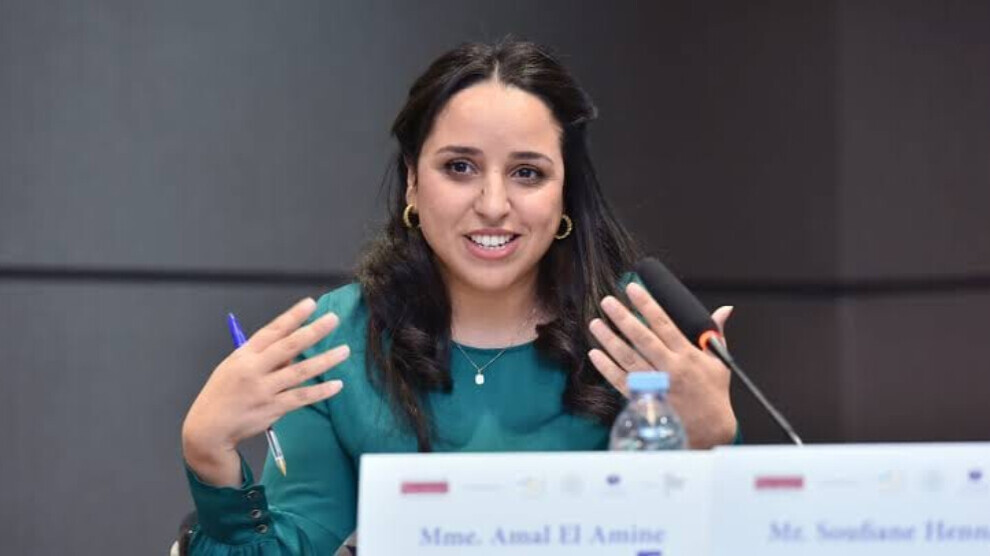
Morocco — Before becoming a human rights activist fighting to protect minors from early marriage, Amal Al-Amin had a friend who excelled in school during middle school. One day, her friend told her that her brother wanted to marry her off to an older man. At the time, she did not fully grasp what that meant, but weeks later, when she went to her friend's house and discovered she had gotten married, she realized that a girl's life could change overnight.
Contact between the two girls was lost from that day on, but the incident never left Amal Al-Amin's memory. She says that experience left her with many questions: How can a girl's life change overnight, when she had the same dreams and the same future?
The story, which Amal Al-Amin describes as having remained etched in her memory and left "a lump in her throat," became one of the reasons that drove her to commit to defending girls' rights.
Today, after nearly 11 years of working on the issue of child marriage, along with issues of violence against women, equality, and children's rights, Amal Al-Amin believes that the fight is not merely about preventing a child from getting married, but about defending her right to shape her own life. She summarizes girls' priorities in three words: education, protection, and free choice.
She says that education is what enables girls to shape their lives and paths, while free choice remains an essential condition for a girl to build her future away from guardianship and pressure.
Through Amal Al-Amin's work in the "Dounia" coalition to prevent child marriage, established in 2020 and comprising 26 associations working in the field of women's and children's rights in about 12 regions of Morocco, she says the reasons behind child marriage in Morocco are multiple, varying from one region to another and from one family to another. "The result is the same—child marriage—but the stories are different."
When Marriage Becomes the End of Education
In some families, marriage is presented as the only available alternative for a girl in the absence of other opportunities, especially when the family is in a vulnerable situation. In turn, marriage itself leads to leaving school and interrupting the educational path.
Amal Al-Amin points to another paradox observed in field work: "Some girls themselves may become convinced that marriage is the solution, not only for their own future, but to improve their families' economic situation or to reduce the burden on them." She believes this perception is reinforced when a woman's value is linked to her social status as a married woman, or when girls face early social pressure.
In some areas, a girl aged 16 or 17 who has not yet married may be labeled as "bayra" (spinster), making marriage seem like an escape from ongoing social pressure. Some girls also view marriage as a means of stability or escape from poverty, but field experience, according to Amal Al-Amin, shows the opposite.
She adds: "Marriage does not end vulnerability; it deepens it, because it deprives the girl of opportunities for education, work, and economic independence, making her more vulnerable to continued vulnerability throughout her life."
Amal Al-Amin directly links child marriage to school dropout, recalling a study conducted by the "Rights and Justice" association in 2019, which concluded that 90 percent of the surveyed women who married did not include a single case of someone who continued her education after marriage.
For Amal Al-Amin, the problem goes beyond dropping out of school. Marriage places the child before family and psychological responsibilities that exceed her age and capacity to bear. She notes that even adults find it difficult to balance work, study, and family life—so what about a child?
She adds that at this stage, the girl had not yet discovered her potential, built her personality, or defined her life project, before finding herself faced with the responsibilities of marriage and family.
Why Don't We Talk About the Man?
Amal Al-Amin opens an angle that is rarely discussed: the responsibility of the man who proposes to marry a child. While much of the discussion focuses on the family and the girl, she believes that society does not sufficiently raise the question of the adult man who chooses to marry a child.
She calls for opening a social and legal debate on this responsibility, and for conducting psychological and social studies to understand the motives that lead men or young men to agree to marry girls at a young age.
She points out that it is not always a man in his sixties or fifties marrying a child; the man may be in his twenties, thirties, or forties, while the girl is fifteen, sixteen, or seventeen. "The continuation of these cases confirms that changing the law must be accompanied by changing mindsets."
The Family Code... When Exception Becomes the Rule
Moroccan law sets the age of eligibility for marriage at 18 in Article 19, but Article 20 grants the family judge responsible for marriage the authority to authorize the marriage of a boy or girl under the age of eligibility, under conditions and procedures stipulated by law, while Article 21 relates to the consent of the legal guardian.
Amal Al-Amin believes that the revision of the Family Code represents an important opportunity to reconsider this exception. "This exception, unfortunately, has become the rule." She considers that the exception, which was supposed to remain limited and in rare cases, has expanded and is now widely used, which, in her view, undermines the presumed protection of children.
Law Alone Is Not Enough
Despite her call for amending the law, Amal Al-Amin insists that legislative reform alone will not solve the problem. For her, it must be accompanied by public intervention that includes combating school dropout, especially in rural areas and vulnerable regions, providing school transportation, boarding schools, and social support for families, in addition to protecting girls from violence and exploitation.
She also calls for awareness programs targeting families, in various languages and dialects, including boys, girls, educational institutions, religious figures, and media professionals. The message that should be conveyed, according to her, is that marriage is not a means of protecting a child—real protection lies in education, health, security, independence, and empowering the girl to build her life project.
She calls for providing social, psychological, and legal support for girls threatened with marriage, along with mechanisms for reporting and intervention to prevent any attempt to exploit marriage for those under 18, stressing that the best interests of the child should be placed above any social, economic, or family consideration.
From Taboo to Resistance to Change
Amal Al-Amin does not see the obstacle as merely legal. One of the biggest challenges, according to her, is the resistance of part of society to any discussion on child marriage, especially when activists are met with religious or social narratives that consider opposing this practice as "prohibiting what is lawful" or "legitimizing corruption."
She says the debate on child marriage is no longer, as it used to be, a taboo subject, but it has in turn faced greater resistance, warning of narratives issued by some people with social influence, which present early marriage as a natural solution to problems.
She believes the danger of these narratives lies in their oversimplification of the issue and their failure to address the consequences: dropping out of school, economic vulnerability, violence, and exploitation. She recalls the work of reception centers, where women who married as minors are received and speak of various forms of violence they experienced, and deep psychological effects that remained with them.
Change Requires a Long Breath
For Amal Al-Amin, the greatest professional challenge is moving from individual testimonies and stories reaching associations to effective legal reforms and public policies. She says advocacy requires a long breath, as it requires working simultaneously with institutions, families, media, schools, and civil society.
She does not see the slowness of change as a reason to retreat; rather, what drives her to continue is her belief that behind every marriage case lies a life, a path, and dreams that could be lost. She stresses that every girl has the right to live her life and her dreams, and to go as far as she can in her life.
She adds that change may be delayed, but it is possible, and every family that becomes convinced that their daughter's place is at school, and every girl who is able to continue her education and choose her future, represents an additional reason to continue.
A Girl Is Not a Burden
Amal Al-Amin directs her message to families and decision-makers. For her, child marriage is not merely a family decision or a wedding celebration, but an issue that affects society and the future of an entire generation. "We cannot ask a child who was deprived of her right to education, growth, and personality building to bear the responsibility of marriage and family, especially raising a new generation."
As for decision-makers, she calls for clear political will, a law without exceptions, and public policies that guarantee education, protection, and health, and provide real alternatives for girls and families.
Amal Al-Amin does not distinguish between raising a boy and raising a girl—both need safety, and a family, government, and institutions that help them build their personality and choose their future with awareness and freedom.
The human rights activist summarizes her speech by saying that investing in children's education and empowerment is an investment in the family and society's future. She concludes: "Fighting child marriage is a collective responsibility... because protecting a boy and a girl today is protecting and building tomorrow's society."