
When Hejazi Ornaments Tell the Story of Women and Identity
Sarah Mubanna Al-Abdali’s artwork combines two women’s images with geometric ornaments and architectural arches, using colors and heritage details to evoke Hejazi memory and explore art, identity, and women’s presence.
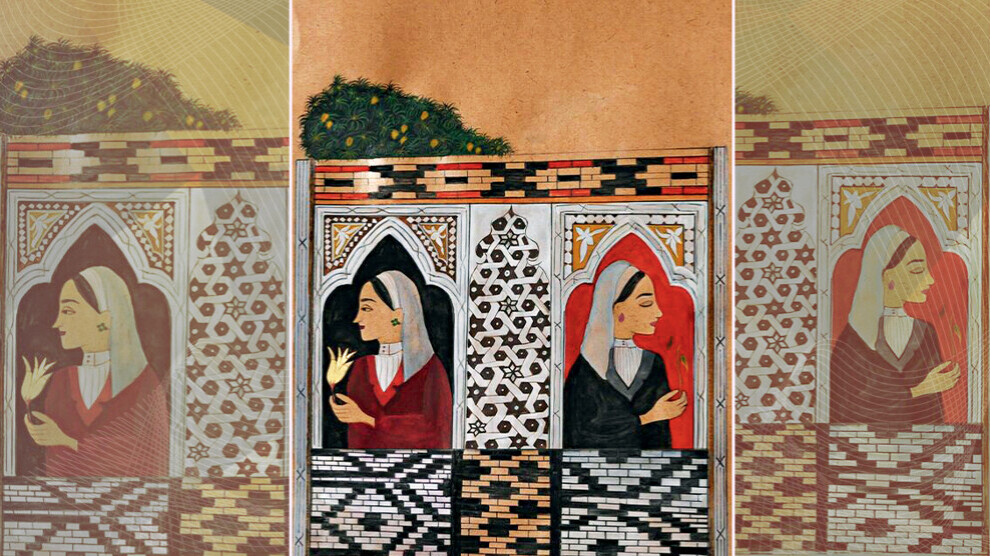
NEWS CENTER– In a space where warm colors meet precise geometric ornaments, and where architectural arches embrace the features of women, Saudi visual artist Sarah Muhanna Al-Abdali opens a window onto a visual world where identity intertwines with memory, and heritage with contemporary artistic expression.
The painting "Two Women in Khanji's Ribat" does not content itself with presenting two images of two women, but builds a visual scene in which human and decorative elements intersect, prompting reflection on the relationship of art to cultural heritage and the status of women in social memory.
The work shows two women centered within two pointed architectural frames, separated by a space rich in intertwined geometric formations. While red stands out in the head covering of one of the two figures, the colors of the other figure tend toward dark shades, creating a clear color contrast between them, balanced by the presence of white, black, green, and shades of brown and orange. As for the decorative bands extending at the top and bottom of the painting, they give the scene a visual unity that links its different parts within a cohesive structure.
The experience of Saudi artist Sarah Al-Abdali presents an artistic model inspired by Hejazi heritage, and re-reads it within a contemporary visual language. She does not deal with heritage as a set of fixed ornaments and shapes, but as a rich cultural memory that can be explored and reshaped in connection with questions of identity, belonging, and social and urban transformations.
In her works, she relies on research into the history and material culture of the Hejaz, benefiting from elements of architecture, ornamentation, and traditional arts to present artistic visions that transcend direct documentation of the past. Thus, ornamentation turns from an aesthetic element into a language carrying cultural and historical connotations, and opens a dialogue between local memory and contemporary art.