
From the 74th Genocide to the Journey of Searching for Identity and Justice (5)
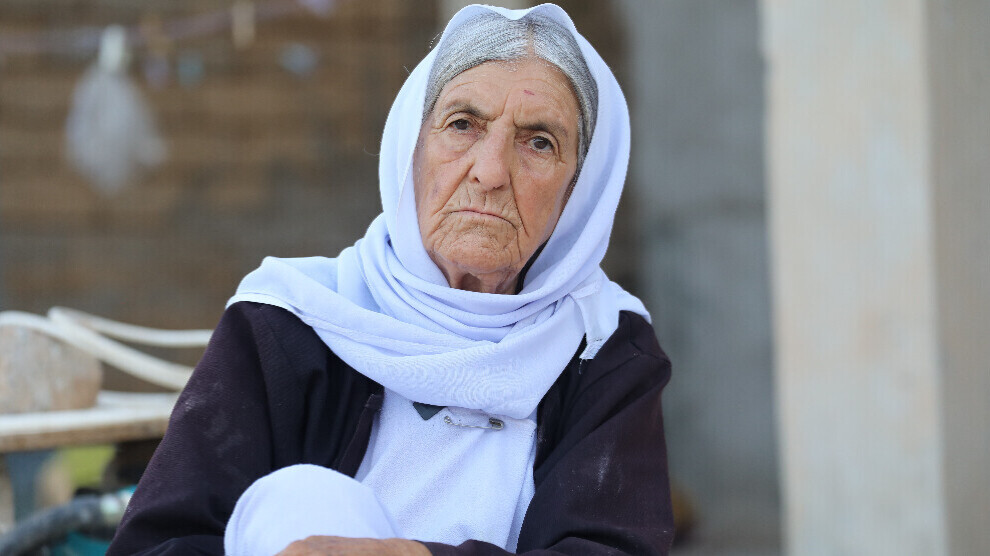
Mother Kamo carries a painful story of suffering and loss after being taken captive by ISIS during the (Shingal)Sinjar tragedy, living through harsh months of fear and deprivation while holding on to hope for her missing children.
JIHAB ZIMO& KULISTAN AZIZ
Shingal — The morning of August 3, 2014, was not merely the beginning of a new day, but the start of a chapter of terror whose pages have yet to close, even today, for thousands of Yazidis. Among them is Mother Kamo, who recounts a story of survival intertwined with loss — a life that came to a halt the moment ISIS stormed their villages.
The roads of Shingal are not as you might imagine or know them. Most of the roads leading to the villages are poor, and many are dirt tracks — which is why it took us a long time to reach Tal Ezer. Mother Layla, whom we met during our journey documenting the Ferman, introduced us to Mother Kamo, a witness to the Ferman.
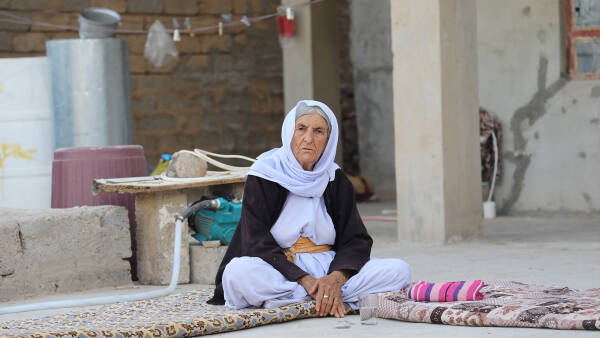
In the village of Tal Ezer, amid ruined homes with only one house still bearing signs of life, Mother Kamo lives alongside her ailing husband, who has been unable to stand since what happened to him during the genocide. Recalling that morning, she says her son came to her on the day of the Ferman and told her ISIS had entered the Seba subdistrict: "I had dreamed that I had fallen into ISIS's hands," she says, noting that when her son told her this, she gathered her children and said, "Let's go, let's leave."
They all left and walked past the edge of the village. But her husband changed his mind and said, "We're not going anywhere, we're going back home." Mother Kamo recalls that day: "We went back home, I made tea and baked bread in the tandoor, but my son went out to check on the village, then came back running, saying: there's no one left in the village... We left the food as it was and fled."
The family had no car, so they walked with dozens of other residents toward the Shingal town center. Some relatives managed to save a number of family members, including her son's pregnant wife and the young children, but Mother Kamo remained on the road with the rest of her family, and they soon fell into ISIS's hands.
The group was walking through the fields when a car carrying armed men stopped. One of the young men accompanying them tried to use his weapon, but Mother Kamo stopped him, saying any resistance would get them all killed. Moments later, the gunmen began firing over their heads to terrify them, before forcibly taking them to the Seba subdistrict.
There, Mother Kamo tried to reach her son after one of the detainees told her he was in another car, but one of the ISIS mercenaries stopped her. She says: "I told him: even if you kill me, I'm going to see my son" — but the car carrying her son sped off toward Syria, while she was taken with the rest of the women to Tal Afar, and from there to Mosul.
In Mosul, she was held with dozens of other women and children inside a dark room with no light. Recalling those hours, she says: "We could no longer see each other, the darkness was so thick. I told them: either kill us, or get us out of this place."
There were twenty-one people in the room, and none of them slept a wink all night. Just before dawn, Mother Kamo lost consciousness — only then did the person in charge come and open the door of the room. After that, the door was never closed again.
Days later, ISIS mercenaries took them out to a courtyard, lined them up facing a wall, and told them they were all going to be killed. Weeping broke out among the women and men, while Mother Kamo raised her hands to the sky and said: "O Tawusi Melek, if we have done any good in your sight, forgive us." One of the mercenaries heard her and asked, "Are you praying to Tawusi Melek?" She answered: "Who else would I pray to?" Despite his attempts, Mother Kamo did not yield.
She noted that the mass execution was not carried out that day: "After a while, ISIS members entered the place where we were held, chose a large number of captives for themselves, then distributed the rest among the rooms and locked the doors on them."
She continued: "We remained held like this for nine days. On the tenth day, they told us they would move us somewhere else. I told them: 'Even if you cut off my head, I will not leave Mosul. I am a sick woman, and I'll be of no use to you. You've taken my entire family captive — if you want to kill me, kill me, but I won't go anywhere.'"
Mother Kamo spent six months in ISIS captivity, moved between Mosul and Tal Afar, and says most of those guarding them were Arabs who had joined ISIS. During those months, the captives lived under harsh conditions, deprived of water and basic services, unable even to bathe throughout the summer months: "In Tal Afar, they distributed people among houses, but they put us in a sheep pen. We cleaned the pen ourselves and managed to gather a few household items to use. We stayed there seven days, then they took us back to Mosul again... After three months, one night, they brought us a jug of water and a washtub, and told us: wash yourselves."
One day, ISIS mercenaries came in carrying a register of the captives' names, and began calling out the elderly. Mother Kamo says: "They said one of their emirs had issued a pardon for us, and that's how I was released. I was the only one from my family who got out this way."
Of the 13 family members ISIS had abducted, only seven returned, while the fate of six remains unknown to this day — including her two sons, her daughter-in-law, her two daughters, and her grandson.
The grieving mother says an acquaintance later told her that her son Khodeida was still alive in the Ba'aj area with ISIS, and that a mediator had tried to ransom him with money, but ISIS leadership refused, demanding two Arab prisoners in exchange for his release — a condition that was impossible to fulfill.
After her release, Mother Kamo went to the Lalish Temple, then spent two years in camps in the Kurdistan Region before returning to Shingal — but she affirms that returning did not mean reclaiming her life: "The genocide made us age before our time. Before it, I didn't suffer from any illness; today, there isn't a single part of my body that doesn't hurt."
Despite the years that have passed, she is still waiting for news of her missing children. For her, the wound has not healed — it still bleeds every day, because the pain never ends as long as the fate of her loved ones remains unknown.
To be continued...