
"Behind the Walls"... A Moroccan Film Opens Debate on the Care Burden Borne by Women
The Challenge Association for Equality and Citizenship has chosen to use cinema to spark debate on unpaid domestic work through the short film "Behind the Walls," which sheds light on the care burdens borne by women.
HANAN HART
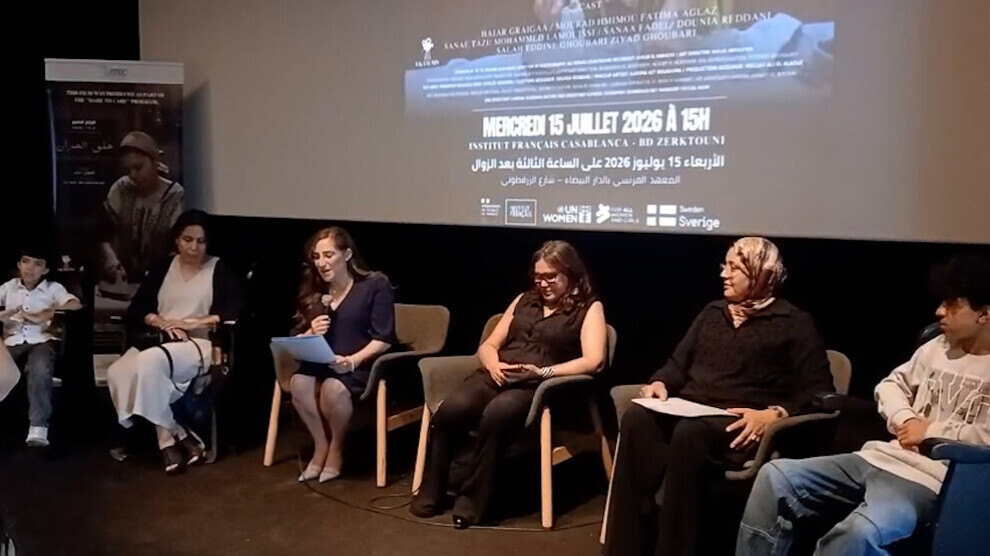
Morocco — In a context where debate continues in Morocco over the care economy and the reform of the Family Code, the Challenge Association for Equality and Citizenship presented the premiere of the short film "Behind the Walls" yesterday, Wednesday, July 15, in Casablanca.
The film, written and directed by El Houari Ghbari, tells the story of "Amal," a woman who dedicated her life to caring for her family after leaving work to raise her two children. Her day begins before everyone else—preparing breakfast, taking the children to school, shopping, and caring for her mother-in-law, who is ill and bedridden—before her day ends amid a series of invisible household tasks. However, her mother's illness and her need for an expensive surgery, coupled with her husband's refusal to provide financial support for her mother, lead her to consider returning to the labor market. This begins a new phase in which she rebuilds her economic independence and opens the door to a greater sharing of responsibilities within the family, embodying what the filmmakers describe as the concept of "positive masculinity."
In this regard, Bouchra Abdou, President of the Challenge Association for Equality and Citizenship, stated that the film is rooted in the reality lived by thousands of women who daily perform domestic and care work that receives neither social nor economic recognition.
She added that domestic work is arduous labor performed by women within the home, yet it is neither recognized nor valued, nor seen as productive work with economic value. When any dispute or separation occurs, women are treated as if they had made no contribution within the family.
She explained that the film also discusses women's contribution to the accumulation of family wealth during married life, despite this contribution often remaining unrecognized. She noted that women, through their daily work inside the home, participate in building the family and its assets, yet this role is not reflected when wealth is divided or their economic contribution is assessed.
She pointed out that the film presents a model of what she described as "positive masculinity," as the husband is not portrayed as a violent or abusive person but as a man acting according to inherited social perceptions that consider household work to be women's responsibility. With his wife's economic independence, he realizes that sharing care and domestic work is a shared responsibility, and that partnership within the family is based on cooperation, dialogue, and the sharing of burdens.
She affirmed that economic independence gives women greater capacity to participate in decision-making within the family and enhances dialogue and balance between spouses, contributing to building a more harmonious family.
The film also directs its messages to decision-makers, according to Bouchra Abdou, amid debates related to Family Code reform and the care economy. It also targets youth and civil society and political actors, aiming to contribute to changing the stereotypes that confine domestic work to women and to open a societal debate on sharing responsibilities within the family.
The Association does not present the film merely as an artistic work but as a tool for advocacy on equality issues. According to the event's organizing statement, the work is based on the conviction that art and cinema are effective means of sparking public debate, questioning social representations, and consolidating a culture of partnership and equity through works capable of touching reality and stimulating dialogue on priority issues.
The film comes within the framework of the "Dare to Care" project implemented by UN Women in Morocco, as part of a regional initiative that also includes Jordan, Egypt, and Tunisia, aimed at promoting the sharing of care work between women and men and changing stereotypes related to gender roles within the family.
The care economy is receiving increasing attention in international debates on gender equality, as it includes domestic work, childcare, care for the elderly and people in vulnerable situations—tasks mostly performed by women without pay. International organizations consider that this work, despite its pivotal role in family stability and supporting economic activity, does not receive sufficient recognition, prompting them to call for the recognition of its value and the encouragement of a more equitable distribution of its responsibilities between women and men.