
"Al-Daq": A Symbol of Women's Identity and Culture
In Mesopotamia, traditional tattooing known as "Al-Daq" carries deep symbols of womanhood, fertility, protection, and identity, preserving a cultural memory passed down through generations.
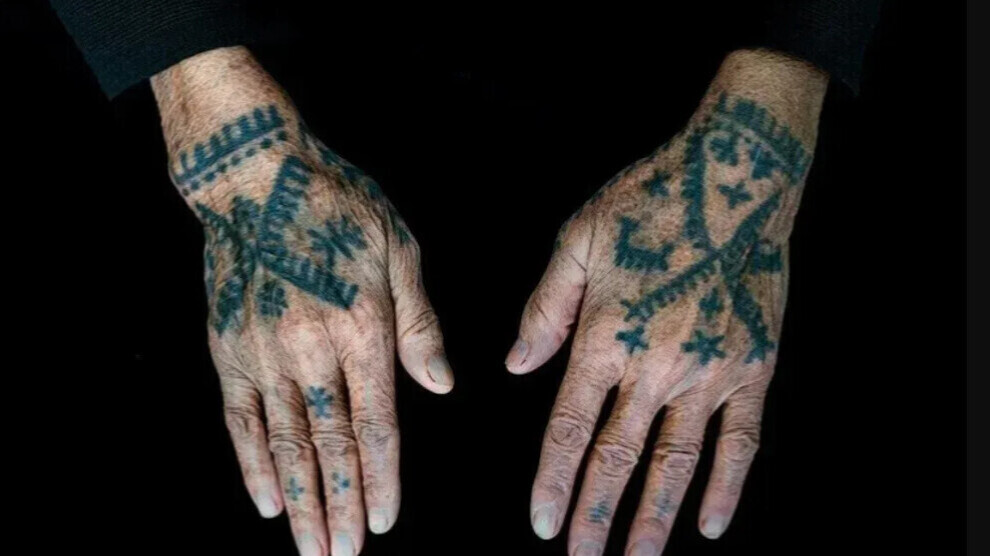
News Center — "Al-Daq" is the local name given to the traditional tattooing widespread among Kurds, Yazidis, Arabs, and various groups living in Mesopotamia. This tradition involves inscribing specific symbols on the body. It was not merely an aesthetic practice but also acquired meanings related to beliefs, protection, fertility, identity, and community memory.
The roots of Al-Daq culture trace back to the Mesopotamia region, particularly the geography of Kurdistan, where this culture remains alive to this day. It is considered one of the important cultural rituals, especially in areas such as Mardin, Urfa, Amed, and the broader Rojava region, as well as among the Yazidi community. Other local peoples living in the region have also adopted this culture over time, with Al-Daq forming part of their cultural identities.
The symbols used in the Al-Daq tradition carry different meanings depending on the region and community. These symbols embody themes such as womanhood, fertility, safety, love, unity, connection to nature, protection, and life—through rituals inscribed on the body. Women's status, creativity, and productive capacity hold great significance in the world of meanings conveyed by many of these symbols.
For example, the triangular shape symbolizes protection, women's fertility, and creativity, directly representing women's presence. In the roots of most Al-Daq motifs, a triangle-like form appears—whether as dots or lines taking a triangular shape.
Additionally, circular shapes with lines adorning their circumference appear as a symbol of the sun. As is well known, belief in the sun was strong in ancient Kurdish beliefs, and some of its manifestations remain alive among Yazidis to this day. Therefore, the sun symbol cannot be read as mere decoration; it can also be considered one of the symbols that carry Mesopotamia's collective memory and transmit it to the present.
Al-Daq in the Book "The Historical Foundation of the Women's Revolution and Its Future"
The book "The Historical Foundation of the Women's Revolution and Its Future" includes a definition of Al-Daq stating that the traces of goddess culture appear in the tattoos carried on the bodies of Kurdish, Arab, and other regional women. The symbols that women inscribed on their faces and bodies—such as the sun, moon, gazelle, tree of life, dew, cross, snake, and Shah Maran—are the very same symbols that appear on cave walls, in ancient drawings and statues, in tombs, stones, house decorations, ironwork, textiles, and embroideries.
Women and girls adorned their foreheads, chests, hands, shoulders, feet, and legs with symbols associated with goddess culture. It is said that the tattoo ink was prepared only using fire and the milk of mothers who had given birth to daughters.
"The Secret of Al-Daq" as Told by Mothers
Kurdish mothers recount the secret of Al-Daq through beliefs passed down through generations. Among these accounts: "Al-Daq is not made with the milk of a mother who gave birth to a son, because the color does not set; it only sets with the milk of mothers who gave birth to a daughter."
As for the meanings carried by Al-Daq motifs, they extend to many emotions and life experiences. Mothers say that Al-Daq expresses pain, fear, hope, desire, love, and the beauty of life.
It is also believed that Al-Daq protects against the evil eye, evil, diseases, and various dangers. Beliefs associated with bringing luck and happiness, carrying love and joy, adding blessings to life, and bringing sustenance to the home form an important part of this tradition.
From this perspective, Al-Daq culture can be viewed as one of the ancient cultural traditions that developed in Mesopotamia and remains alive, particularly through women's bodies, memory, and transmission from generation to generation.
The Presence of Symbolic Language on the Body
Today, tattooing has become a common means of expression in many parts of the world, and people use symbols inscribed on their bodies to express their ideological stances, affiliations, dreams, memories, and personal stories.
However, unlike the modern concept of tattooing, Al-Daq is not merely an individual choice or aesthetic preference. It is an ancient cultural narrative that carries on the body the beliefs of the region to which it belongs, women's life experiences, community memory, and the fears, hopes, and wishes related to life.
Today, revisiting Al-Daq does not simply mean remembering an old tattooing tradition; it also means re-reading the cultural memory of Mesopotamia, the knowledge carried by women from generation to generation, and the symbolic language expressed through the body.