
A New War in the Middle East: What Is Happening in Yemen?
Iran’s future policy and potential internal changes are key factors affecting Yemen’s developments, as possible political change in Iran could let the Houthis reshape their regional relations.
ROJBIN DENIZ
As war and the search for a new order in the Middle East intertwine, we witness the gradual introduction of interventions aimed at reconstructing the countries of the region. The interventions that began with Afghanistan, continued with the occupation of Iraq, and are preparing the Middle East for the next century, have also changed the nature of war and the manner of its management. With the Arab Spring, the developments witnessed in Egypt, Tunisia, and Libya, and finally the atmosphere of conflict that emerged in Syria, left their mark on the last fifteen years in the region. The recent developments in Syria have also led to assessments that this part of the new order envisioned by external powers for the region has been completed.
How Did the War in Yemen Turn into a Global Power Conflict?
The return of the war in Yemen to the forefront after Syria constitutes an important dimension of the new power balances in the Middle East. Yemen, which has been witnessing armed conflicts for more than a decade, entered a phase of relative calm during the past four years. However, the Mecca Defense Agreement signed between Turkey, Saudi Arabia, and Pakistan following the NATO summit held in Turkey, which was also described as the "Middle East NATO," led to the emergence of assessments regarding the new security strategy being formed in the region.
After this initiative, which is developing as a new defense mechanism against Iran, the return of developments in Yemen to accelerate anew opened the discussion about the relationship between regional security relations and the conflicts in Yemen. The renewed intensification of confrontations between the Houthis and the Yemeni government, which extended to the Saudi border, indicates that the war in the country has moved to a different dimension. This time, the spread of conflicts over a wider geography, unlike previous periods, shows that the war in Yemen is not limited to the civil war inside the country only, but has also become part of the regional power balances.
To understand the reasons for the war currently taking place in Yemen acquiring a global scope, one must look at the historical, political, and sectarian background of the country. The Zaidi Imamate rule continuing throughout history, the Ottoman Empire's dominance over the region, the colonial phase, the polarization produced by the Cold War, and the current regional rivalry between Iran and Saudi Arabia, constitute the historical background of the current war.
The Emergence of Zaidi Imamate Rule
The Zaidiyyah is a sect that emerged within the Shia traditions in Islam, and had an important place in the political history of Yemen. In 897, the Zaidis in Yemen established the first state of the Zaidi Imams led by Imam Yahya bin Al-Hussein. Thus, the first foundations of the political state were laid.
The Zaidiyyah also had a historical influence in Iran and some surrounding areas. However, the sectarian and political balances in the region changed with the arrival of the Safavids to power in Iran during the sixteenth century. In 1553, the Safavids attacked the Zaidis and tried to eliminate them. After these attacks, the Zaidis headed toward the Zaidis in Yemen, while one of their branches headed toward Morocco.
With the Ottoman Empire's occupation of Yemen, the Zaidis resorted to the mountainous areas, and continued to resist the Ottomans for centuries. In 1911, the Ottoman administration recognized the autonomy of the Zaidi Imamate in northern Yemen. Thus, the Imamate system obtained an important political space to move within the Ottoman dominance. After the defeat of the Ottoman Empire before the British and French, the Ottomans withdrew from Yemen. With their departure, the Zaidi Imams were given an opportunity to re-establish independent rule in northern Yemen.
The Cold War, Division, and Civil War
While British rule continued in the south of the country, the Zaidi Imams continued their rule in the north. With the arrival of the 1960s, the rise of Arab nationalism, anti-colonial movements, and the international polarization produced by the Cold War affected Yemen from within. Yemen was completely divided into two parts.
On 27 September 1962, a military coup in northern Yemen ended the rule of the Zaidi Imamate, which had continued in different periods for about a thousand years. The Yemen Arab Republic was declared instead of the Imamate system. This development ignited a long civil war between the Republicans and the forces supporting the Imamate rule.
Northern Yemen established closer relations with Saudi Arabia and the West. As for southern Yemen, British colonialism ended with the withdrawal of the British in 1967. The south then developed close relations with the Soviet Union and China, and adopted a socialist political and economic model. But the disintegration of the Soviet Union and the change in international power balances led to the unification of the two parts. In 1990, northern and southern Yemen united and the Republic of Yemen was declared. However, unity did not end the political, economic, and social differences between the two regions. Disputes over power-sharing, resource distribution, and political representation led to the outbreak of a new civil war in 1994.
Iran's Geopolitics and the Fate of a Geography
The Zaidis continued to be an important social force in Yemeni politics. It is estimated that about 30 to 35 percent of Yemen's population are Zaidis. The Houthis are also known as an extension and continuation of the Zaidis. The emergence of the Houthis dates back to activities that began in the 1990s with the aim of preserving Zaidi identity, religious education, and cultural heritage in northern Yemen. During that period, intellectual and political clubs were established in Zaidi circles. Among them was the "Believing Forum," which carried out activities aimed at reviving Zaidi religious and cultural values. Over time, these activities turned into a more organized social and political movement.
Houthi is basically the name of a tribe, and their leader is the tribe's sheikh. Their real name is "Ansar Allah." With the deepening of political, economic, and social problems in Yemen during the first decade of the twenty-first century, the Houthis began to gain strength in the Saada area in the north of the country. Since 2004, they have entered into armed confrontations with the central Yemeni government. In 2011, they participated in the popular protests that began in Yemen during the Arab Spring phase. The Houthis became during this phase one of the most prominent actors in the anti-government movement. In 2014, the Houthis took control of the capital, Sanaa, which led to a major change in the power balances in the country. A year later, with the military intervention of the Saudi-led coalition, the conflict in Yemen turned into a regional war.
To achieve its geopolitical goals, and after Iran established what is known as the Axis of Resistance, it made its relations with Hezbollah in Lebanon, the Popular Mobilization Forces in Iraq, the militias in Afghanistan, the militias in Pakistan, and the Houthis in Yemen, strategic relations. These relations can take different forms, starting from political support, passing through military training and logistical assistance, to technology exchange. In this framework, the Houthis are viewed as one of the important elements in Iran's regional influence, while at the same time retaining a prominent role within the framework of their local power and the civil war.
After Hamas's attack on Israel on 7 October 2023, and the war that began in Gaza following that, the Houthis carried out attacks with missiles and drones on Israel, declaring that they support the Palestinians. They also targeted ships linked to Israel and other commercial ships in the Red Sea. These attacks led to disruptions in international maritime navigation.
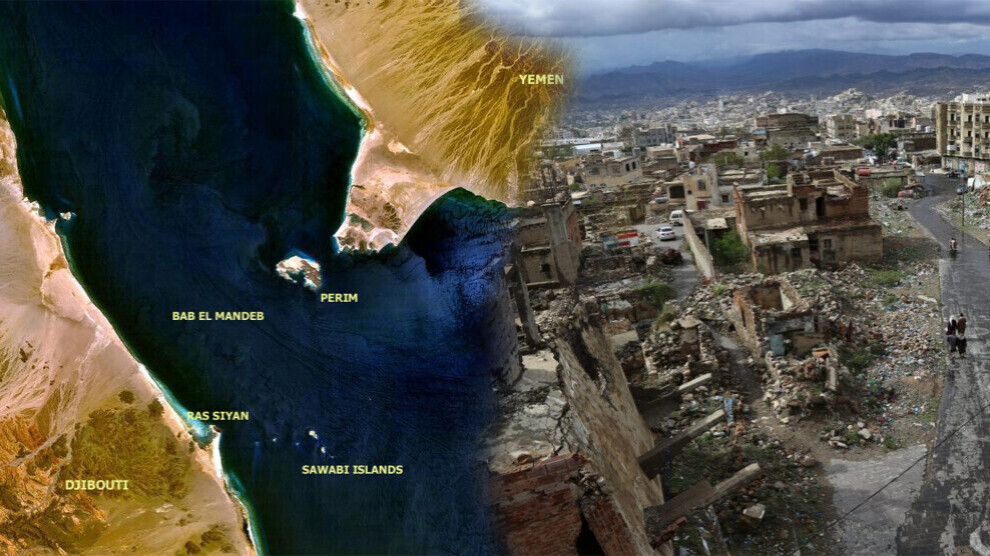
Yemen is a transit area for global and international trade routes, as it is located near the Bab al-Mandab Strait that connects the Red Sea to the Gulf of Aden. This strait is one of the important passages for maritime trade and energy transport between Europe and Asia. Consequently, the conflicts in Yemen not only affect the country's internal politics, but also carry the ability to directly influence the security of global trade.
Since Iran is aware of this, it seeks, through the Houthis, to benefit from Yemen's strategic geographical location with the aim of changing the region's balances in its favor. The Houthis are trying to advance toward the Bab al-Mandab Strait. This is viewed as a step that could obstruct international maritime trade and affect the global economy.
The impact on the Bab al-Mandab Strait, after the Strait of Hormuz, the Gulf of Aden located in the Indian Ocean, and the Suez Canal, could lead to major changes in energy supplies, international trade, and the power balances in the region. The Houthis' development of their capabilities in the field of ballistic missiles and drones has also turned into an important security issue for the United States and Britain, foremost among them Saudi Arabia and the United Arab Emirates. Iran appears to be following a strategy targeting the energy and trade routes that are considered a vital artery for the world. Therefore, the war in Yemen may turn from a civil war into an international crisis threatening global trade.
Has the Fuse of a World War Been Lit?
This situation led to the movement of Saudi Arabia mainly, alongside the United States, Britain, and the Arab coalition. Further Houthi advances will also drag the countries that signed the Mecca Agreement into this war, which is likely to extend to include the region. Saudi Arabia's security concerns, the UAE's regional interests, and Western countries' policies aimed at protecting maritime trade routes increase the likelihood of the civil war in Yemen turning into a war on a global scale. This shows us that intervention in Iran will begin through reshaping Syria, and extend to Yemen and Iraq.
A Country on the Brink of Destruction
The continuation of the civil war in Yemen for long years, alongside the war acquiring a global dimension, has inflicted great destruction on the country's geography and society, and primarily on women and children. This aspect of the war, which is often invisible, reveals that women and children pay the greatest price for the influence conflicts waged by external and regional powers. In the midst of this war, women and children are often used as tools, subjected to repression, and imposed upon them a war that has nothing to do with them.
The war has turned life in Yemen into something resembling hell. The escalating social and economic crisis has become a serious problem not limited to Yemen alone, but including the entire region. During the civil war, refugee camps, which have become a symbol of the humanitarian tragedy, turned into living places for Yemeni women. Women and children form an important part of those who lost their lives in the war. It is known that more than 50 percent of those forced to displace are women and children. As for cases of rape, kidnapping, and other forms of violence, they have far exceeded what statistics reflect.
According to 2025 statistics, more than 400 women were kidnapped and subjected to rape and torture. These are figures that appeared in human rights reports. As for what NuJINHA correspondents reported from the field, it indicates that the real numbers may reach twice or even three times these figures. This situation reflects a picture of a reality in which at least one woman in Yemen is subjected daily to kidnapping, rape, and violence.
With the recent war, data indicate that about 2,200 people disappeared or were forced to leave their places of residence during a period ranging between a month and a half and two months. Reports also stated that about 300 people lost their lives in the recent clashes.
Alongside the war in Yemen, media reported that the morality police units known as "Zainabiyat" targeted women opposing the war and women's rights defenders, and practiced against them kidnapping, violence, and death threats.
Women are forced to choose between two different political and military forces. Yemeni women, alongside their suffering from the material destruction caused by the war, are forced to face the pressures imposed on their bodies and identities as well. The war has turned into a multifaceted destruction threatening not only the present of women, but also their future.
World War or Integration?
The continuation of the war in Yemen and its expansion, or entering a path of searching for a solution, is closely linked to regional and international power balances. In this process, the policy that Iran will follow and the potential changes the country may witness are among the important factors that could affect the course of developments in Yemen.
The occurrence of a possible political change in Iran may lead the Houthis to reshape their regional relations, and push them to search for a new alliance with Saudi Arabia. Such a development could open the way for a new process of integration and solution in Yemen, based on the possibility of different political and social forces coexisting together, and on accepting differences.
The future of Yemen is linked not only to reaching an understanding between the warring forces, but also to forming an inclusive political structure that recognizes societal differences, guarantees women's rights, and relies on the political will of the people.