
Areej Al‑Sa'afin looks with one eye toward the blurriness of the painting and the future
Amid war's ashes, Areej Al Sa'afin, a witness to double pain, lost her eye and paintings yet clings to light, hoping treatment restores her vision and life's tranquility.
Rafif Asleem
Gaza – Palestinian artist Areej Al‑Sa'afin lost one of her eyes but did not lose her will or her ability to draw. This happened while she was fleeing from a shell thrown by Israeli forces at her and her family during their displacement from their home in the Al‑Bureij area in the central Gaza Strip. Today, she tries to adapt to her health condition and the lack of raw materials to continue expressing herself through art.
Before October 7, 2023, the artist Areej Al‑Sa'afin had prepared her room, painted it green, and carefully arranged the paintings she had created around the corners, depicting nature, women, daily life, and various other themes, in preparation for inviting the media to her own exhibition featuring more than 15 paintings in December 2023. But that did not happen because of the outbreak of war.
She says: "One day before the destruction, I looked at the paintings with sorrow, as if I had predicted what would happen to them in the coming days. I took many photos and locked the room door tightly, as if I were guarding a precious treasure." She noted that the next day, the house of their neighbors was bombed, and her room was largely destroyed. A few days later, they were forced to flee their home, and on the way, an Israeli shell struck them, killing her brother and seriously injuring her, causing her intestines to come out of her abdomen.
In the hospital during surgery, she recounts that she suffered internal bleeding in the brain that would not stop, so doctors had to remove part of her small intestine and remove her right eye to control the bleeding. They then placed a plastic piece in its place to preserve her appearance. She explains that her left eye is now healthy, but she wants to get rid of the bullying she faces every time she leaves home and to live a normal, peaceful life.
The paintings burned, Areej Al‑Sa'afin's eye went out, and the smartphone containing photos of the unpublished paintings was destroyed. Yet she did not abandon drawing. Drawing was her best way to express her feelings – joy, sadness, anger, and all other states she experienced – and it was her lifeline. But today, she cannot draw with the same quality and style because the effort exerted with only one eye causes her severe headaches.
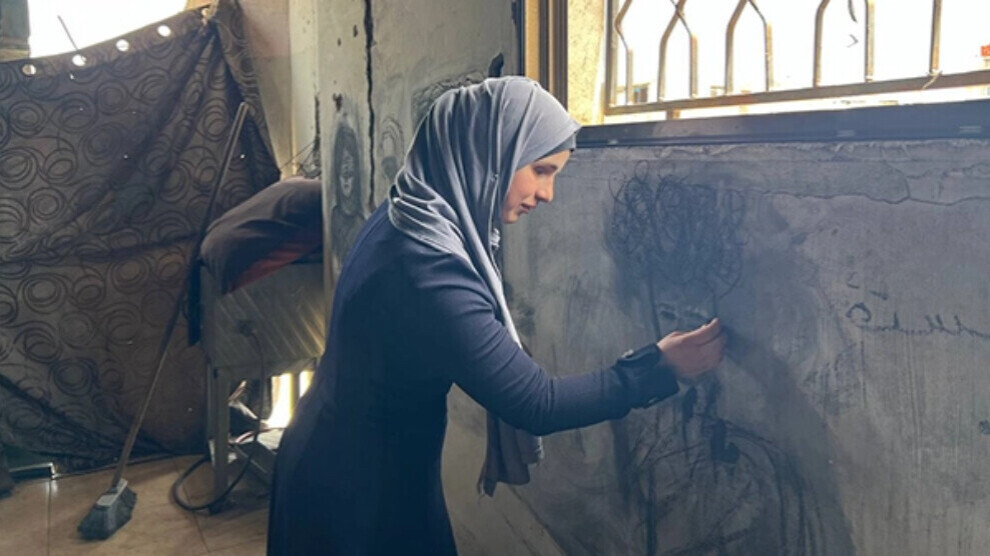
Today, Areej Al‑Sa'afin sees only half the scene and tries to complete the other half by imagining it. She picks up charcoal from burnt cooking wood and tries to draw the lines, hoping that this time the result will be satisfactory to her, but she fails and tries again, plunging her into severe depression. She points out that she draws what she misses – two eyes staring toward the distant future to redraw the story whose course war changed.
What saddens her most is when she complains that looking at bright light or her continuous attempt to produce a painting tires her eye and causes her severe head pain, only to be told by those around her: "You are imagining it; the eye was removed from its socket, why would it hurt you?" So she often prefers silence and not expressing what she feels, even though she desperately needs to talk.
Like other female artists in Gaza, she suffered from an acute shortage of tools and paints. There were no canvases to paint on, which pushed her to turn her bedroom wall into a large canvas gathering all her recent drawings. She also replaced colors with charcoal from burnt cooking wood, and even used kohl (eyeliner) as a drawing tool, as she currently relies only on black to depict the scenes that come to her mind, linking them to the harsh reality she lives in.
Areej Al‑Sa'afin studied social work and kept drawing as a talent she developed through training courses and practice. But she faced displacement, living in a tent for eight months, and finally the death of her two brothers before her eyes and the loss of one of them. Since that day, she has felt a blurriness in what she sees, and she hopes that her fate will not be the same.
What Areej Al‑Sa'afin asks of the world today is to obtain a medical referral for treatment abroad and to be allowed to leave so she can get a prosthetic eye and complete her physical and psychological treatment, enabling her to live a normal life like other girls her age, and to be able to paint and produce works with balanced vision and quality that she is satisfied with, as she was before.