
Suffocating Thirst Crisis in Gaza... Contaminated Water and a Collapsing Health Reality
Gaza faces a water crisis as destroyed networks and halted aid fuel disease. Contamination and drought threaten daily life and public health.
RFIF ASLIM
Gaza — The Gaza Strip is currently experiencing, with the intensifying summer heat, a horrific water crisis, in addition to the difficulty of obtaining water for daily use, with contamination levels in groundwater reaching 96%, leaving only 4% usable, according to recently published UN and international reports.

Nour Abu Mu'ileq, a specialist in water and environmental sciences, explained that the water situation in the Gaza Strip is not ordinary but a tragedy in every sense of the word. According to reports from the UN Office for the Coordination of Humanitarian Affairs (OCHA) and the United Nations Children's Fund (UNICEF), approximately 95% of the Strip's population cannot obtain the water they need during summer, which ranges from 3 to 6 liters per person in emergencies, while the World Health Organization estimates the requirement at 15 liters.
Destroyed Water and Sanitation Networks
She pointed out that 80 to 85% of water and sanitation networks are completely destroyed, and those remaining are operating at medium capacity—not at full capacity as before the attack on the Gaza Strip—reflecting a real state of incapacity and water insecurity for all residents of the Strip, especially children and women.
According to recent UNICEF reports, less than 3 to 5% of the groundwater on which Gaza's residents primarily relied remains drinkable. This is due to several reasons, including seawater infiltration into the aquifer, direct water contamination either due to population pressure and practices over the past three years, or as a result of the impacts of the attack and pollutants that penetrated and contaminated the aquifer.
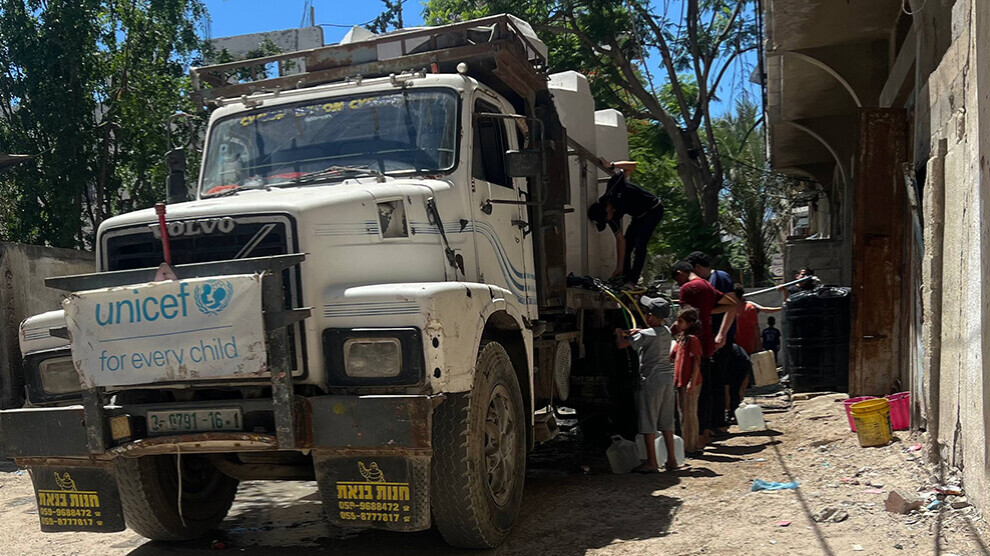
She said that international institutions that used to provide water daily and free of charge to residential neighborhoods and overcrowded camps through water tankers operating on an emergency desalination system have suddenly stopped performing that role. This has led to a reduction in individual water consumption—whether for personal hygiene or drinking—which has negatively impacted public health and contributed to the spread of a number of diseases, especially skin diseases for which there is currently no treatment, while dehydration rates have also increased significantly.
At a time when residents need to increase their water share amid rising temperatures, residents are forced, according to Nour Abu Mu'ileq, to reduce that share to the minimum limits. Some have even been forced to use completely contaminated seawater due to the absence of sanitation networks in the Strip and the discharge of wastewater inside, in addition to sewage channels opening onto the Strip, leading to microbes adhering to the skin amid non-existent medical services.
A Critical Humanitarian Crisis
She affirmed that these problems worsen with the summer season, as rising temperatures increase the risk of fever, dehydration, and diarrhea. The groups most affected by these diseases are children, women, the elderly, those with chronic illnesses, and other vulnerable groups in society who already lack proper healthcare, whether in hospitals or medical points.
She explained that the health situation in the Gaza Strip is collapsed, and the Palestinian Ministry of Health currently cannot bear the burden of the contaminated water residents are using, nor the effects of diseases that may even affect the respiratory system. Therefore, the situation requires serious action by relevant institutions to spare residents the calamities of facing new diseases that perhaps were not anticipated, which certainly will not align with the deteriorating economic situation.
Nour Abu Mu'ileq, a specialist in water and environmental sciences, concluded by saying that UN reports describe the water situation in the Gaza Strip as a critical humanitarian emergency, especially with the emergence of diseases unknown to residents before the attack. She noted that these documents have revealed the collapse of the water and sanitation system, and that the combination of this situation with these complications is a catastrophic matter whose consequences cannot be predicted.