
Southern heritage in Lebanon…a memory resisting oblivion and reviving joy
Reviving heritage and village customs in southern Lebanon is no longer merely a cultural activity or a passing restoration of the past but has become an act of clinging to roots and preserving the memory and identity of the south.
RANA JONY
LEBANON_Amid the attacks and destruction to which southern Lebanon is being subjected, and the damage affecting its historical and heritage legacy — cemeteries, mosques, churches, and archaeological sites — the need has become more urgent than ever to preserve this heritage and protect its details, as an integral part of the identity of the land and its people, and a living memory that stores a history passed down and preserved by generations over time.
From this starting point, poet Layla Reda, along with dozens of women from the town of Al-Babliyeh, chose to confront attempts to erase memory in a different way, one based on adhering to customs and traditions and reviving popular heritage. They dedicated one day each month to restoring the manifestations of southern village life and reviving its details, in an initiative aimed at transmitting this legacy to new generations, so that it remains present in their conscience just as it has remained firmly rooted in the memory of mothers and grandmothers.
From the manjira and the village wedding, to preparing traditional provisions, grinding wheat, and preparing zaatar, and other details that may seem small but store the stories of a whole lifetime and the memory of generations — details that Layla Reda is keen to revive, affirming that this memory must not die, no matter how intense the war or how circumstances change.
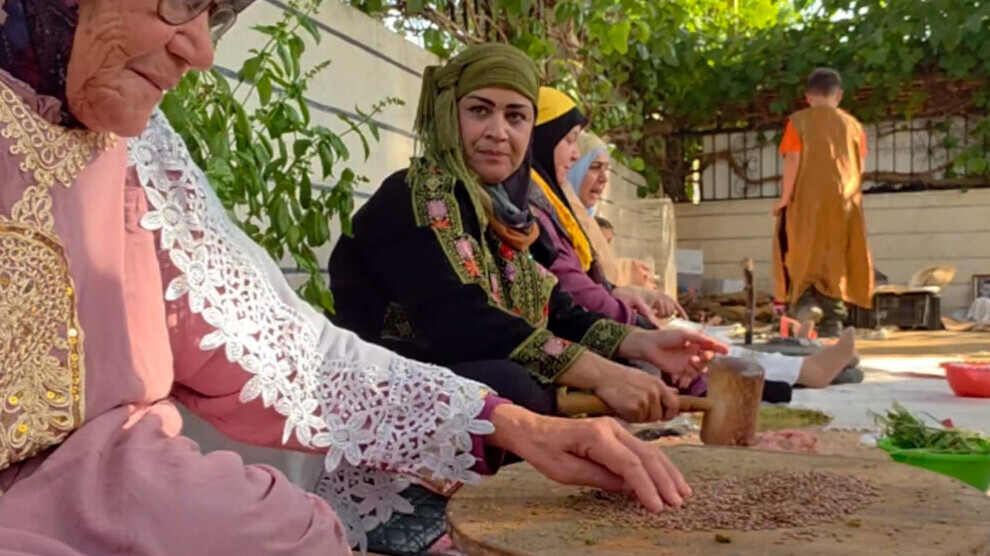
In the courtyard of the house, among the belongings of the old home, the women were present, and with them heritage in all its details. A manjira, village clothing, a southern wedding, saj bread, and the simplicity of southern life... a scene that brought those present back to days gone by, when weddings were held in the courtyards of villages, everyone participated without discrimination, simplicity was the title of life, and joy brought people together.
Layla Reda says that preparing for this day took more than a week, and at some stages exceeded ten days, to collect old items, prepare traditional clothing, and train the women to recreate the details of that life. She pointed out that the work was not easy, as it required searching for every old piece and communicating with women and girls and introducing them to how to embody the roles and wear village clothing, so that the message would be clear, from the generation of grandparents to today's generation.
"Our message is that the land has a history, an identity, and a memory"
She affirms that the goal was not merely to hold a heritage activity, but to revive the land and direct a message to new generations that this land has a history, identity, and memory that cannot be uprooted.
The village wedding was one of the most prominent stations of the heritage day, as the details of old weddings were recreated, when the town square turned into an open space for joy, where everyone gathered. There were no invitation cards or costly preparations; rather, invitations were made by visiting homes, and the bride was escorted to the rhythm of the drum, the mijwiz, the dabke, and the ululations, while everyone participated in the celebration.
Layla Reda hopes that weddings will regain their open popular character, after they have in many cases become limited occasions. For her, the joy of a wedding is not complete except with everyone's participation, especially since this custom was one of the most beautiful images of social solidarity and cohesion among the people of the town.
The details of daily life were not absent from the heritage scene; wheat bread, saj bread, the manjira, handicrafts, and the preparation of traditional foods were all present to bring back to the women the memories of mothers and grandmothers.
Stories that encapsulate an era of strong relationships
Saida Reda expressed her nostalgia for the past as she contemplated the loaf of bread on the traditional saj, considering it an authentic legacy that takes her back to the "old days," which she described as the most beautiful. She pointed to the changing and difficult conditions of life due to the war, which weakened the usual social ties between neighbors, but at the same time stressed the women's attachment to their homes and their remaining in them despite all the crises and current circumstances.
Among those present, Amal Younes found in handicrafts more than just a hobby; they are part of a social memory and a heritage passed down by women.
Rafiqa Shuaib recounts a chapter from the town's memory dating back to the late 1960s, when a woman from Baalbek arrived carrying with her the secrets of wool work, and began teaching the region's women and encouraging them to produce until they mastered spinning.
She proudly recalls how this passion turned into national work, when those wool sweaters were knitted by women's hands to support participants in the 1967 war, affirming that these crafts are not merely a source of livelihood, but an integral part of a living heritage that must be protected from oblivion.
Thuraya Hatit affirms that the 1970s were characterized by strong social ties, when doors were open and joy was an occasion that brought together the entire town's residents.
The story is not limited to recalling the past; it extends to the present, as the participants see that reviving these customs is also a space for meeting and gathering, and an opportunity to seize moments of joy amid war, anxiety, and attacks.
In Al-Babliyeh, the heritage day was not merely a restoration of images from the past, nor merely a celebration of the customs of grandparents, but an attempt to keep memory alive, and an affirmation that what southerners inherited of customs, traditions, and stories is not passing details, but part of their identity and existence, and a memory they do not want to die.