
Palestinian Woman Consumed by Cancer Awaits Medical Referral for Treatment Abroad
"Islam Arafat, cancer-stricken and immobile, lives in a Gaza tent. She holds a referral but can't leave, waiting for treatment as pain consumes her."
NAGHAM KARAJA
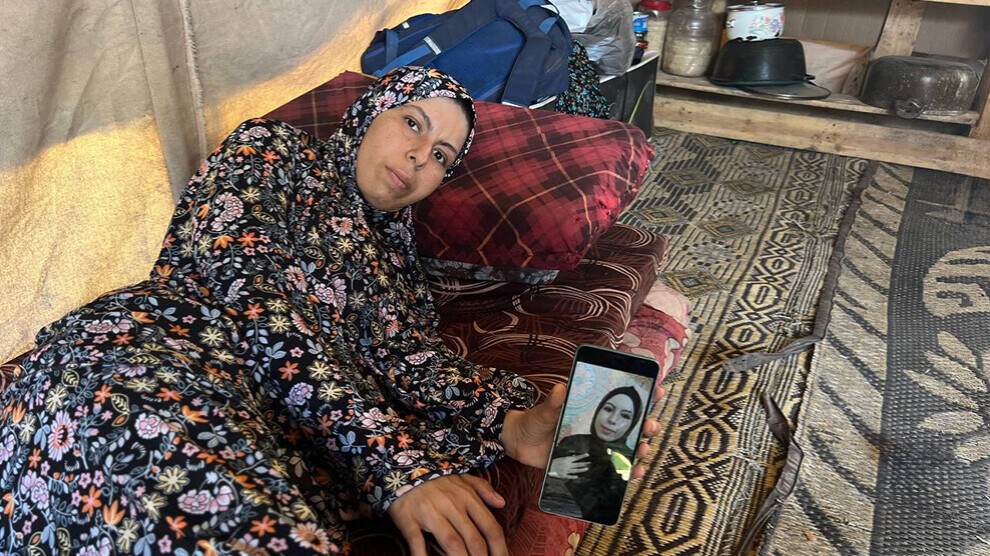
Palestine_ Islam Arafat, 30, did not know that the pain that had plagued her for months was not a passing health issue, but concealed a cancerous tumor that had spread through her body. The displaced woman from eastern Gaza City initially thought she was suffering from a "fissure," before doctors at Al‑Shifa Medical Complex revealed an enlarged tumor and diagnosed her, according to her account, with cancer that had spread to the colon, rectum, liver, lungs, and lymph nodes in the pelvic area.
Today, Islam Arafat lives in a tent in the central Gaza Strip, after losing her ability to walk and sit normally. She has a medical referral for treatment outside the Strip, but she is still waiting to be able to leave Gaza and reach the care she needs.
She explains that doctors told her the disease had been in her body for at least two years without her knowing, and when the war began, she was displaced and living in a school that had been turned into a shelter in the northern Strip, before the school came under siege and shelling.
She recalls those moments as one of the most harrowing experiences of her life, saying that Israeli warplanes dropped explosive materials on the shelter where she had been displaced, causing suffocation among the displaced: "They dropped bombs and substances on us that caused suffocation, and I could not breathe properly. Everyone was vomiting, while I remained struggling to breathe."
Among the survivors were members of her family, while others lost their lives. At first, she did not expect it to be cancer; she thought she had a minor health issue, before the surgery revealed an enlarged tumor: "I thought I had a fissure, and when I went for surgery, doctors discovered an enlarged tumor, and that's how the disease was detected."
According to her account of her diagnosis, the disease was not confined to one place but spread to the colon, rectum, liver, lungs, and lymph nodes in the pelvic area. As the disease spread, pain became the defining feature of her daily life.
She describes how the disease robbed her of life's simplest details: "The disease has affected me greatly; I cannot stand or sit, I spend my entire day lying on my back, and I can no longer walk or sit. All I wish for is to sit like other people and walk like them." She cannot manage her daily needs alone; inside the tent, she relies on family members to help her move and care for her.
Cancer Patients Facing War
Islam Arafat's suffering does not stop at her individual case. Cancer patients in Gaza have faced, since the start of Israel's war on the Gaza Strip in 2023, disruptions in treatment, displacement, and declining access to health services—factors that increase the physical and psychological burden of illness.
For Islam Arafat, this crisis has directly affected her treatment journey. She receives chemotherapy at Al‑Shifa Medical Complex, and says that obtaining the dose consumes hours of waiting and procedures: "We are patients, and we are supposed to get some rest, but unfortunately we wait three or four hours to complete procedures and receive the chemotherapy dose."
She adds: "Sometimes we sit next to garbage waiting to go up and sit on a bed to receive the dose. Treatment conditions are very difficult."
A Medical Referral That Does Not Open the Way
Islam Arafat obtained a medical referral for treatment outside the Strip, but having the referral did not mean she could travel. According to the World Health Organization, patients whose conditions require care unavailable in Gaza need a medical evacuation pathway that includes referral, approvals, and coordination with relevant parties. A medical referral alone does not mean a patient can leave the Strip.
The difficulty of this pathway is reflected in the scale of the need for medical evacuation. In January 2026, the UN Office for the Coordination of Humanitarian Affairs reported that more than 18,500 people, including nearly 4,000 children, urgently needed medical evacuation to receive care unavailable inside the Strip.
On January 27, the Ministry of Health in Gaza, according to OCHA, said that about 4,000 cancer patients were on critical evacuation waiting lists, and that 1,268 patients had died, according to the ministry, while waiting to leave the Strip for urgent medical care.
These figures do not mean that all patients on waiting lists are prevented from traveling for the same reason; each case has a different medical and procedural pathway. But they reveal the scale of the evacuation crisis in which Islam finds herself.
In conclusion, Islam Arafat appealed to the World Health Organization: "I ask them to help me and enable me to travel so I can receive treatment. In Gaza, I cannot get the treatment I need. I want to be treated properly, and for this pain and this unjust siege on Gaza to end."
Between a disease spreading through her body, pain that never leaves her, and a medical referral that has not turned into a treatment journey, Islam Arafat remains trapped between her urgent need for treatment and a way out she cannot open on her own, waiting for a treatment opportunity that may come before the pain becomes stronger than her ability to endure.