
Palestinian Mother Finds Her Son’s Body at Yellow Line, Recounts Tragic Details
After days of searching, Fatima Abu Khammash found her son’s body near the Yellow Line. She spent four days pleading with Israeli forces to allow her to retrieve it.
RAFIF ESLIM
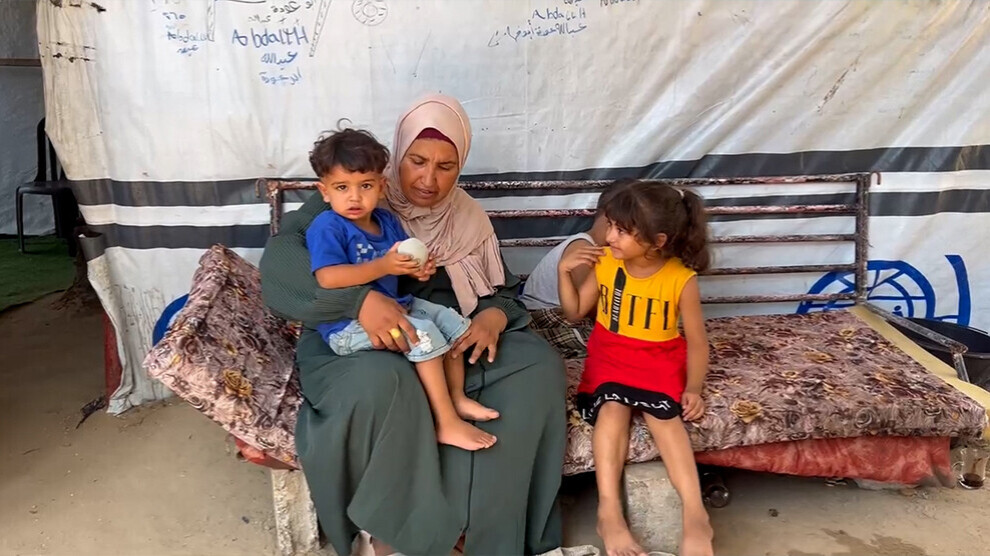
Palestine_ Along the Yellow Line in central Gaza, Fatima Abu Khammash sat for four consecutive days pleading with Israeli forces to allow her to retrieve her son's body, just meters away. International organizations, including the Red Cross, were unable to secure a permit for the retrieval. But the mother succeeded, and on the fifth day, she buried her son.
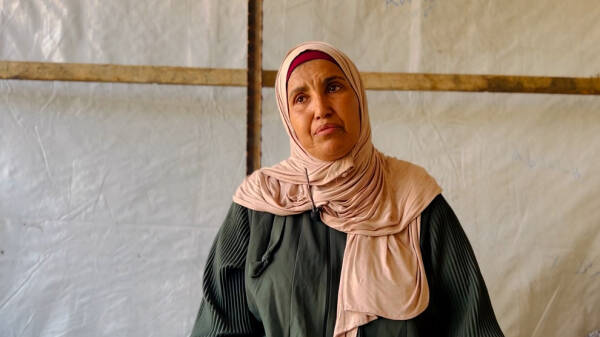
Fatima Abu Khammash recounts that her son Muhammad was suffering from PTSD, as confirmed by his doctor at the Gaza Mental Health Center. Every May, his symptoms would emerge—he would become aggressive and uncontrollable. In the last days of April, he would go voluntarily to admit himself for the entire month. With the outbreak of war, his condition worsened, becoming impossible to manage, especially with limited or unavailable treatment.
She Defied Fear in Search of a Body
She recounts that she never expected Israeli forces to shoot him, as he was mentally ill and in need of treatment. She thought he might be arrested or turned back. But after several days of his absence, she began searching. Her intuition led her to the Yellow Line. When everyone confirmed his features and the white clothing he had left the tent in, she gathered her courage and stood exactly at the line, holding a white flag, and saw a familiar body nearby.
When she saw the body, she dropped the flag and burst into tears and pleas. A drone then approached, and a soldier spoke to her through it, ordering her to leave or face the same fate as her son. She refused, begging him to allow her to move just one meter and pull the body before stray dogs could eat it. He refused. She asked him to at least pull it inside his position so it wouldn't decompose. He refused again. She wept until sunset and was forced to leave, by her account.
Fatima Abu Khammash sat every day from morning until evening, with the same conversation between her and the Israeli soldier repeating. He threatened to kill her, even recalling the first time she was bombed nearby by a tank—but she did not flinch and remained steadfast. All she wanted was her son's body. She adds that on the final day, after she had spent it crying and throwing sand on her head, the soldier agreed to issue a permit and told her to come back the next day to receive the body. Indeed, she got what she asked for and buried her son in a worthy place.
Three Sons Lost in One Year
Muhammad was not Fatima's first loss. Before him, she lost Osama, 27, killed in an Israeli airstrike while securing aid trucks from theft to feed the hungry in Gaza. After him, his younger brother was killed while sitting with friends in front of one of the school gates sheltering displaced families who had lost their homes—an airstrike struck, with no known reason. The chain of loss ended with Muhammad, all within a single year.
Fatima Abu Khammash affirms that she suffers from severe psychological illnesses, unable to cope with all this loss alone. Her three eldest sons were gone in the blink of an eye, and psychological support services in the stricken city are nearly nonexistent. Yet she is forced to stand on her feet to support the young children of Muhammad and Osama, noting that her daughters-in-law need the same support.
Fatima Abu Khammash works at a clinic under UNRWA. She tries to rush through her workday to return to her grandchildren and check on them, after providing for their needs with great difficulty due to soaring prices and supporting three families. She says what brings her comfort most is watching the little ones play and looking at photos and videos she took of her three sons before they were killed in Israeli attacks—their voices are what bring her back to life after entering another world of grief and silence.
The Beginning of the Story
The story began when the eldest son lost his younger brother. His psychological distress accumulated, and he decided to return to the home located inside the Yellow Line, hoping to find a memory that brought them together. Despite being pulled back by residents several times, he crossed the line and was shot by Israeli forces stationed there.