
Mervat Al-Zaqzuq Supports Women Through Her Safe Space “Tabtaba”
Mervat Al-Zaqzuq’s Gaza safe empowers women and children through learning and psychological support, rebuilding security and fostering recovery from camp suffering.
RAFIF ASLIEM
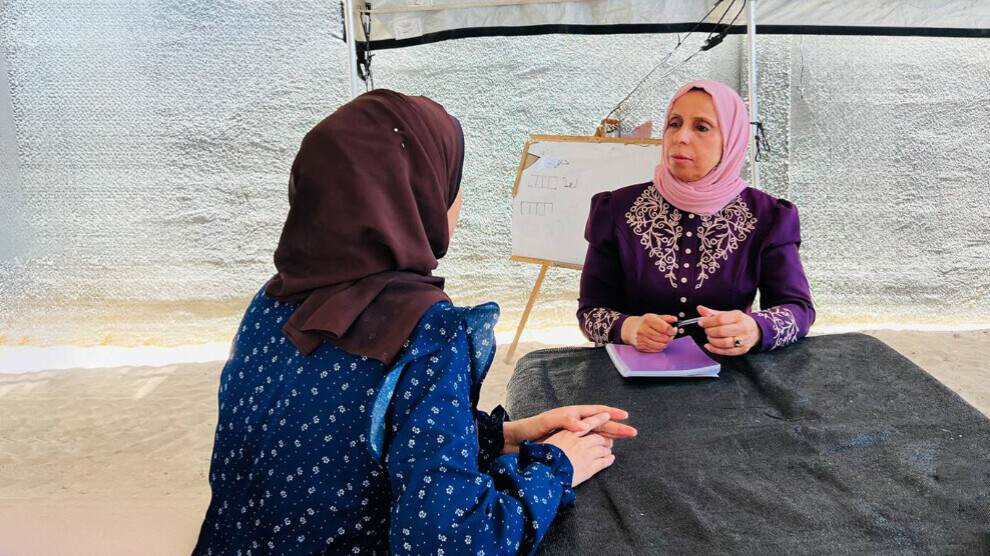
Gaza — On private land owned by her family, community and feminist activist Mervat Al-Zaqzuq decided to open a "safe space" for abused women as an individual initiative she led herself. She did not expect the number of beneficiaries to exceed one thousand women within just one month, prompting her to seek suitable funding for her space located in the "Al-Salam" camp, one of the largest camps in the southern part of the Strip in Khan Yunis.
Mervat Al-Zaqzuq, a community pioneer and doctorate holder, says that the idea of the "safe space" came as a continuation of the "Bokra Al-Na" (Tomorrow Is Ours) school project. On October 20, 2025, she decided to begin establishing a school serving the residents of the Al-Salam camp, which was built on an area of four blocks and houses 900 families, whose children spend their time chasing food kitchens, water trucks, and wandering about. She noted that she became convinced of their right to learning and psychological support, and that is what she set out to do.
From Teaching Children to Empowering Women
She adds that this step came because she has been a feminist and community activist for ten years, and it was difficult for her to witness the post-war situation. She established the school without initial funding and succeeded, but when she began providing psychological support to children, she noticed that they came from an environment lacking stability. She decided to start with the mothers to ensure a healthy generation, so she began sending invitations to them along with their children, and indeed they began to frequent the place for one session per woman.
She does not deny that when she opened the school, she was astonished by the numbers coming to enroll in classes. In one day, there were between one hundred and one hundred and twenty children wanting to study, meaning they were facing one hundred mothers—or perhaps fewer—in need of psychological support, as some of those children were siblings. Consequently, there was a dilemma about how to accommodate those numbers of mothers and children within just one month without a supporter, so she turned to the UNFPA and the Association of University Graduates, who supported her initiative.
Today, she does not consider the school or the "safe space" her achievement; rather, she considers the forty female employees her greatest achievement. She was able to provide job opportunities and a fixed monthly salary for those women who had been suffering from unemployment and a difficult economic situation, in addition to the support she was able to provide to victims of violence through psychological debriefing sessions, personal hygiene kits, and some food parcels to empower them.
Compounded Violence
Women in the Gaza Strip face various forms of compounded violence. In addition to emerging from a brutal war that lasted for two continuous years, there is social, economic, and psychological violence, with domestic violence considered one of the most prominent forms weighing heavily on them. She stressed that women lost the complete meaning of safety when they were forcibly removed from their homes after they were bombed, leaving them in need of complete psychological rehabilitation and a reformation of the concept of security and safety.
She points out that Palestinian women need the outside world to strip them of the label of heroism and resilience and to begin providing assistance, as they are internally shattered and trying to adapt to the pre-existing situation. Therefore, the psychological support program in her space transformed from one day into a full program under the name "Tabtaba" (Patting)—eight sessions with 500 abused women, through which they are taught how to deal with crises and psychological pressures, and to build confidence by creating a protection plan that enables them to appreciate themselves and their efforts.
She emphasizes that through the space, she sought to eliminate some misconceptions about providing psychological support to vulnerable women. She receives women from various educational and economic backgrounds—housewives, teachers, doctors, university professors—all of whom have suffered from difficult conditions, reaching a point of burnout and cessation of giving. She adds that through the space, she does not see any woman as weak; the fact that they were able to come to the place and seek help makes them strong women.
The Spread of the Idea and Its Societal Impact
Mervat Al-Zaqzuq explained that within three months, she was able to reach 1,500 women and provide them with support. Through this experience, she found the importance of generalizing the idea of the "safe space" across all camps and cities of the Gaza Strip. She even asserts that the absence of such spaces is a serious problem, asking: "How can we leave women alone? Wasn't two years of war and six harsh months of famine and continuous exhaustion enough?"
In conclusion, she notes that the availability of "safe spaces" in every camp or area is a necessity due to the harsh nature of life imposed on women in Gaza. Today, if a woman in the southern part of the Strip needs to reach them, it takes two hours round trip under the scorching sun, while if she were from the city, it would take double the time and effort. She points out that she may provide transportation fees to a case if she is in difficulty and truly needs it, but it is not a solution—she is a housewife with children or perhaps a worker, so providing a space near her is essential.