
Between Loss and a Tent… The Story of a Girl Carrying the Burden of Harsh Motherhood
The childhood of thirteen-year-old Rahaf Badr has turned into a heavy burden of forced motherhood after losing both her parents, inside a tent that cannot withstand the wind nor protect her from hunger and pain.
Nagham Karaja
Gaza — Children in Gaza live a harsh reality far beyond their age, deprived by war of their most basic rights to education, healthcare, and safety. Many have lost one or both parents and are forced to shoulder responsibilities no child should bear, amid repeated displacement and dire living conditions inside tents unfit for life.
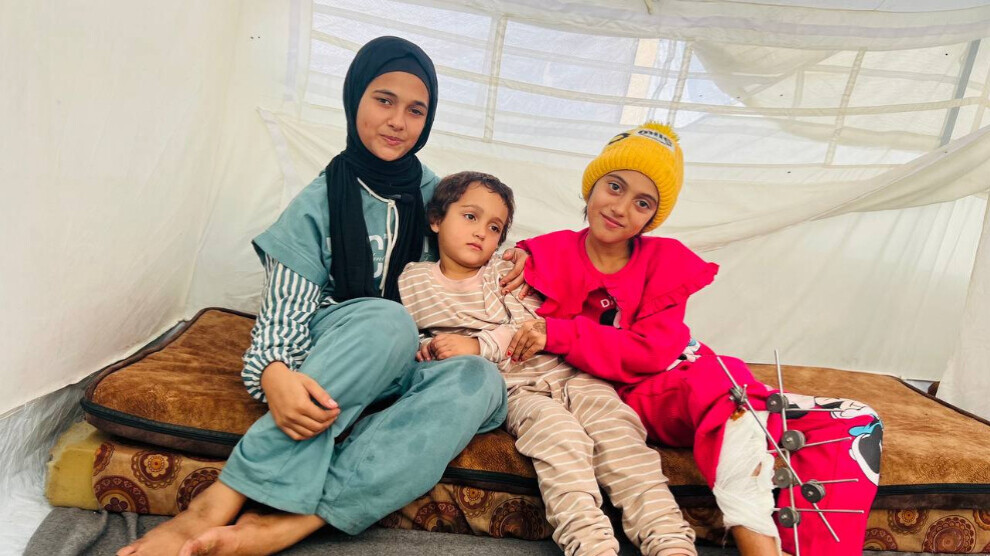
Thirteen-year-old Rahaf Youssef Badr never imagined that her mother’s last words — “Take care of your sisters if I am gone” — would become an inescapable reality. She thought her mother was joking or being overly worried, but illness and war conspired against her small life and robbed her of childhood all at once, turning her into a mother before her time — alone in a tent that cannot endure the wind, responsible for her three younger sisters who look to her for protection, food, and affection.
Carrying the Burden of an Entire Family
During their displacement from northern Gaza to the south, Rahaf discovered that her mother had breast cancer. She resisted for a full year, fighting the disease, but death came faster than treatment. She passed away, leaving behind a child carrying the weight of an entire family.
In the same month, Rahaf’s father attempted to return to their destroyed home in the north to retrieve some belongings, but the house was bombed, and he was killed inside. No one could recover his body due to the danger in the area. Rahaf was denied even a final farewell, and without warning, she was thrown into responsibilities far beyond her age.
Rahaf now sits in her worn-out tent in northern Gaza with her sisters, who look at her as a mother. In a quiet voice she says, “I suddenly became a mother without choosing it. I cook, wash, and soothe them to sleep, when I should be doing my schoolwork. How can I protect them when I am a child like them?”
She should be in school, but she cannot leave the tent or abandon her sisters.
“When I see my friends going to school, I feel like I belong to another world. I wish I could join them, but who would care for the little ones? Who would carry this burden for me?”
The family relies on scant humanitarian aid, barely enough to feed the girls. A relative has been trying for months to secure an orphan sponsorship for them, but the doors remain closed and the institutions overwhelmed. Thus, Rahaf faces the responsibility of caring for three children without financial or institutional support.
Daily Hardships in a Tent Unfit for Life
In one corner of the tent sits four-year-old Taghreed Badr. Every time Rahaf tries to comb her hair, the little girl whispers her mother’s name with a trembling voice.
“When I comb Taghreed’s hair, I remember my mother’s hand doing it so gently. I can’t imitate her… it makes me feel like I’m failing, like everything is too big for me.”
But the most painful hardship is endured by ten-year-old Israa Badr, whose left foot was pierced by shrapnel while she stood on a street corner. She needed metal plates to fix the injury. The pain has not left her, especially in a tent with no proper bedding or medicine.
Holding back tears, Israa says, “My foot hurts all the time. I cry at night because I can’t sleep. The doctors said I might not survive and that the surgery was dangerous, but I kept fighting the pain without medicine. I don’t know why I can’t have the basic rights any child should have.”
Israa has received no medical care since the surgery. All Rahaf has is a wet cloth to cool her sister’s wound when the pain becomes unbearable.
“Sometimes I cry secretly so the little ones don’t see me. I’m afraid they’ll sleep hungry or be in pain and I can’t help them. No one understands how a child can bear all this.”
The tent itself adds another layer of suffering. Its torn sides let in dust and water; it becomes suffocatingly hot in summer and collapses in the wind. Yet the family has nowhere else to go.
“I’m afraid the tent will fall on us at night, or that my sisters will get sick from the cold, rats, or dirty water. We live in a place unfit for life, but we have no other choice.”
A Clear Violation of Legal Obligations
Regarding the lack of sponsorships, Rahaf asks, “If we had just one sponsorship, we could eat well, buy medicine for Israa, and get notebooks and clothes for my little sisters. Why are children like us left without any help?”
The case of Rahaf and her sisters is a blatant violation of children’s rights as outlined by international conventions, which oblige the global community to protect children in conflict zones and ensure access to food, healthcare, education, and safe housing. What this family endures is an affront to human dignity — a severe breach of legal and moral obligations toward the most vulnerable children in war.
Amid this human devastation, Rahaf continues to resist the fragility of her age. She sleeps last and wakes up first, as if carrying the world on her shoulders. She is not a mother — but war forced her to become one, dragging her childhood behind her like a shadow that has lost its color.
In the end, she expresses a simple hope:
“We don’t ask for much. We just want to live, to continue our lives like other children. I want to go back to school, for Israa to heal, and for my sisters to sleep without fear. Is that too much to ask?”
And so, the life of this small family remains suspended between loss and a fragile tent — between pain and patience — and between a child trying to act as a mother. Three sisters who have nothing but each other to face a world that collapsed on them far too early