
Behind the Veil: How Does the Iranian Regime Hide Poverty Behind Women's Bodies?
In Iran's poverty-stricken cities, the hijab hides deeper crises, as the regime uses women's bodies to divert attention from economic and social collapse.
SARA POURKHEZRI
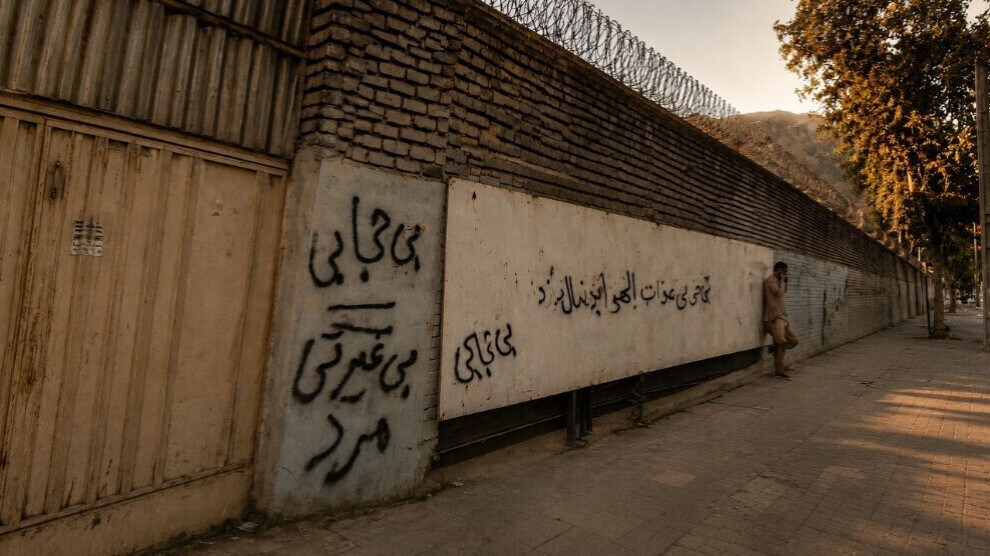
Kermanshah — In one of the neighborhoods of Kermanshah, eastern Kurdistan, a woman rummages through a garbage container searching for food, while a barefoot child begs passersby. These scenes repeat daily in one of the poorest and most deprived Kurdish cities in Iran, where suffering is embodied in people's faces rather than in statistics. Despite this reality, the authorities focus on covering the city's walls with slogans such as: "Unveiling brings divine punishment"—a reflection of a policy that employs the hijab issue to divert attention from livelihood crises and reinforce tools of control.
The Hijab as a Tool to Conceal Real Crises
For more than four decades of the Islamic Republic's rule, the authorities have relied on the hijab issue to divert attention from the people's suffering and shift society's focus from economic and social crises to monitoring and controlling women's bodies. In Iran, the hijab is not merely a religious or cultural issue but one of the fundamental pillars of the repression system. The state dedicates enormous human and financial resources to preserving it, enacting laws, launching propaganda campaigns, and exercising various forms of organized violence.
In this context, the hijab becomes a tool of social control, allowing authorities to regulate women's presence in public space, making their bodies an arena for displaying power, and criminalizing any form of civil disobedience under the pretext of "non-compliance with hijab." This excessive focus aims to create a virtual "enemy" to blame for crises, allowing the concealment of economic failure, the expansion of poverty, the prevalence of structural corruption, and the worsening of social problems. When a woman walks without hijab in a street, authorities treat her as a threat far more dangerous than poverty, unemployment, addiction, or even a barefoot child begging. This inversion of priorities reflects that the hijab issue is not a moral matter but a political tool to direct public opinion and consolidate the regime's authority.
Frankees B., a women's rights activist, says: "Phrases such as 'morality police,' 'pull your scarf forward,' 'the hijab is protection not restriction,' 'please enter with Islamic hijab,' and thousands of similar slogans have become familiar to every woman who has lived under the Islamic Republic. For many years, the hijab has ceased to be merely clothing but has become a means of repression and spreading fear. The word 'hijab' itself has become a justification for practicing various forms of injustice and violence."
Although the authorities formally announced the abolition of the morality police after the Jina Amini uprising, what actually happened, as our interlocutor explains, "was merely a change in form, like a snake shedding its skin." This system "has not disappeared" but has "reproduced itself under new names and methods."
Today, official pressures on women, their bodies, and their clothing continue through more subtle means—from street harassment and exorbitant fines to deprivation of public services, imposition of social restrictions, and security threats. Even now, as she says, new threatening messages are written across different parts of the city, as if all society's problems are caused by women's clothing. The authorities are not content with the punishments they impose themselves but also threaten women with supernatural and metaphysical punishments.
When the Victim Is Blamed for the Crime
In the Islamic Republic's legal system, the hijab is viewed not only as a religious duty but as a tool to control women's bodies and behavior. Through laws, penalties, and mechanisms of repression, the authorities define and enforce what they consider "acceptable behavior" for women.
The danger of this approach intensifies when the authorities, directly or indirectly, provide cover for violence against women by conveying the message that any departure, however minor, from the state-imposed hijab standards may expose women to punishment or assault.
This is evident in cases of harassment and sexual assault, where the victim often becomes the target of blame while the perpetrator is absolved of accountability. Instead of prosecuting the offender, the woman's clothing or behavior is presented as justification for the violence she experienced. This reflects a moral and legal inversion where the victim is required to prove her innocence while the perpetrator escapes responsibility.
Although religious and jurisprudential texts do not explicitly state that a woman's clothing justifies assault against her, prevailing laws, official discourse, and the culture shaped over decades under official propaganda have contributed to entrenching among a segment of society the belief that a woman who experiences sexual violence must have "provoked" the perpetrator through her clothing or behavior.
The roots of this belief lie in a patriarchal structure entrenched over many years. When the state deploys security forces in the streets to arrest a woman for a slipping scarf or clothing that does not conform to official standards, it sends an implicit message that a woman who does not comply with hijab deserves punishment, humiliation, and exclusion. Over time, this message transforms into a social conviction that justifies violence, making it appear as a legitimate reaction rather than a crime deserving punishment.
This discourse also reinforces the linking of a man's "honor" to a woman's clothing, especially when authorities promote slogans that consider not wearing hijab as evidence of a man's lack of "protective jealousy" (ghayrah), while crimes of killing women by fathers, brothers, or husbands are met with reduced sentences. In this way, the authorities cement the image of man as the guardian of "honor," while women become subjects of surveillance and punishment.
In recent years, many women have been arrested, imprisoned, and subjected to various punishments for what authorities described as "bad hijab." The killing of Jina Amini after her detention by the "morality police" is one of the most prominent examples of violence related to the enforcement of hijab laws.
Thousands of women, according to human rights reports, have been subjected to harassment, assault, threats, or killing on account of their appearance or clothing—whether by security forces or family members. Across all these cases, one common denominator remains: women were the victims, while the authorities—whether within state institutions or the family—remained the final arbiters of their fate.
The Dual Use of Hijab: Repression in the Streets and Showing Tolerance in Politics
Although the hijab is used in the Islamic Republic as a tool of control, repression, and social regulation, it acquires a completely different function at certain political moments. In elections, official marches, and government events, authorities sometimes make a point of showing unveiled or non-compliant women in media images, in an attempt to suggest that their popular base is not limited to conservative supporters, and that even those not adhering to hijab support the system.
Through this approach, the authorities seek to broaden their image before public opinion and create a contradiction in the audience's perception. On one hand, the media and rights organizations emphasize that the hijab is forcibly imposed and used as a tool of repression; on the other, official media show images of unveiled women at official events, raising doubts about the mandatory nature of hijab in Iran.
This contradiction aims to confuse the audience and push them to question whether criticisms of hijab policies are exaggerated, or whether women are indeed freely choosing their clothing.
Thus, the hijab in the Islamic Republic is no longer merely a fixed religious or legal obligation but has become a flexible political tool—used at times to impose control and punishment, and at other times to display openness and manufacture legitimacy. Yet the outcome remains the same: the continued instrumentalization of the hijab as a means of domination and the exclusion of women who oppose the authorities' policies.