
Amana Abu Ghabn... War Stole Her Childhood and Left Her Alone to Face Life
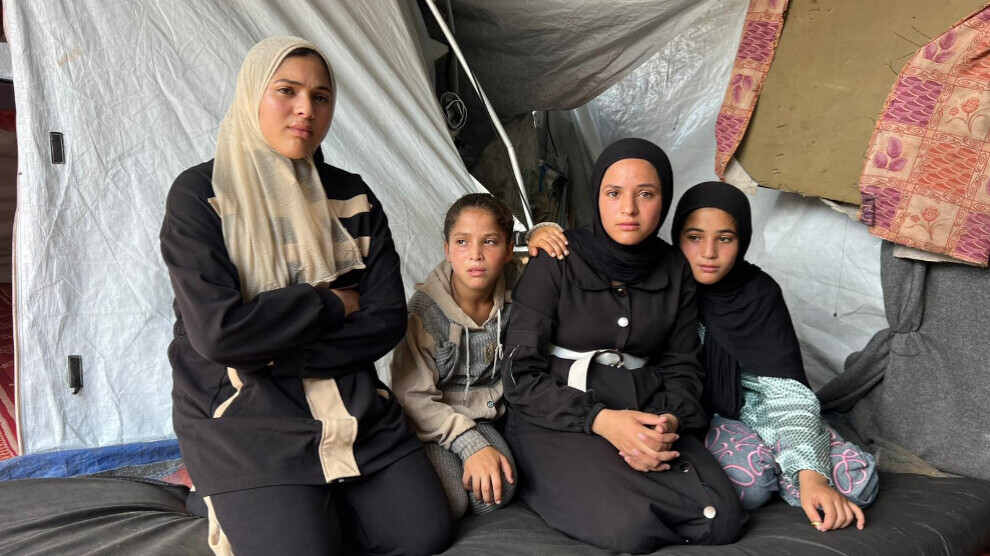
Amana Abu Ghabn carries the burdens of an entire family since her father's summary execution and her mother's disappearance two years ago, taking responsibility for three sisters in an endless journey of survival.
NAGHAM KARAJA
Gaza — At seventeen, Amana Abu Ghabn never imagined that she would be transformed overnight from a student preparing to continue her education into the guardian of four sisters, tasked with feeding them, protecting them, comforting them, and making decisions beyond the capacity of adults.
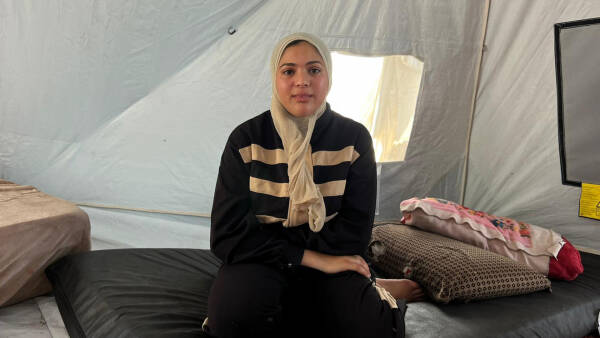
Since December 5, 2023—the day her mother went missing during the siege of the Jabalia camp in the Gaza Strip—her life changed completely. She took on the responsibility of a family that lost its father to summary execution, while her mother's fate remains unknown to this day, amid a war that robbed her of education, safety, and childhood, and forced her to play the role of both mother and father inside a tent west of Gaza City.
The family had sought refuge in one of the shelters in Jabalia camp, fleeing the bombardment, before Israeli forces surrounded the area with fire and gunfire intensified from all directions. As the danger escalated, Amana's father insisted that his wife and daughters leave the shelter with International Committee of the Red Cross (ICRC) teams, fearing that their departure might later become impossible, while he decided to stay behind.
The mother left with her daughters but refused to be separated from her husband, instructing her eldest daughter Amana to wait with her sisters in a corner near the shelter until she returned to him. She did not know that that moment would be the last time she would see her mother.
An Unending Search
Amana Abu Ghabn recalls the scene in a voice still carrying the terror: "I stood with my sisters waiting for my mother as she had asked us, but the minutes turned into hours of fear. Drone bullets were raining down on us from every direction. I didn't know what to do, so I left my sisters for a moment and ran to look for her. I thought I would find her next to my father, but he told me he hadn't seen her since we left. That's when I realized everything had changed."
Israeli forces advanced into the area, making it impossible to stay. Amana was forced to take her three sisters and flee west, carrying in her heart a single question: where did her mother go?
Only two days later, she received news that Israeli forces had summarily executed everyone who remained inside the shelter, including her father. But she refused to believe the account, as she was unable to return to the site due to ongoing military operations.
Instead of surrendering, she began an arduous search for her mother, moving between hospitals, checking lists of the wounded and the dead, and searching among bodies for an entire month—without finding any trace of her.
She says: "I would enter every hospital hoping to find her injured but alive, then leave carrying a new disappointment. I searched among the wounded, looked at faces that had lost their features, and asked everyone I met. But my mother remained absent without news. I thought she might be detained, because the thought of losing her without a trace was harder than I could bear."
Twelve days after the shelter siege, Israeli forces withdrew from the area. Amana Abu Ghabn rushed back to the place where she had left her father. There was the shock that would stay with her forever: she found him lying on the ground, three bullets having pierced his body—a scene that confirmed he had been summarily executed.
She recounts in a voice heavy with pain: "I will never forget that moment as long as I live. I wished the news had been false, but I found him where we left him, lying on the ground, bullets piercing his body. I felt as if time had stopped, and I could no longer comprehend anything around me. Since that day, I have not known what tranquility means."
Her mother's fate remains unknown to this day. Amana Abu Ghabn tried to contact the ICRC, hoping to learn whether she was detained in Israeli prisons, but the response came back negative, leaving the family suspended between hope and absence, with no answer to end months of waiting.
Deprivation of Education, Shelter, and Humanitarian Aid
The effects of psychological trauma continued to haunt Amana for months, as she became solely responsible for four sisters. As military operations intensified in the northern Gaza Strip, the girls were forced to flee with relatives southward, where they lived for nearly three months in a cramped tent in Deir al-Balah in the central Strip, sheltering more than ten people, with overcrowding depriving them of privacy and the most basic necessities of life.
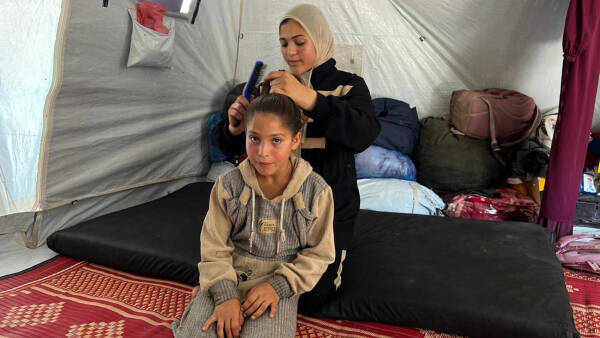
When they returned to Gaza City, they found no home to shelter them, nor a relative who could host them. They took refuge in an orphan camp, but it lacked support and basic services.
The absence of their father's death certificate prevented them from receiving humanitarian sponsorship, as much aid is still disbursed in the name of the head of the household, depriving them of food and relief parcels. Amana Abu Ghabn found herself required to provide for her sisters' needs without any source of income.
She adds: "I miss my mother in every difficult situation—when one of my sisters gets sick, when we cry at night, when we can't provide our simplest needs. I feel her absence is greater than I can bear."
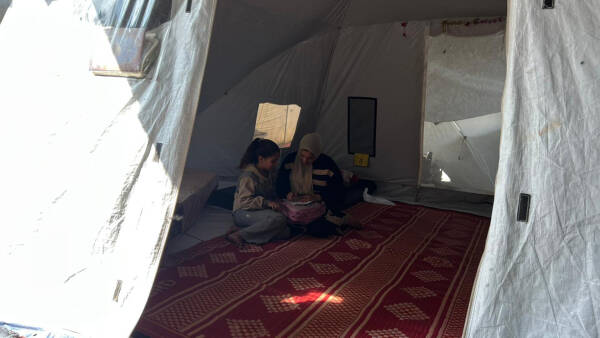
The losses extended beyond the family to the girls' educational future. Amana Abu Ghabn, who was preparing for high school, was forced to stop her studies after she could not pay the fees, despite her repeated attempts to find free education opportunities. Her sister Aliya was also deprived of continuing her education for the same reason.
Their youngest sister, Nour (8 years old), managed to enroll in a free educational tent, but she walks a long distance every morning, leaving her shelter at 6 a.m. to arrive at school by 8 a.m., for fear of being late.
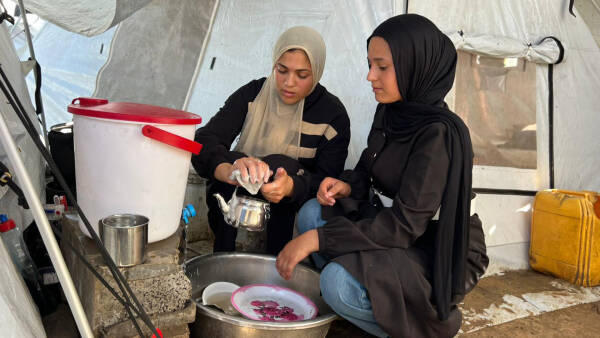
Inside the tent, Amana's responsibilities begin at dawn and do not end with nightfall. She prepares food with limited resources, lights a fire for cooking, manages her sisters' needs, follows up on their daily affairs, and tries to protect them from the rodents that constantly attack the tent.
Today, Amana Abu Ghabn asks for nothing more than an answer to a question that began on December 5, 2023, and has remained unanswered: Where is her mother? While she manages the lives of three sisters inside a tent that protects neither from summer heat nor winter cold, her only hope is to one day know the fate of the mother who left to return in minutes—but never came back.