
The Tenth Amed Fair… Women’s Writings Carrying Messages of Solidarity and Hope
Amid women's growing presence in culture and literature, the tenth Amed Book Fair in northern Kurdistan became a meeting space and platform for women writers to share experiences and messages.
AKIN STERK
Amed – The tenth Amed Book Fair launched on 26 September at the Mesopotamia International Exhibition and Conference Center, organized by the "Tuyap Exhibitions" group, in cooperation with the Turkish Publishers Association, and with the support of the Amed Chamber of Commerce and Industry (DTSO). It is being held with the participation of a large number of publishing houses that have set up their pavilions, amid a wide turnout from the city's residents.
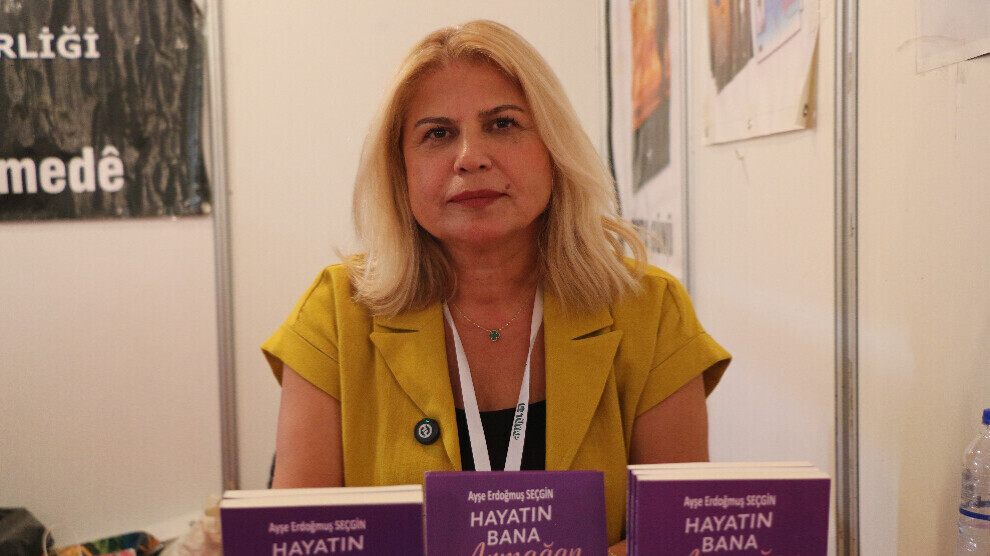
Writer and teacher Aisha Erdoghmush Setchgin is participating in the fair, which continues until the fourth of next October, with her two books "What Life Gave Me" and "Starting from the Self."
"I Allocated the Book's Proceeds as Scholarships for Female Students"
Aisha Erdoghmush Setchgin says that in her book "Starting from the Self," she addresses her experiences with her students, explaining that she decided to allocate all its proceeds to university female students in the form of scholarships. "I allocated all the proceeds of this book as scholarships for university female students. This made me happy. The book's purpose made me happier than its mere publication."
She believes that writing for her is inseparable from social responsibility, confirming: "We are here as women and as individuals in this society, to convey our voices. We are women who read and write, know our rights, and struggle for them. We are here to gather those around us, enlighten the path of our women, make them happy, or rather discover the paths that lead us to happiness."
"Amed Never Leaves Writers Alone"
Speaking about the fair, Aisha Erdoghmush Setchgin noted that this is the tenth time the book fair has been organized in Amed, considering that the city presents a good model in welcoming writers and caring for them. "Amed never leaves our writers alone, whether they are writers coming from abroad or writers from our region. The turnout is very good."
She believes that the value of the fair is not measured by sales alone. "Although sales are not very large, people coming to meet, talk, exchange conversations, and get to know new colors — all these things are valuable to us."
With the fair continuing until 4 October, Aisha Erdoghmush Setchgin extended an invitation to readers to visit the fair, browse the books, and meet the participating writers.
She summarizes her message in a direct call to reading, writing, and solidarity: "Therefore, let us all read, let us write, and let us support one another. Woman is woman's homeland."
"Women Read and Write More Now"
Aisha Erdoghmush Setchgin believes that women's presence in the field of writing is increasing day by day, at a time when women in the past faced social restrictions that prevented their engagement in reading and writing.
She says that women were besieged within a narrow scope of social roles. "When we look at why our women did not write in the past, we find that they were confined within a small world. They were expected first to raise children, then to prepare good food in the kitchen, and so on."
She says that "writing requires a knowledge base. We must read a lot and allocate time for that. Just as a woman practices her profession, she must also allocate time for writing when she wants to author a book. She must dedicate at least three to five hours daily."
She pointed to the importance of the support a writer receives, especially at the beginning of their experience. "When starting this journey, the people who hold your hand and help you, especially at the beginning, are of great value. If you come across such a person, things go well. But if you do not come across such a person, then of course all the burden falls on you."
"The Phone Cannot Replace the Book"
Aisha Erdoghmush Setchgin addressed the impact of technology and phones on reading habits, noting that people used to read more in the past, and that the spread of phones and technology led to a decline in the time allocated to books. "Reading introduces a person to different worlds. The phone we see in our hands actually prevents us from that. People used to read more in the past. With the development of technology, reading books has declined further."
But she believes that technology, no matter how advanced, cannot cancel the status of the book. "Nevertheless, the phone cannot replace the book." She called for continuing to read and discover new books, noting that readers' interest in books, reading them, and evaluating them "will be a pleasure for all of us."