
The Oranian Blouse... Threads That Tell the Memory and Identity of Algeria
From the alleys of old Oran to global heritage platforms,the Oranian blouse endures as a symblo of Algerian elegance and identity, preserving genetations’ stories and festive traditions.
RABIA KHARIS
Algeria — In the city of Oran, one of Algeria's largest cities and the capital of the Algerian west, the Oranian blouse stands out as more than just traditional clothing; it is an integral part of Algerian women's identity and cultural memory. This garment, in its details, holds a diverse civilizational heritage in which Amazigh, Arab, Islamic, and Andalusian influences intertwine, along with a long history of resistance and resilience, transforming the blouse into a symbol that preserves customs and traditions and embodies Oran's artistic and historical specificity.
To learn about the history of this garment, the secrets of its craftsmanship, and its evolution, our agency met with international sewing and tailoring trainer Najat Mazaghash, who believes that the Oranian blouse is not merely a piece of fabric but a living expression of pride and Algerian identity. She explains that its modern history dates back to 1830, while its roots, according to her account, extend to the 16th century, affirming that every stitch and detail in this garment carries a part of an inherited memory that craftswomen strive to keep alive.
Multiple Historical Roots
The Oranian blouse carries in its design traces of the civilizational diversity the region has known, with a clear Andalusian influence. Najat Mazaghash says that when she works on weaving the blouse, she feels as though she is evoking the legacy of Andalusian artisans who settled in the region's cities, noting that this garment has undergone many transformations over time.
She explains that in its early stages, the blouse was closer to a tunic and a wide cloak, before its designs evolved to suit contemporary demands while maintaining its essential elements, foremost among them embroidery with gold threads and decorations that give it its distinctive character.
The Oranian blouse is closely linked to the city of Oran, as she noted, where the old neighborhoods, including Al-Darb and Al-Kamin, contributed to the emergence and development of this heritage over time. Today, the new city stands out as an important center for the manufacture and marketing of this garment, with tailoring workshops and fabric shops spread throughout, where traditional craftsmanship meets modern designs.
In the alleys stretching from Sahat Al-Tahaha through Ghouti Abdelkader Street to Mazwar Muhammad Street, traditional tailoring workshops sit alongside shops specializing in fabrics and embroidery. These workshops transform into spaces that preserve the details of the craft, where seamstresses pass on the expertise of previous generations to young designers, while simultaneously using modern tools and traditional techniques.
Thus, these shops are not limited to selling fabrics and dresses; they form a living space for the continuation of heritage, as each design tells of hours of manual work and meticulous embroidery, while the expertise of grandmothers continues alongside the innovation of the new generation.
How Is the Oranian Blouse Made?
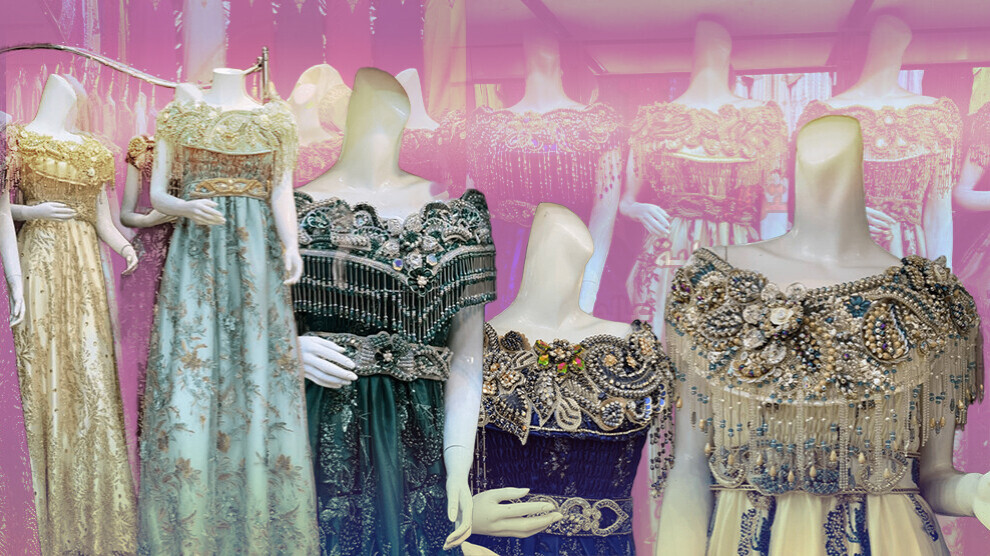
Inside the tailoring workshops, the process of making the blouse begins with fabric selection, piece design, and determining appropriate decorations and embroidery. Najat Mazaghash explains that the blouse is designed long down to the feet, with a rounded lower part, while the fabric quality varies according to the occasion and social status—embroidered silk, cotton, linen, or lace can be used.
The neckline, as she explained, may come in a square shape or a V-shape, adorned with embroidery or embellishments, while the sleeves vary in length and design. The blouse is also cinched at the chest, often completed with a belt that gives it its distinctive traditional shape.
She notes that the Oranian outfit typically consists of three or four essential pieces, including the blouse and the "Jaltita" (the inner garment), in addition to the Arab trousers locally known as "Sarwal Janb Al-Tastifa" (feminine side trousers), which measure about one and a half meters in width and can be made from silk fabrics such as satin or crepe.
Between the gold thread and hand embroidery, the Oranian blouse continues its journey through generations, maintaining its presence as a piece of Algerian heritage while simultaneously adapting to contemporary taste without losing its historical features.
Social Dimensions and Traditional Names
The Oranian blouse has many names and styles depending on its tailoring details and decorations, with each style carrying a particular story and reflecting an aspect of Algerian women's cultural identity. Najat Mazaghash explains that the "Al-Kursi" blouse was among the most popular styles for the Algerian bride, alongside the "Al-Zaim" blouse, now known as the "Sari" embellished blouse, which has held a prominent place in Oran's tailoring traditions and continues to maintain its presence in the Algerian traditional fashion scene.
The name "Al-Zaim" blouse, according to Najat Mazaghash, derives from the density of embroidery and decorations adorning it, known as "Ta'amirat," using various types of decorative stones, such as "Al-Mour," crystal, and others, giving it a majestic and beautiful appearance.
Algerian women did not wear these garments randomly; rather, each type was associated with a specific age stage or social occasion, as she explained. Colors, decorations, and stones were carefully chosen to harmonize with joyful rituals and celebratory displays, or to reflect solemnity in sad occasions, making traditional dress part of an integrated social and cultural system.
Among the most prominent styles of the Oranian blouse are the "Al-Kursi" blouse and the "Al-Kabarat" blouse, which was reserved for elderly women such as mothers, grandmothers, and family elders, along with the "Al-Waqr" blouse worn at funerals and mourning periods, typically characterized by dark and sober fabrics such as brown, gray, and black.
As part of the valorization of this cultural heritage, Algeria has submitted a request to UNESCO to register the "Oranian blouse" in all its styles within Algerian cultural heritage. This effort reflects the importance of this garment in the collective memory of Algerians, as more than just traditional clothing—it is a living record of customs and rituals passed down by mothers and grandmothers through generations. With its decorations, colors, and gold threads, the Oranian blouse continues its presence as a symbol of elegance, identity, and the richness of Algerian heritage.