
Robiaa Al-Hajli… The Guardian of As-Sweida’s Memory and Documents
Rabiaa Al-Hajli preserves history by protecting inherited family documents and belongings, viewing them as records of the region's memory, fearing this heritage may be lost without future generations to transmit it.
ROCHELLE JUNIOR
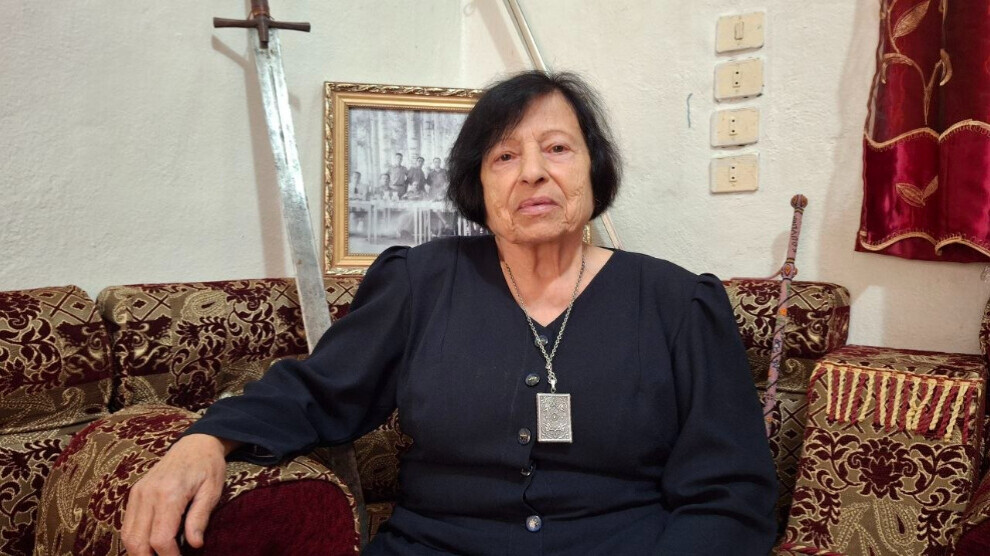
AS-SWEIDA_ Rabiaa bint Mazyed Al-Hajli, 80 years old, keeps a collection of books, newspapers, documents, and belongings that reached her from her father and grandparents. She sees in them a record of her family’s memory and part of the history of As-Swieda city in Syria, and fears that this legacy will be lost over time if it finds no one to preserve it and transmit it to future generations.
Rabiaa Al-Hajli spent about thirty years in the teaching profession before retiring, but she did not abandon another role she considers an extension of her responsibility toward generations, which is preserving what her ancestors left of documents and memories. She says that her father had the greatest role in her connection to this legacy, as he encouraged her since childhood to listen to conversations and asked her to sit beside him. She recalls him saying to her: "Keep my memories for me," a phrase that remained present in her memory and pushed her to preserve what he left for her.
Books and Newspapers Passed Down Through Generations
The collection kept by Rabiaa Al-Hajli includes books, newspapers, and documents addressing events and figures from the history of As-Sweida, among them materials related to her father and what he lived through during the French Mandate period, alongside personal belongings, including swords and sticks, which she says she is keen not to allow anyone to use or tamper with.
Among the books she refers to is "Blood and Expulsion," which addresses her father's biography, in addition to old newspapers that she says contain news and correspondence about the participation of the region's people in confrontations and military events during that phase.
Rabiaa Al-Hajli deals with these materials as more than family belongings. For her, they are documents through which an aspect of the place's history can be read, especially since some of them include names of people, events, and journalistic correspondence that have been preserved from one generation to another.
Documents in the Face of Accusations of Treason
Rabiaa Al-Hajli links her adherence to these documents to what she describes as attempts at "accusing the Druze of treason," especially after the events of July 2025 in As-Sweida, and she rejects reducing the history of the region's people to general accusations.
She notes that these materials include documentation of positions and confrontations in which the region's people participated, and she considers them evidence in defense of the land. She believes that preserving these documents and making them available to researchers and new generations allows reading those events instead of settling for circulating narratives.
Among what Rabiaa Al-Hajli keeps are documents addressing events that occurred in Damascus during the French Mandate period. She recounts, based on what is stated in them, that a group from As-Sweida participated in defending the residents of Damascus during confrontations with a group of Circassians, and she says that her father was among the participants in those events.
Women in the Narratives of Memory
Rabiaa Al-Hajli does not separate preserving the history of men from preserving the stories of women. She says that women were part of the events witnessed by the region, and also played a role in transmitting memory from mothers and grandmothers to sons and grandchildren.
Regarding the events and massacres of July 2025 in As-Sweida, she recalls narratives about women who participated in defending their land. "During those events, a woman carried arms and was able to kill six of the attackers, while another woman drove a car and participated in defending the region."
She confirms that these stories must remain present within memory because women were not outside the events, but were part of them and partners in protecting their families and land. They also carried many narratives to subsequent generations.
From Family Memory to the Memory of the Place
Rabiaa Al-Hajli also talks about her grandfather, and what the family transmits about his participation in confrontations during the Ottoman era. She recounts, based on family memory, that he went out in one of those confrontations accompanied by 38 horsemen, and they returned with 68 prisoners.
She considers that oral memory and the written document complement each other. Therefore, she is keen to keep books, newspapers, and papers preserved alongside personal belongings that she sees as carrying a value linked to their owners and the phase in which they lived. "New generations may move away from knowing the history of their fathers and grandfathers, and the loss of documents means the loss of part of the details that cannot be recovered later."
She fears that these materials will find no one to preserve them after her departure. Therefore, she believes that establishing a museum or specialized center could provide her and other families with a permanent place to preserve and document documents, newspapers, and old belongings.
Rabiaa Al-Hajli evokes her grandson, who showed keenness to preserve his grandfather's memories. She hastened to encourage him to move forward in preserving this legacy and transmitting it to the next generation, finding in his passion a glimmer of hope that ensures the continuation of this living memory and its protection from fading.
In her view, the museum transcends being a repository of old belongings, to be a vibrant space that encapsulates the memory of the place, documents the bonds of the past with the present, and offers new generations the opportunity to explore what fathers and grandfathers left behind.