
Beaufort Castle… History Carved in Stone
In the heart of southern Lebanon, Beaufort Castle stands as a witness to centuries of conflict, while the recent explosion raises fears for its modern restorations, in contrast to the solidity of its rocky structure tied to the mountain itself.
RANA JOUNI
Lebanon — Beaufort Castle is not merely an archaeological landmark in southern Lebanon but a historical and strategic site whose walls hold centuries of wars and transformations. The castle, parts of which date back to the Crusader period, was an important ruling fortress and an advanced military position, containing prisons, quarters for military commanders, and an observation tower.
During the recent war, the area surrounding Beaufort Castle was subjected to a massive explosion in which Israeli forces used about seven hundred tons of explosives, raising fears for parts of the castle and its modern restorations.
A Multi‑Functional Rocky Castle Telling a Successive Military History
Archaeology expert and visual artist Lina Jouni explains that the castle dates back to the Crusader period, when it was among the important castles with a political and military role, containing prisons, facilities for military commanders, and an observation tower.
She notes that the castle's main building contains a large number of stairs and internal rooms that do not appear from the outside. While walking through the corridors, clear paths can be observed, along with others requiring descent via stairs, where successive rooms are distributed beneath one another, in addition to tomb‑like spaces extending toward the river line.
She affirms that the site's importance is not limited to the Crusader period, as the castle formed a fortified and strategic position used in different stages of wars, including the civil war and the war with Israel, and Turkish forces also reached it in earlier periods.
She explains that the nature of the castle's construction was directly linked to the nature of the land and rocks in it. The site stands on extremely hard rocky ground, especially flint rocks, which imposed its winding shape on the construction, as expansion or excavation was not possible in some areas, so available spaces were exploited according to the site's topography.
She notes that the existence of the cave with large cavities gives a clear idea of the size of the grottoes and tunnels in the castle. However, she explains that these tunnels cannot necessarily be considered war or military tunnels in the traditional sense but were part of the castle's general system, which performed multiple functions, including the military function, with some parts used as prisons, as well as being a command headquarters.
Modern Restoration in the Face of the Original Building's Solidity
She explains that the castle played a fundamental role as an observation tower, given its elevated position that allows revealing the surrounding area from various directions. On one side, the river extends; on another, the plains of Zoutar and Kfartebnit appear; and from other directions, Deir Siryan and the surrounding areas can be seen. She says this strategic location made the castle an observation point revealing its surroundings widely.
Lina Jouni moves to one of the castle's towers, explaining that the tower consists of two floors, while more than three floors extend below it, containing a large number of rooms that were designated for guarding. She notes that the castle underwent restoration work that took a long time before being reopened in 2015 and 2016. However, the restoration focused mainly on rehabilitating the castle's exterior appearance, including treating some parts that were covered with concrete, and was not a complete structural restoration of the rocks themselves, given the difficulty of working on extremely hard rocks and their particular nature.
She explains that the restoration work allowed access again to the rooms in the lower layers. It also included installing new stairs in places where the original stairs had been destroyed during the occupation period and before 2000. She notes that the castle witnessed, during different stages, the presence of multiple parties and groups, and those leaving sometimes resorted to blowing up parts of the site, destroying a number of stairs and internal corridors.
She adds that the rooms deep inside the castle were used for multiple purposes, including imprisonment, housing guards, and rooms designated for administration. To allow access to them, new iron stairs were installed as part of the restoration work.
However, she warns that parts of the modern restoration may have been damaged as a result of explosions and missiles with concussion effects, explaining that this work, despite contributing to preserving the castle's general appearance, was not designed to withstand such strikes. She notes that some parts of the modern restoration are likely damaged, while other parts of the castle's structure remained more resilient due to their rocky composition.
The Castle's Rocky Construction Enhances Its Resilience Against Shelling and Explosions
Lina Jouni explains that the castle stands mainly on huge rock blocks, a geological nature that made the site difficult to exploit for agriculture or construction and prevented facilities from extending toward the river. She believes this same rocky structure contributed to protecting the internal parts from complete collapse due to shelling and explosions.
She explains that destroying the castle from the inside would have required reaching its deepest levels, descending through stairs and corridors to the internal layers, then using large quantities of explosives in multiple ways, with the aim of directly affecting its rocky structure and causing actual collapse in it.
Lina Jouni expresses her fear that the recent explosions may have caused damage to parts of the castle, especially those that underwent modern restoration. She explains that the materials used in the restoration work differ from the original construction, as some parts relied on modern materials less solid than the rock blocks of which the castle has historically been composed.
She notes that the recently rebuilt stairs and corridors—including metal passages and bridges covered with wood or metal pieces to facilitate visitor movement—were not designed to withstand large quantities of explosives and missiles, even if some parts are made of iron.
She affirms that the original construction deep inside the castle is more capable of withstanding, due to the thickness of the walls and rock blocks forming its basic structure. She explains that the proportion of openings and windows in the external walls is very limited compared to the thickness of the walls and rocks, which enhanced the castle's ability to resist strikes.
She notes that some internal floors were used across different historical stages as prisons, whether during the Crusader era or in later periods, including the period of Israeli presence. She points out that the castle did not rely mainly on firing openings in its defense.
She explains that the firing openings in the castle are narrow and long, some about ten centimeters wide, while their length ranges between 60 centimeters and about a meter. These openings were used for shooting arrows and bows, but their number is very small compared to the size and structure of the castle.
The Castle Resists Destruction
Lina Jouni believes that the limited nature of these openings, along with the thickness of the walls and the strength of the rocky construction, largely explains the ability of the castle's original parts to withstand and avoid comprehensive collapse.
On the other hand, she warns of other risks that may threaten the site, especially the possibility of tampering with its internal parts or opening new passages toward the heart of the castle, which could distort its historical structure or cause damage to it. She also points out that damage to the upper parts of the castle will inevitably reflect on the towers and facilities located above.
She notes that the castle has not been inspected up close since the explosion, and therefore the extent of damage cannot be definitively determined at present. However, the upper parts, especially the towers, remain among the points most feared to have been affected.
Lina Jouni believes that the parts damaged from modern restoration can be rehabilitated and restored, explaining that the recently created passages and stairs may have been damaged or collapsed, but rebuilding them remains possible, including using stone and rehabilitating them in a manner consistent with the castle's nature.
But she points out that the most difficult part to destroy is the castle's rocky foundation, saying that what cannot be easily removed is the mountain itself, especially since the site stands on extremely hard flint rocks.
She explains that the idea is not only related to the castle being exceptionally fortified but to the nature of the rock on which it was built, as the strength of flint rocks makes destroying them extremely difficult, even if highly powerful weapons are used.
She affirms that the castle's engineering and construction method played a fundamental role in granting it this resilience. She believes its strategic location, along with its engineering structure and rocky nature, made it throughout history a focus of attention for the powers that succeeded one another in the region and sought to control and use it.
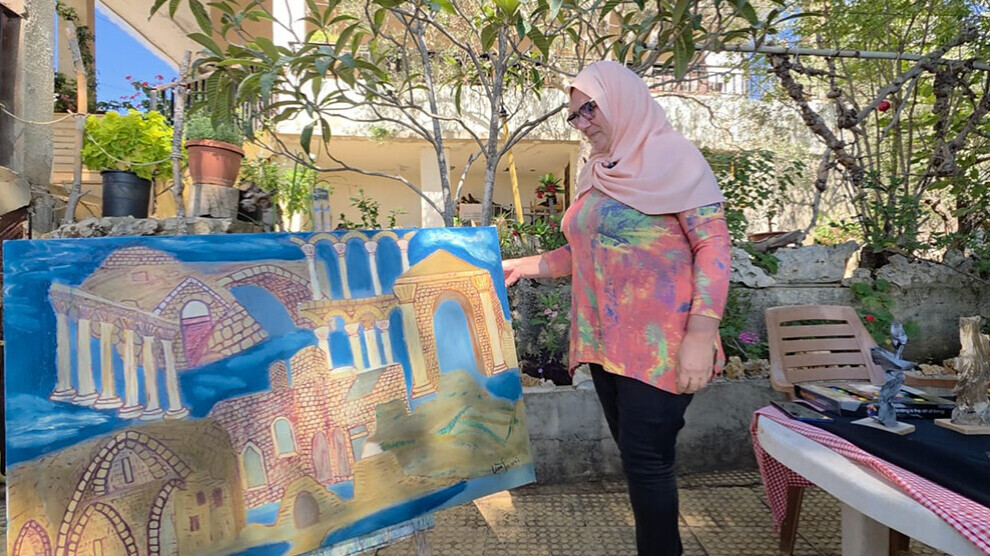
About the artwork in which she painted the castle, she explains that she chose to present it in a foggy scene, deliberately not showing the details of the stone divisions and window openings, given the damage it sustained and because its final form after the upcoming restoration work remains unknown.
She compares this castle with other archaeological sites that have been damaged, noting that some sites, such as Chamaa, Doubiyeh, and Anjar, differ in the nature of their construction and touristic function, while other sites, including the Baalbek walls, sustained significant damage, but their restoration remains possible since most of their construction stands above ground level.
As for this castle, according to Lina Jouni, it differs in the nature of its construction, as its foundation is tied to the mountain itself. She explains that the site is more like a mountain that was shaped and given architectural forms, but its essence remained flint rock, which grants it greater strength and ability to withstand damage.