
Aylol Nazlıer: Singing the Memory of the Land and Mother Tongue
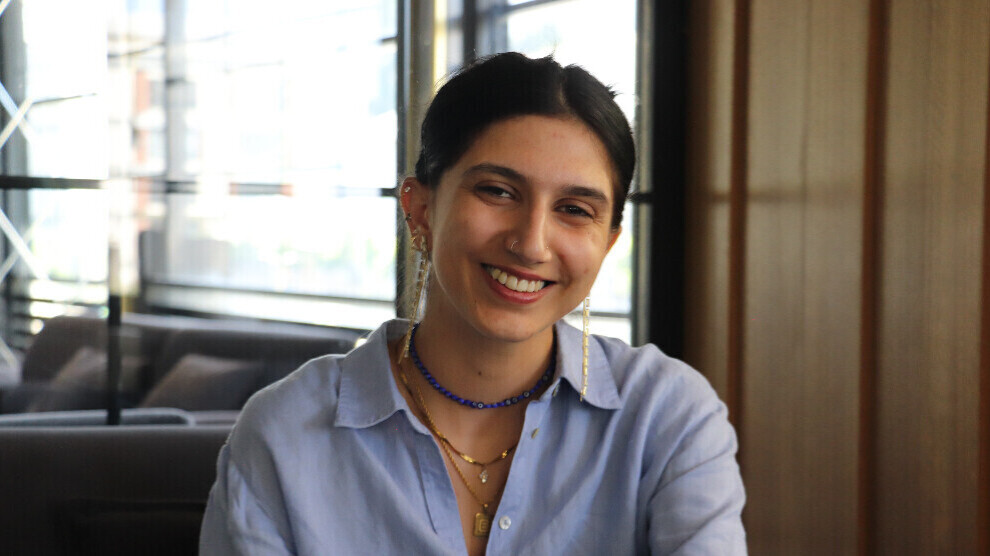
From her village to the stage, Aylol Nazlier carries the songs of her childhood as more than melodies—they are memory, identity, and a language connecting generations.
MEMEHAN HELBIN ZEYDAN
Bitlis_ In North Kurdistan, policies of cultural identity erasure and forced assimilation continue, targeting language, art, and collective memory—particularly the memory of women who have carried and preserved a rich cultural and artistic heritage across generations.
This targeting has not been limited to preventing expression in the Kurdish language; it has also affected the oral heritage passed down by women from generation to generation, stripping it of its identity and origin, and reproducing and adapting it in Turkish.
In the face of policies of repression, prohibition, and marginalization that seek to exclude Kurdish from the public sphere and weaken its connection to daily life, women continue to resist by holding onto their mother tongue, reviving the songs, stories, and cultural memory that have formed part of their identity. Among these women, the young Aylol Nazlier stands out, choosing music as a means of preserving what is being forgotten, and bringing old voices back to life in their original languages.
Aylol Nazlier, 21 years old, began studying music at the age of nine. Since then, she has dedicated part of her experience to performing songs in Kurmanji, Armenian, and other languages—particularly those that have not found their way into popular culture or are threatened with oblivion—seeking to preserve the song not only as a melody but for the stories, memory, and identity it carries.
From Family Obligation to Passion for Music
Aylol Nazlier says she began her musical journey at the Aram Tekran Music Institute under her family's guidance, explaining that at first she did not go willingly, before her relationship with the place changed over time and music became a genuine passion for her.
She added: "After one year, the institute was closed by the trustee appointed to head the municipality. After that, a private institution called 'MA Music Center' was opened. I continued my music education there and became much more enthusiastic, going with love and desire. Because we were receiving education there in a democratic environment. Volunteer teachers founded the music center with great determination and continued giving lessons to children there. Then we grew up and reached their level. Today, each of us continues our life as a musician, on stage."
The Impact of Popular Culture
Aylol Nazlier believes that the transformations imposed by popular culture on people's relationship with art have not been neutral but have affected the way art is produced and received.
She said: "Without feeling, we cannot enjoy the music we produce, nor can we convey that sense of pleasure to the audience. Popular culture, at some point, allowed us to reach people very quickly. This is a fact, but it also caused us to disappear just as quickly. And between those transitions that take only seconds, we too became fleeting clips, and at some point we began to lose our feeling."
She added: "People no longer want to listen to music, watch theater, or go to the cinema collectively as before. Because we have now reached a stage where consumption has peaked. Collective listening and watching have almost ended. Interaction has also declined. And with the decline in interaction, some feelings in society have become numb, and this of course affects our art as well."
Attacks on the Mother Tongue
Aylol Nazlier affirms that targeting the mother tongue is not a new phenomenon, pointing to the continued policies of forced assimilation that have affected her Zazaki (Dimliki) dialect for many years. She recalls from her childhood the extent of the Turkish language's presence in her life. "Many of our Kurdish youth, and even elders, now speak Turkish. Because they can express themselves more easily through it as a common language. When two people meet, one speaking Dimliki and the other Kurmanji, they speak Turkish instead of each speaking their own language and dialect. Turkish is the language of one people, and I have infinite respect for all languages. But when there is a clear and explicit attack, we must develop a mechanism to protect ourselves."
She notes that the songs she grew up with in her village were not merely artistic works to her but a living part of memory and emotion. "We did not see these songs as just a story; they gave us the feeling that we were living them in that moment. Today, young people have a preoccupation with not being recognized or seen. And this anxiety sometimes pushes them to distance themselves from their culture."
"The Melody of This Land Is One"
Aylol Nazlier explains that re-singing old songs in her mother tongue represents for her a way to hold onto her culture and keep it alive, affirming that music should not become a space for ownership and exclusion.
She added: "We have lived on this land with Armenians, Syriacs, and many other cultures. What we call melody or feeling is not something specific to Kurdish, Turkish, or Armenian—it is human. So I never want to enter into a debate: this melody is mine, this melody is yours, this is mine, this is yours."
The Memory of Mother and Village
She recalls her relationship with the folk songs she heard in her village since childhood, affirming that each song has a story and a memory rooted in the past. "Their stories all go back to a very distant time. Before I start singing a song, I go and ask: What is its story? What are its lyrics? And they tell me."
She explained: "My mother was born and raised in one of the villages of Çewlig (Bingöl). She does not know Turkish, so she cannot tell me her stories in Turkish, and I sometimes find myself unable to express myself fully in the Zazaki dialect."
"Music in My Mother Tongue Excites Me"
Aylol Nazlier sees singing in her mother tongue as a direct connection between the present and the generations before her, explaining that reviving old songs gives her a feeling of connection to those who wrote these songs generations ago. "I feel great excitement when I make music in my mother tongue. At this stage, I feel satisfied—musically and spiritually alike—and therefore I naturally prefer singing old songs more."
She affirms that the mother tongue is not merely a means of communication but a space where a person's identity and first memory are formed. "Every person exists and expresses themselves through their mother tongue." She notes that the mother tongue is the field where a person feels most comfortable and secure. "It is the language the mother sang to her child while breastfeeding. I believe a person's codes begin to form from that moment."
She affirmed: "We are connected to that language and attached to it because our mother speaks it. We see two worlds now. There is the world of our grandmothers, grandfathers, and mothers, who lived a natural life in the villages, away from our age's technology, and conveyed their emotions to others. In contrast, there is the world of the new generation born into phones and television, disconnected from their mother tongue and not embracing their own culture—some of them even feel ashamed of it because they were marginalized at some point."
Aylol Nazlier noted in concluding her remarks that the culture of repression and violence was among the means that contributed to distancing children from their mother tongues, explaining that fear was passed from one generation to the next as a result of what previous generations endured.