
A Writer Breaks the Wall of Silence in Defense of Tunisian Women’s Issues
Tunisian writer Habiba Mahrazi has broken the barrier of silence to expose what is left unspoken in women’s issues, affirming that women make up half of society and that their absence threatens its well-being and stability.
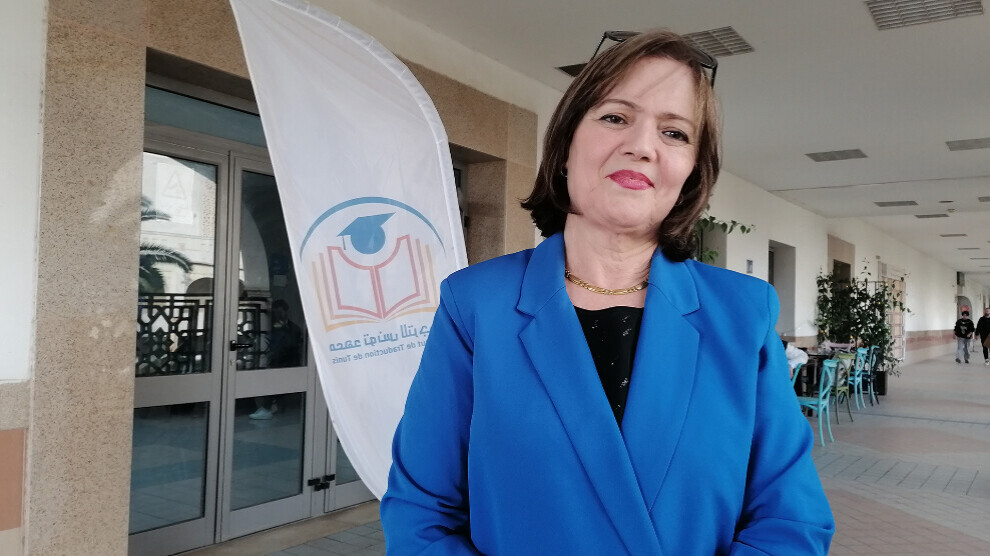
Nazihah Bousaidi
Tunis -Amid the social and cultural transformations Tunisia has witnessed since independence, the Personal Status Code has emerged as one of the most important historical achievements, consolidating women’s status and reinforcing the stability of the family and society. This code constituted a solid foundation for rejecting polygamy and granting women unprecedented rights.
Tunisian writer Habiba Mahrazi chose to break the wall of silence and defend these often-overlooked women’s rights, stressing that women are half of society and that any infringement on their gains represents a direct threat to family balance and societal progress.
To learn more about her writings, her bold stances, and their impact on defending women’s rights—at a time when attempts to revert to polygamy and regression are resurfacing, which she considers a red line that must not be crossed—our agency conducted the following interview with writer Habiba Mahrazi, whose passion for writing has accompanied her since childhood and who finds pleasure in reading women’s literature.
How did writer Habiba Mahrazi’s journey begin?
The novel, the short story, and creativity are a passion and a feeling that dwell within a writer. Since childhood, I wanted to write anything at all; I felt a release in writing. When I reached university, this passion grew and developed—from writing short stories to writing longer narratives that encompass as many marginalized segments of society as possible. I believe that writing does not suddenly emerge at forty, fifty, or sixty years of age; it must have roots that extend back to childhood.
As a child, I was deeply attached to learning because I was aware that our neighbor, who did not flee her husband’s house despite being beaten, did so not out of love but because she had no support, no income, and no education to show her that she was not inferior to a man. I mentioned this in my short story collections A Mute Decision and A Devil and a Veil, as well as in my novels Atonement of Imprisonment for Women and the latest, A Dream in My Body. I was the only girl in our area in Kairouan who surpassed the “Sixième” level and joined secondary education. At that time, society did not realize that education protects both women and society.
Which feminist figures influenced your writings on women’s issues? Do you think women have been treated fairly? And did you face criticism because of your boldness in revealing women’s realities in your work?
Influence always comes from the environment in which a writer lives. A writer must have a critical perspective and a position regarding a given situation—such as the status of women. I lived in a society where women were wronged and oppressed, and I used to say: I wish I could document this and write it down, whether in a short paragraph, a long text, or even in a poem of complaint.
There is not a single letter written by Fadwa Tuqan that I have not read. I admired her immensely because she managed to overcome all the difficulties she faced. I was also influenced by the poet Nazik al-Malaika, May Ziadeh, and Aisha Abd al-Rahman (Bint al-Shati). I read all of this while I was in secondary school.
I was heavily criticized when I wrote Seven Banners, in which I addressed the status of women in Kairouan during a specific period, particularly after independence, when illiteracy among girls was widespread. I also spoke about inheritance and was criticized harshly. After that, I wrote Atonement, which was stronger and went straight to the core, addressing what is taboo and left unspoken.
How did the Personal Status Code contribute to consolidating the status of Tunisian women? And how do you respond to attempts to return to polygamy and regression?
The Personal Status Code is the achievement that allowed women to rise within a framework of a stable family and a healthy society. These laws placed Tunisia among the countries where women have reached the highest levels in literary, scientific, and humanitarian fields.
Tunisian women, through their wisdom and insight, preceded the Personal Status Code in rejecting polygamy through what is known as the “Kairouan dowry,” a historical marriage contract dating back to the eighth century that prohibits polygamy and grants women the right to divorce. If a man wishes to marry another woman, it must be with the consent of his wife. This is also known as the “Kairouan condition,” which traces back to Arwa of Kairouan, who stipulated to Caliph al-Mansur that he could not marry another woman without her consent, and that divorce would be in her hands if she did not agree.
Tunisia stands as a living example of the success of the Personal Status Code in elevating society and freeing it from the claws of repugnant regression. This is what I defend in my writings and in literary and intellectual gatherings