
Women’s Communes: An Organizational Framework to Face Challenges and Promote Equality
“Women’s communes in North and East Syria strengthen women’s roles and organize them democratically, ensuring participation in society. Born from the women’s revolution, they promote equality, freedom, and confront social and political challenges
Surkul Sheikho
Tell Tamr – Since the dawn of history, women have played pioneering and influential roles in communal societies, contributing strongly to collective life. They formed the vanguard of society and laid the foundations for its progress, leaving a lasting impact on the course of humanity.
Despite thirteen years of the Syrian crisis, the issue of women’s freedom remains a fundamental challenge. Societal democracy is closely linked to women’s freedom, making it essential to understand and correctly implement this principle, as it underpins the continuity and development of democratic experience.
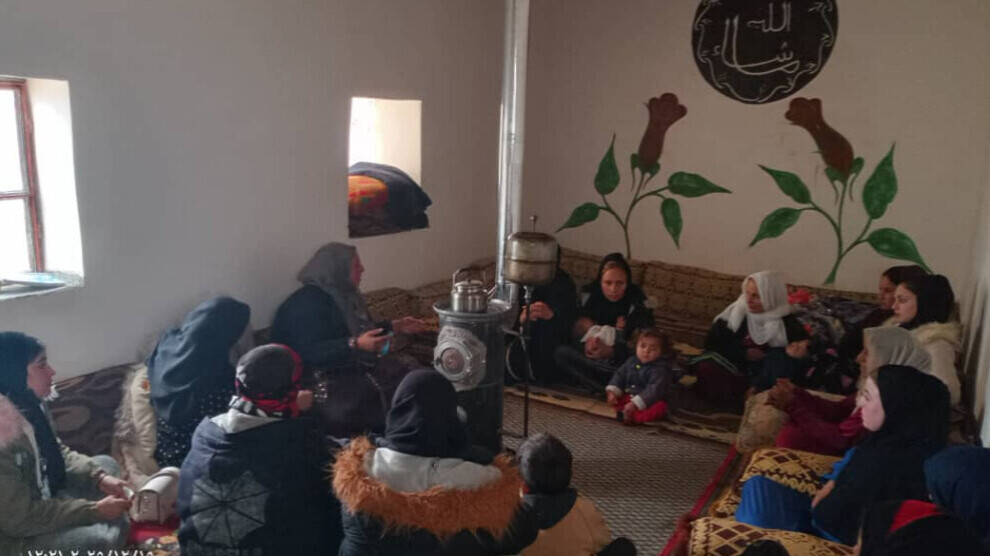
The STAR Conference and the Yazidi Women’s Gathering began establishing women’s communes across the regions of North and East Syria. This initiative aims to strengthen women’s roles and organize them within a community framework that reinforces values of participation and democracy.
Each women’s commune consists of 11 women, three of whom handle administrative tasks, with one serving as the co-chair of the general commune. Specialized committees are formed based on need, including the Economic Committee, Health Committee, Women’s Protection Committee, Cooperatives Committee, Justice Committee, Environment Committee, Golden Crescent Committee, and Finance Committee.
All resources of the women’s communes are dedicated to serving women, with 30% of the general commune’s budget allocated to the women’s association. The STAR Conference and the Yazidi Women’s Gathering continuously monitor the work of these communes, and the communes report monthly on their activities and achievements.
Establishing Women’s Communes Began in Jabal Kizwan
In Tell Tamr, part of the Jazira region, the STAR Conference initiated the establishment of women’s communes, beginning in Jabal Kizwan as the starting point of an organizational path aimed at strengthening women’s roles and expanding their participation in social life.
Jabal Kizwan was chosen because the area still faces challenges related to women’s freedom and the need to instill a correct understanding of democracy, alongside promoting equality between men and women. The region also continues to struggle against violence targeting women, making it a natural starting point for the creation of women’s communes.
To better analyze problems and develop suitable solutions, an independent women’s organization is required in each village and neighborhood, ensuring effective responses to challenges and enabling women to participate in decision-making.
Reviving the Commune System and Redefining Gender Roles
Nihad Shendi, an administrative official at the STAR Conference, stated that the Rojava Revolution revived the commune system. Through the principle of co-chairing by women and men, a radical shift in societal mindset is being achieved:
“The co-chair system represents a new step in redefining the roles of women and men in contemporary society, after their roles were marginalized and excluded.”
Shendi emphasized that the communes have moved beyond traditional dependency and service roles. They are now structured so that each individual is responsible for their role within society. “In this way, the democratic system can evolve to grant everyone the right to expression and participation, enhance individual independence and freedom, and make them active members of a democratic nation.”
She stressed the importance of men and women jointly making decisions and determining solutions to community and family issues within the commune. “Decisions should not be made individually by one co-chair and imposed ineffectively on others,” she noted, emphasizing that women reject mindsets that marginalize or exclude their role.
After establishing general communes, the need for women’s communes became clear. These communes, alongside general ones and without discrimination among women or communities in the region, strengthen the struggle against various forms of dominance, tyranny, and occupation, and address attempts to fragment society.
Women in villages and neighborhoods face greater and more intense challenges, necessitating direct outreach and raising awareness about the importance of democratic family structures and protection. “Hence the need to establish women’s communes as an organized framework to ensure women’s active participation and enhance their role in confronting difficulties.”
Communes as a Fruit of the Women’s Revolution
Shendi confirmed that women’s communes provide women with a broader space to exercise their rights in education, health, economy, environment, and arts. “They enable a deeper understanding of justice principles and laws that guarantee their rights, contributing to legal awareness and strengthening their societal position.”
She added that the establishment of women’s communes represents a significant achievement of the women’s movement over fourteen years of struggle. “Although this step came late due to years of ISIS attacks and Turkish occupation, which continue today, the struggle continues with greater momentum through ongoing building and development efforts.