
The Attack on the Women’s Revolution Reveals the True Face of Damascus
As women's rights in Rojava, won through years of sacrifice, and their freedom symbols are targeted, events in Hasakah clearly express imposing a culture of rape.
ROJBIN DENIZ
NEWS CENTER_The daughter of Rojava built her existence on women’s struggle and their active participation in various fields in the face of the dominant patriarchal mentality that uses violence and the culture of rape to impose its authority and seeks to entrench its existence through extremist organizations such as ISIS, the Nusra Front, and Al-Qaeda.
The most prominent stations of this struggle were manifested in Raqqa, Kobani, and Sinjar, where women confronted ISIS and contributed to its defeat, even in its stronghold in Raqqa. This resistance formed an extension of women's struggle throughout history, and an uprising against the culture of rape consecrated by capitalist modernity, in defense of women's physical, intellectual, and philosophical existence.
The Culture of Rape Is to Be Spread in Syria
In the Middle East, especially in Syria, there is a culture of rape that is to be legitimized through the system of religious thought. In Syria, this culture reproduces itself through Arab nationalism and gender-based discrimination, as one of the contemporary expressions of the dominant patriarchal mentality.
This mentality that has seized power in Syria knows itself through the concept of the strong crushing the weak, and targets women first and foremost. The effects of this approach can be seen in almost most parts of Syria. The kidnapping of Yazidi, Alawite, Kurdish, Druze, and Arab women, and their exposure to torture and sexual violence, as well as the selling of Yazidi women in markets, reveals one of the harshest truths of our era. These acts were committed by parties seeking to establish the culture of rape and turn it into a systematic system. The positions of those in charge of ruling Syria today and the externally intervening forces should also be viewed in this context.
The culture of rape today finds ground to entrench its existence through the political formations followed by the coalition of armed factions affiliated with Hay'at Tahrir al-Sham, of jihadist orientation. The effects of this mentality can also be seen in the efforts to rebuild the nation-state according to an approach based on armed gang formations. Based on the fact that the anti-woman culture based on rape finds its clearest embodiment through these armed formations, looking at events from this perspective will be more accurate.
Attempts are being made to impose a system that imposes its vision and mentality on society, and seeks to subject it to the restrictions of the culture of rape. This system is being built through coercion, violence, brutality, and various forms of repression. The attacks on the areas of Hama, Homs, Damascus, and As-Suwayda, as well as on the Kurdish areas in Syria, are among the most prominent tangible expressions of this approach.
Through armed groups linked to the remnants of ISIS, the Nusra Front, and Al-Qaeda, which today wear the official uniform of the state, the dominant patriarchal mentality is being organized and this approach is being spread in society. The effects of this culture can be seen everywhere that has witnessed attacks.
Severe Anger Toward Kurdish Women
The collective attack carried out by armed groups in Hasakah on a poster embodying the connotation linking a woman's braid to the slogan (Jin, Jiyan, Azadî) cannot be considered a passing event. It is impossible to separate this attack from the culture of rape. When looking at what is happening in Hasakah and various areas of Syria, one cannot ignore that those in charge of ruling the country today draw their strength from the dominant patriarchal culture based on rape. Women are aware of this, and do not remain silent toward these attacks.
The victory achieved by women in the war against ISIS, led by Kurdish women, has become one of the biggest sources of anger for this mentality. This anger was manifested in attacks that included killing female fighters, assaulting their bodies, cutting their braids, throwing their bodies from buildings, and kidnapping women. The matter did not stop there, but various political maneuvers and initiatives were resorted to with the aim of ignoring and excluding women's political will.
The approach taken toward women during the integration process between Damascus and Rojava revealed this truth clearly. A tendency emerged to push women away from decision-making processes and societal life, make them a target of the culture of rape, and continue attacks on their values. As for the limited gains achieved regarding women's representation during the integration process, they came as a result of their continuous struggle and insistence.
However, the hostile position toward women was not limited to this extent. New attacks were carried out in Hasakah targeting women's values; posters bearing images of female martyrs of the women's revolution were removed, and humiliating acts were committed against these symbols.
These scenes have become etched in women's memory, and formed one of the most brutal practices of our era. These scenes should be viewed as an image illustrating how the culture of rape is to be spread in society through a state turning into a structure based on armed gangs.
Brutal Attacks on the Values of Kurds and Women in Hasakah
The events witnessed in the Ghweiran and Nashwa neighborhoods in Hasakah sparked great anger among women and youth. These scenes also constitute a clear example of how the new Syria is intended to be built. These attacks were carried out despite everyone's knowledge of how attached the Kurdish community is to its martyrs and its appreciation for them, which makes them a humiliating stance targeting the Kurdish people.
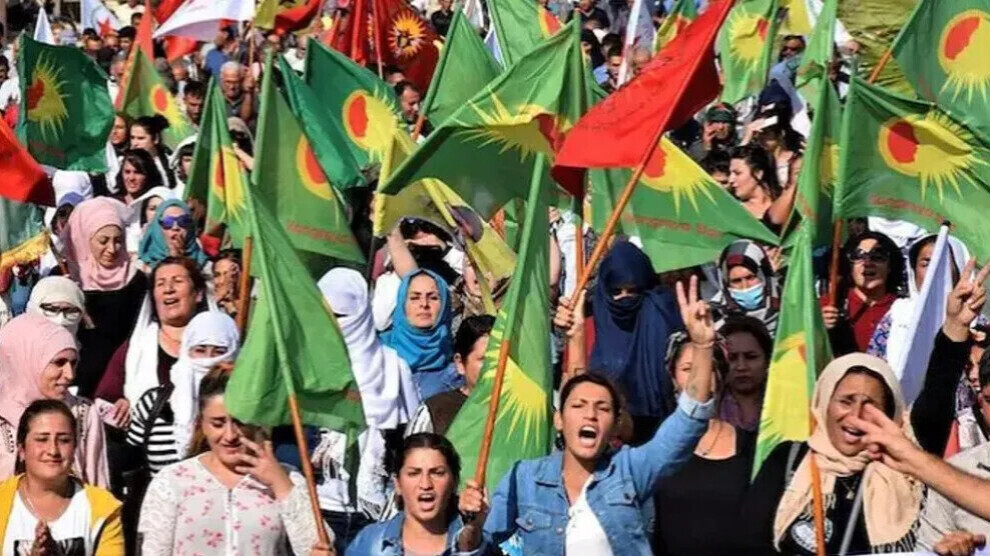
These scenes sparked widespread anger, not only among women, but among Kurdish society in general, and led to widespread reactions. Everything that happened constitutes an assault on the memory of women and Kurdish society, their values, and their will to determine their future.
The party that identifies itself as the interim administration in Syria is one of the direct representatives of this culture; it believes that women who do not adhere to patriarchal standards "deserve" rape, and seeks to entrench this perception. It also works to spread it through Arab nationalism. This is also what stands behind the attacks targeting women and their values in Hasakah.
Entrenching the Culture of Rape in Damascus
The Damascus administration, through this approach, seeks to employ the gains of Kurdish society, the will of women, and the rights they have achieved to serve its interests, or in other words, to exploit them. External powers and Turkey appear to fully support this approach. In light of wars and crises, projects of building new nation-states emerge that feed nationalism, gender discrimination, and political religiosity, and draw their strength from the culture of rape, as projects that characterize this era.
Making the areas where Kurds live a center for generating ISIS was aimed at eliminating societies linked to the culture of the mother woman, using war, occupation, and brutality as tools of the culture of rape. In other words, wars in our era are managed through armed groups that employ the culture of rape, and through mentalities that turn states into entities resembling armed gangs.
The same calculations and mentality stand behind the attacks on Hasakah. If we look closely, we will find that women and the gains and values of the Kurds come at the forefront of the direct targets of these assaults.
Women have gained great experience during their struggle against ISIS. The will and strength that women acquired from the culture of resistance have proven, in a tangible way in our era, the justice of their struggle. This struggle was particularly clearly manifested in Kurdish women. With the revolution, women gained awareness, organized their ranks, and turned into an active force capable of initiative and movement. Thus, they directed one of the biggest blows to the culture of rape.
The struggle of Rojava's women, which maintains its vitality to this day, still possesses a level of organization capable of preventing the culture of rape from imposing itself. The organized anger of women and their resistance will remain one of the most important strongholds of resistance in the face of the new Syria that is intended to be established.
We know that the path to societal freedom and women's freedom cannot be opened without transcending the culture of rape. More importantly, democratic integration or building a democratic Syria cannot be achieved without that. True societal freedom requires recognizing women's will, protecting the gains they have achieved, and overcoming the baskın patriarchal mentality.