
Rojda Yıldız: Women’s organizing is the strongest form of self-defense and confronting violence is a collective responsibility
Rojda Yıldız of Genology magazine said the capitalist system reproduces violence against women in different forms, affirming women's solidarity and organized struggle against violence are the strongest forms of self-defense.
MMEHYAN HALBIN ZIDAN
WAN_Violence against women is taking increasingly cruel and widespread forms and is not limited to physical assault; it extends to the imposition of aesthetic standards and stereotypes that capitalism forces upon women’s bodies, to the point that a woman who does not conform to these standards becomes vulnerable to marginalization and violence, as if she deserves it.
Amid a discourse that normalizes and perpetuates violence as part of man's nature, patriarchal domination is reproduced and socially entrenched, leading to a rise in femicide, trafficking of women and pushing them into prostitution, and the exacerbation of systematic violence and sexual assaults that even reach children.
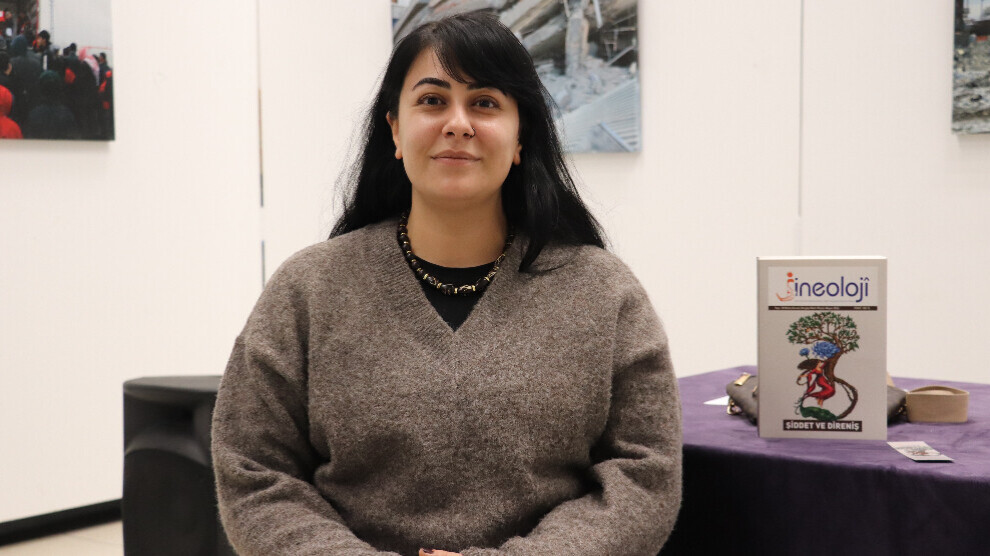
In this context, Rojda Yıldız, a member of the editorial board of Genology magazine, stressed that violence is not an innate trait linked to a particular sex, pointing to the dangerous levels violence against women has reached, in her assessment of the phenomenon ahead of November 25.
"Every system begins by reorganizing the relationship between woman and man"
She affirmed that violence against women is not a new phenomenon, but the product of a deeply rooted historical system extending back thousands of years, to the point that it has permeated social consciousness to the extent that some of its forms have been normalized, such as slapping and beating, and treated as ordinary practices.
She explained that successive systems used violence according to their ideologies to reshape the relationship between woman and man, and to impose specific perceptions about their roles and status in society. This was manifested across the ages, from myths and religions to philosophy and the sciences.
She stressed that every new social system begins by imposing its vision of the relationship between the sexes, defining how woman should be and how man should be, making control over this relationship one of the pillars of reshaping society.
"About 100,000 women are killed annually"
Rojda Yıldız criticized the emptying of the concept of freedom of its content under the capitalist system, which promotes individual freedom while hiding behind this discourse systems of violence and systematic exploitation.
She pointed to the scale of violence women are subjected to globally, explaining that about 100,000 women are killed annually by men, in addition to nearly 40 million women who have been pushed into prostitution, about 80% of whom are between 13 and 23 years old, according to the figures she cited.
She added that the sectors of prostitution, pornography, and drugs have become sources of capital accumulation, amid the expansion of exploitation and trafficking of women, their kidnapping, and their forced into prostitution, considering that these practices reveal the contradiction between the discourse of the safe family and stable society, and the reality full of violence and violations that is being hidden behind this image.
From historical domination to contemporary violence
Rojda Yıldız shed light on the escalating kidnappings of women and children around the world, evoking the Epstein Island case, and considering that what was revealed about it is only part of what is happening behind the scenes of exploitation and violations, explaining that women and children are turned into tools to satisfy the desires of the patriarchal system and the tendencies of the wealthy, and to serve the interests of capitalists.
She affirmed that violence did not disappear with modernity or capitalism, but reproduced itself in more camouflaged and less clear forms. She cited Hammurabi's code and some religious interpretations that enshrined man's right to punish woman, considering that woman's body has historically been subject to a system of control and punishment.
She added that the paradox lies in the fact that modern constitutions and legal systems declare equality between women and men, while crimes and violence directed against women continue on a wide scale.
She wondered how this systematic targeting continues under laws that recognize equality, stressing that the attack is no longer limited to woman's body, but extends to her identity, feelings, ideas, and entire existence.
A capitalism that feeds on the exploitation of women
Rojda Yıldız explained that the 1980s and 1990s witnessed a remarkable rise of women's movements, but the system soon moved, with the beginning of the second millennium, to contain this momentum and attempt to empty it of its struggling content, by integrating women's demands and rights into international agreements, legal frameworks, and funding initiatives.
She pointed out that this containment was accompanied by a decline in the voice of women's movements, in contrast to the expansion of an economic system that turns woman's body and appearance into a commodity and a source of profit, as the sectors of beauty, fashion, prostitution, and pornography have become among the most prominent fields based on the exploitation of women.
She added that this exploitation takes more dangerous forms, through the kidnapping of women, confiscation of their passports, forcing them into prostitution, filming them, and placing them in conditions that prevent their return to their families, amid a network of interests and markets that continue to profit from their bodies and suffering.
Organized struggle is a necessity to confront violence
She asked: "Are women truly free? Do they feel satisfied with their bodies and live in conditions that guarantee them freedom and safety?" pointing out that the world is witnessing a highly critical phase, in which forms of exploitation overlap with the decline in women's representation in political life, even in European countries, over the past decade. She considered that the patriarchal capitalist system seeks to undermine women's gains and marginalize women in various fields, affirming the need to expose violence in all its forms and confront it through an organized collective struggle.
She also stressed that individual positions rejecting violence, despite their importance, remain insufficient in the face of the escalating scale of violations, pointing out that women's acquired rights are being subjected to increasing attacks, and affirming the need for November 25 to be a station for exposing hidden forms of violence, shedding light on them, and opening discussion about ways to confront them and methods of struggle against them.
"Organizing is the strongest form of self-defense"
Rojda Yıldız pointed out that the concept of self-defense, which has been a focus of women's movement discussions for years, does not mean practicing violence or responding with beatings, but is fundamentally based on self-awareness and understanding of woman's identity, existence, rights, and aspirations.
She explained that the concept of "Xwebûn" (self-knowledge) constitutes a fundamental entry point for this awareness, by posing questions about woman's identity, the nature of her intellectual and emotional world, and how she wants to live. She stressed that this awareness should transform into women's organizing and collective solidarity, considering that organizing is the strongest form of self-defense.
She added that individual initiatives and mechanisms for women to protect themselves acquire great importance amid the escalation of violence, but they remain limited unless they transform into an organized collective struggle, given the multiplicity of forms of violence, from psychological to physical and sexual, making confronting it a collective responsibility that cannot be reduced to individual cases.
"Violence is no longer a normal matter for women"
Rojda Yıldız stressed the need for women to possess the ability to defend themselves, given their lack of a sense of safety inside and outside homes, affirming that self-defense is a legitimate right that should not be confiscated.
She also criticized the normalization of violence and the belittling of assaults, to the point that a slap is sometimes no longer considered violence in social consciousness, affirming that violence contradicts human nature, freedom, and existence, and that confronting it requires awareness, organization, and changing the perceptions that the patriarchal system perpetuates.
Violence and resistance
Rojda Yıldız explained that the "Violence and Resistance" file in the November issue of Genology magazine did not confine violence to the concept of masculine violence, but addressed it from broader angles, including violence in nature, the relationship between humans and nature, and its place in the first and second natures of humans.
She affirmed that violence is not an innate trait linked to a particular sex, nor an authentic part of man's nature or personality, but is a behavior reinforced by existing social formations, despite men's greater tendency to practice it in the current reality.
She stressed the need to rebuild social relations on foundations free of violence, pointing out that shouting, anger, the absence of satisfaction and tolerance, and the decline in methods of human communication have become manifestations reflecting the extent of the impact the capitalist system has left on relations between individuals.
"Exiting the existing system is a shared responsibility between the sexes"
She pointed out that ending the normalization of violence within society requires transcending individual initiatives and building institutions and structures capable of bringing about real change, pointing to the role that local administrations, political parties, and independent women's movements can play.
She touched on the ongoing discussions about the concept of "the commons" (shared collective life), especially in northern Kurdistan and other parts of Kurdistan, considering that it can constitute a model for a shared life liberated from violence, including women, men, children, and animals.
She also stressed that men's transformation represents a fundamental issue in confronting violence, calling on men to read the discussions that Genology magazine has raised about masculinity and violence, and to ask about the meaning of a free man and the steps necessary to build a masculinity based on freedom away from domination and violence.
She concluded by affirming that violence is not a problem linked to a particular sex, but is a structural problem linked to the existing system, and therefore liberation from it is a shared responsibility between women and men, requiring changing social relations and building a lifestyle based on freedom and coexistence away from violence.