
Peace in Syria Is a Dream Yet to Be Realized
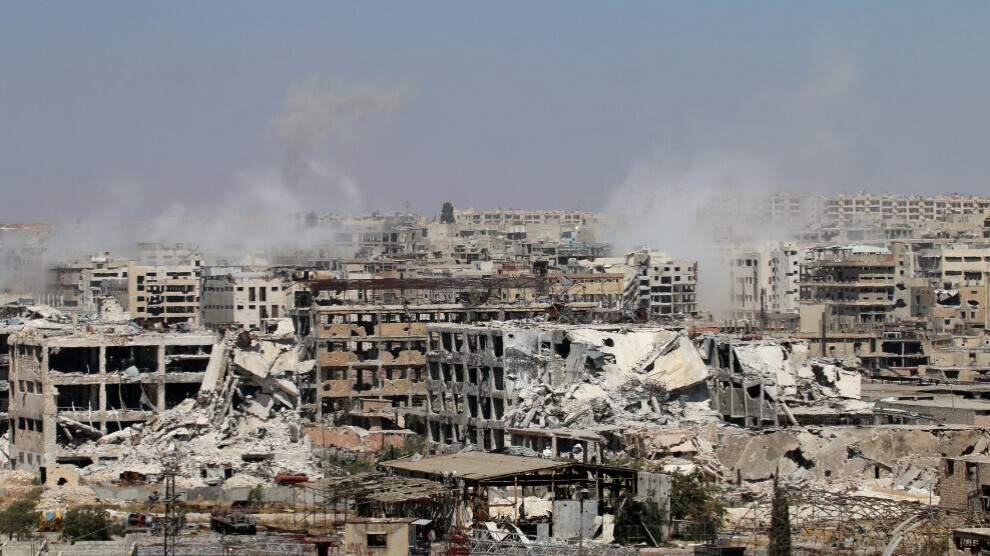
An article by journalist Sirin Mohammad
War is a fire that devours everything. It leaves nothing untouched or undestroyed; neither people nor stones escape it. Peace remains a dream that the Syrian people live with every day, yet it is still far from reach.
The Syrian people had great hopes that the suffering they endured for 14 years—displacement, killing, kidnapping, and economic corruption—had finally come to an end. But their hopes were quickly shattered. After jihadists from Hayat Tahrir al-Sham seized power in Syria, massacres and violations began to affect all segments of Syrian society.
The So-Called Victory Conference
On January 29, 2024, jihadists from Hayat Tahrir al-Sham and allied jihadist factions held a conference they called the “Victory Conference,” a veiled reference through which they portrayed themselves as conquerors and liberators before the Syrian people. The conference, convened by Ahmad al-Sharaa (“al-Jolani”) with leaders of jihadist groups, resulted in him monopolizing all powers and appointing himself leader of the transitional phase—without holding a national dialogue conference or a referendum involving the Syrian people in all their diversity.
The 2012 Syrian Constitution was abolished, and the security and military apparatuses were dissolved, causing a security and military vacuum and spreading chaos across the country. This also led to the exclusion of all qualified individuals and authentic Syrian components from political life.
One of al-Jolani’s first actions was to reward several leaders of jihadist groups who, over the past years, had been known for committing numerous violations against many Syrian communities.
He then hastened to form the first government in Syria after the fall of the former regime, bearing the same jihadist color and mindset. This government attempted to take control and grant itself legitimacy, despite this being contrary to both the constitution and international law. According to international law, when a regime falls, a country should be governed by a transitional authority with limited powers to maintain security and state institutions until national partners convene a national conference. Such a conference should result in a body that drafts a new constitution, elects new members of parliament, and holds a popular referendum to choose a president elected by the people in all their components.
Attack on an Alawite Religious Shrine in Aleppo
Events accelerated after al-Jolani and his group took control of power in Syria. Angry protests erupted in several regions following the circulation of a video showing armed men vandalizing an Alawite religious shrine in Aleppo. Massive demonstrations took place in the Syrian coastal regions and the city of Homs, with thousands of civilians protesting the continued violations against religious sanctities.
These protests were met with live gunfire by jihadists from Hayat Tahrir al-Sham in Homs to disperse demonstrators, resulting in the killing of one protester and the injury of five others.
Between December 8, 2024, and December 5 of the current year, the killing of 11,439 civilians was recorded across various Syrian cities, including 676 women, with differing motives and causes.
The year was also marked by kidnappings, as hundreds of young women and men—particularly in the Syrian coastal areas—were abducted for sectarian and ethnic reasons. Some fled to northern Lebanon to escape the ethnic massacres committed against them.
Syrian Prisons Never Empty of the Oppressed
Under the former regime, Syrians suffered from arbitrary arrests based on malicious reports and false charges extracted under torture in dark prison cells. When the regime fell and tens of thousands of detainees were released—some of whom had spent more than 40 years in prison—the scene was quickly repeated after jihadists from Hayat Tahrir al-Sham took control of the country.
Arbitrary arrests based on identity resumed, prisons were filled once again, and to this day the fate of more than 120,000 detainees remains unknown.
Arbitrary Dismissal of Employees
Throughout the year, thousands of employees were arbitrarily dismissed across various Syrian cities, either through contract termination or forced unpaid leave. These practices affected staff in service sectors, education, electricity, customs, municipalities, and the health sector.
Those dismissed received no justification for these actions, but most of those affected belonged to a specific component, sect, or religious group. In response, dismissed employees organized protests in several Syrian cities, demanding reinstatement and affirming that they had received no legal explanation for their dismissal.
The Suffering of Syrian Women
Women did not escape violence, killing, and kidnapping after the fall of the regime. Since jihadists from Hayat Tahrir al-Sham assumed power in Syria, hundreds of women and children have been killed. The reasons varied between ethnic and sectarian purges and murders resulting from domestic violence. The fate of hundreds of Alawite and Druze women remains unknown.
Stripping Women of Their Role and Right to Self-Determination
The suffering of Syrian women continued between the fallen regime and the regime that seized power. The same patriarchal mentality did not change; rather, it became more extremist and harsher toward women. Women who believed that after the fall of the regime they would be able to express their opinions, assume positions, and determine their own destiny soon saw this dream shattered.
This was due to the arbitrary decisions and practices imposed by jihadists from Hayat Tahrir al-Sham, such as enforcing “Islamic dress” and niqab on female students inside universities and harassing those who did not comply.
Women were denied their right to decision-making and to holding high-level positions that would represent women—who make up nearly half of Syria’s population. Despite calls to grant women a share of leadership roles in unions, ministries, or parliamentary membership, women’s representation has not exceeded 5%. Internationally, the accepted minimum representation of women is 30%. These practices by the interim government clearly indicate the shackling of women’s role, restricting them, and preventing them from exercising their right as decision-makers.
Afrin City and the Ongoing Pain
The suffering of Afrin’s residents began with a brutal attack by thousands of mercenaries affiliated with the Turkish occupation. They terrorized the population, killed thousands, abducted hundreds, and displaced more than 300,000 Kurds to the Shahba region.
Their suffering did not end with the fall of the regime; they were displaced once again from Shahba to the city of Aleppo and areas of the Autonomous Administration of North and East Syria. Conditions in Afrin itself did not change after the regime’s fall. The Afrin Human Rights Organization – Syria documented more than 160 kidnapping cases and 60 killings during 2025, including four women, as well as 2,500 missing persons whose fate remains unknown.
In addition, looting and theft continue, along with increasing assaults on property, theft of olive harvests, and ongoing tree cutting. This confirms that conditions have become worse than before and that violations by mercenaries of the Turkish occupation are increasing.
Al-Ashrafieh and Sheikh Maqsoud Neighborhoods in Aleppo
In the predominantly Kurdish neighborhoods of Al-Ashrafieh and Sheikh Maqsoud in Aleppo, civilians—numbering more than 450,000—continue to suffer from shortages of flour, diesel fuel, food, and medical supplies due to the siege imposed by jihadists from Hayat Tahrir al-Sham since October 6 of this year.
The jihadists blocked all roads leading to the neighborhoods with earth barriers. Residents staged peaceful protests demanding the lifting of the siege and the reopening of roads, but their demands were met with tear gas to disperse them. The jihadists then opened fire on protesters, resulting in more than 60 wounded and two martyrs.
Events escalated further when the attacking jihadists shelled the two neighborhoods with heavy weapons, deliberately targeting civilians