
Leader Öcalan: Democratic Integration Acquires Its Meaning Only Through Local Democracy
In a message to the Conference of Democratic Local Administrations, Leader Öcalan affirmed local democracy as a radical solution to crises and the key to resolving the Kurdish question, rebuilding state and society through the commune and democratic.
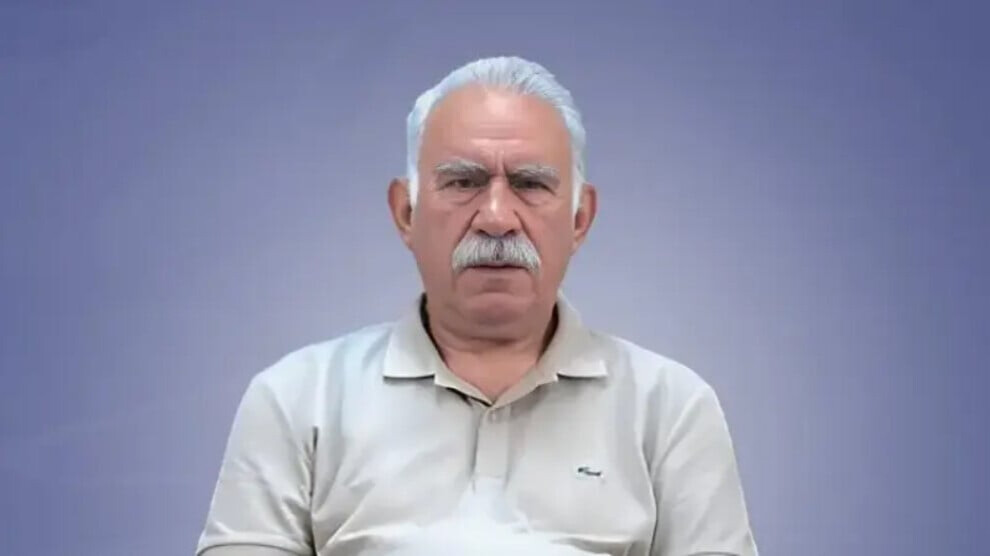
News Centre — Leader Abdullah Öcalan, in his message, called for strengthening local democracy, adopting the commune model, and expanding the participation of the people, women, and youth, affirming that the peaceful solution to the Kurdish question and regional crises begins with democratic local administration.
Leader Abdullah Öcalan addressed a message to the Conference of Democratic Local Administrations of the Equality and Democracy of Peoples Party (DEM Party). The text of the message reads:
"To the delegates and participants of the Conference of Democratic Local Administrations of the Equality and Democracy of Peoples Party,
Throughout history, governance in societies has been based on local governance, that is, on self-administration. Even in the traditions of the state itself, local administrations were the rule, while central authority was the exception, and the prevailing law was local law. However, this heritage has been destroyed by the model of the homogeneous, unitary, and rigidly centralized nation-state imposed by capitalist modernity over the past two centuries. The primary source of most problems and conflicts lies in the imposition and generalization of this model across the world.
With the outbreak of the two world wars, all of humanity, and particularly the European states that produced this mentality, suffered the horrors of fascism and continue to suffer its effects to this day. Since the 1950s, local, national, and cultural rights have been gradually recognized, albeit in a limited manner, and have become part of the fundamental democratic rules. The 'European Charter of Local Self-Government,' adopted by European Union member states, is an extension of this process. The return to local democracy has become a source of salvation for states and a breathing space for societies.
In the Middle East, where Turkey plays a pivotal role, recognition of the right to democratic expression at the local and regional levels would contribute to solving most problems more easily. In particular, removing the restrictions on local democracy could strengthen Turkey's position in the region during its second century. The democratic solution requires the reconstruction of both society and the state. Moreover, the general trend and the requirements of the era are linked to reducing centralization and strengthening local administration. Resisting this trend deepens existing political, economic, and environmental crises. In fact, an entire century has been wasted in this way, and everyone has lost because of it.
For this reason, one should not fall into the illusion of waiting for anti-democratic centralized systems to change on their own. Organized and continuous struggle by cultural and democratic local forces has played a decisive role in accelerating change and transformations. Local democracy and fundamental democratic rules have been achieved as a result of these struggles.
The formula of 'local democracy and democratic constitution' is simultaneously the formula for a peaceful and democratic solution to the Kurdish question. Moreover, the main artery of democratic integration, which we seek to develop within the framework of the Peace and Democratic Society process, is local democracy. Democratic integration only acquires its meaning through local democracy. The absence of local democracy is the primary cause of trustee appointment policies in recent years. In a country where democracy can be so easily denied, no problem can be solved, as the existing facts confirm.
The Kurdish question has reached a stage where a solution can be found at the level of local administration, and not only within the framework of the Kurdish question. Rather, the path to overcoming the problems of local administrations in Turkey in general passes through strong local democracy. Guaranteeing local democracy through law is the realistic and only formula for a solution. What Syria, Iraq, and Iran need is the full and unqualified implementation of local democracy. The solution to all negative conditions lies in democratic politics and local democracy. A democratic society can only be reached through this path.
Local administrations also play a pioneering and decisive role in developing local democracy. The local sphere is the first step toward democracy and toward democratic communes as well. The development of the communal and democratic People's Municipality constitutes evidence of this path. Therefore, alternative social, economic, and environmental models based on the people, not on centralism, power, and monopoly, should be developed. The greatest capital that local administrations possess is the people themselves, and if the efforts of the people are united, no problem will remain unsolvable. Thus, the concept of the democratic municipality must be developed.
The democratic municipality movement, as a broad social network, should build the organization of democratic society everywhere, from communes in villages and urban neighborhoods to cooperatives, from civil society organizations to human rights institutions, from the struggle for women's freedom to advocates for children's and animals' rights, from youth to environmental activists. Priority should be given to the activities and work of women, children and youth, education, language, culture and arts, health, economy, and environment. Areas of production should be expanded, solutions should be provided to the growing problem of unemployment, and new spaces for life should be created under the leadership of women.
The participation of the people in administration and their involvement in all decisions should be adopted. City councils should be established so that citizens can gather, discuss their economic and social issues, and make decisions about them. If the democratic People's Municipality is developed, the people will defend their municipality, and then anti-democratic practices such as the appointment of trustees will not be able to advance easily.
The municipality is not a mini-state, even though the existing system turns it into a small state. It is necessary to free oneself from this view intellectually and practically. The municipality is not a mini-state; it is a commune. In Europe, the basis of the municipality is the commune. Among the Kurds as well, it is based on the concept of the civic assembly (komel or civîk), which has its roots thousands of years old and spread from these lands to Europe.
The state thinks at the macro level, while communes produce solutions at the micro level. Between the two, a relationship of dialogue, negotiation, and competition should exist, not a relationship of conflict. Then, civil society acquires its true functions and transforms into active cultural, social, and economic institutions. Therefore, the spirit of the commune must be revived within municipalities, which possess the necessary ground and potential, and all work should be managed with this spirit. Discussion alone is no longer sufficient; the time for construction and implementation has come.
We replaced the concept of 'class' with the concept of 'commune' in the Manifesto of Peace and Democratic Society, and this has sparked extensive debates. We do not deny classes or the state, but the state is turning into a major complex. Our conception, based on reconciling the state and the commune, offers an alternative to the futile wars that cause major crises and to the exaggeration of class conflict. We continuously seek to develop this conception. The solution lies in transforming the relationship between the commune and the state into one based on democratic struggle and competition. What is sought to be achieved in Syria today is important in this regard, and the same thing should be applied in Iraq. The election of a Turkmen governor in Kirkuk is an example of this; the Turkmens there are not a mini-state; rather, they can form a commune that determines its own content and affairs.
Therefore, municipalities should be managed with the awareness and importance of local democracy, not with a narrow bureaucratic mentality. Solutions to all urban needs — from sanitation to low-cost production, from education to health, from transportation to the environment — can be found through the commune approach. What is needed is to act on the basis that municipalities are communes and to do what that entails.
Success in local administrations and municipalities within the Peace and Democratic Society process will lead to new developments and give greater momentum to the democratic negotiation path. With all the seriousness required to advance this process, I wish success to everyone who contributes to the implementation of the democratic People's Municipality model. I also hope that the Conference of Local Administrations will culminate in success, and I extend to you my greetings and enduring affection."