
Kurdish Handicrafts Between Heritage Preservation and Modern Challenges
Kurdish traditional handicrafts face growing challenges due to social and economic changes and the spread of modern products, threatening some with extinction.
MIHRIBAN SALAM
Halabja_Amid efforts to preserve and develop cultural heritage in line with the times, the importance of supporting artisans and encouraging new generation to learn and continue these crafts emerges, especially in light of the increasing challenges posed by social and economic changes.
Crafts change year by year, which may ultimately lead to the disappearance of Kurdish culture and heritage. However, at the same time, there is a generation that remains interested in preserving traditional handicrafts, affirming that they can protect their culture and craft if they receive government support. Women also place great importance on the quality of their products, so that the craft does not turn into mere commerce but retains its distinctive Kurdish character.
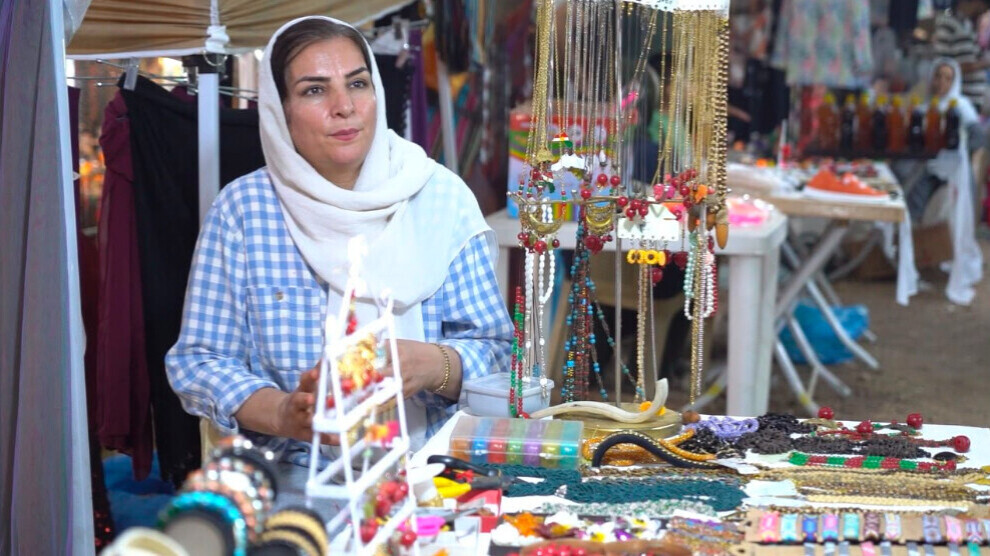
Fatima Ali, a resident of Sulaymaniyah in the Kurdistan Region who works in traditional decoration and ornamentation, said that she strongly wishes for this work to be usable in both modern and Kurdish clothing. However, she prefers it to remain associated with Kurdish attire because it is "part of the culture, and I want it to stay alive"—whether through "Hori," "Jamana," or the "Flag of Kurdistan."
She said: "I am drawn to cultural themes, such as poppies and heritage items. I love using them in Kurdish attire and preserving them. This work provides me with material benefit, and I love it, while at the same time keeping heritage items alive. Some people have asked me to teach them this craft, and I have never withheld my knowledge from them, because I believe that if a person knows something, they should share it. Just as wealth has its charity, knowledge has its charity as well."
Regarding what should be done to ensure the continuation of these crafts, artisan Fatima Ali explained that any work with a national character meant to be preserved is the responsibility of the government and the state. "There should be dedicated places for organizing training courses, and the government should do everything it can to ensure our culture does not disappear."
She noted that "for a long time, I have wanted to organize courses, but that was not suitable for my circumstances, as these courses require time. I have tried through social media pages and phone calls to teach as many people around me as possible. I have also tried to provide training and education through social media pages."
Fatima Ali called on women to pay great attention to the quality of their work, because handicrafts "are somehow connected to the soul; it is work tied to emotions, so the quality must be very high, as if it were the soul of the work."
She emphasizes that "this is not factory work. In factory work, the piece carries no soul, whereas in handmade work, you feel that two people sat down and made the piece with love. Personally, if I do not love something, I cannot make it. Therefore, I call on all women working in handicrafts to prioritize quality and not view it only from a commercial perspective. If handicrafts turn into mere trade, they will gradually lose their beauty, and eventually lose their meaning and disappear."