
Ghada Saba: Cinema as a Platform to Break Taboos and Raise Feminist Awareness
Director Ghada Saba calls for reconsidering Jordan's inheritance laws to protect women, raise awareness of their issues, and sustain cultural platforms that enable this debate.
BARA'A AKRAM
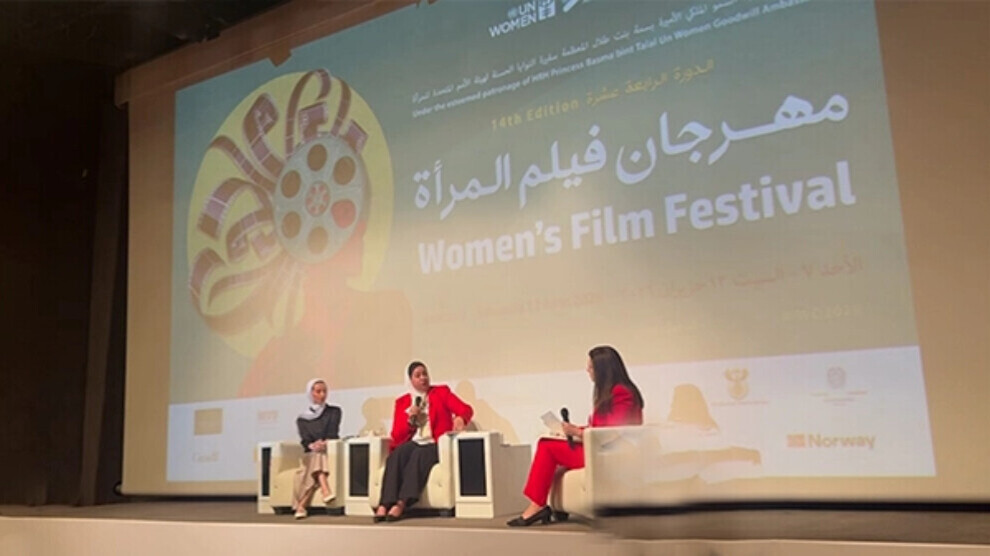
Amman_ The annual Women’s Film Festival seeks to employ cinema as a means of raising awareness and opening discussion around women’s issues. It aims to convey their human experiences to a broader audience and to foster societal dialogue on rights, equality, and protection.
The women’s Film Festival, whose fourteenth edition began in the Jordanian capital Amman on June 7 and continued until June 13, consitiuted an expceptional platform shedding light on women’s issues from complex human, social, and legal perspectives through a selectioin of independent documentary films made and produced by women from various countries around the world.
In this context, our agency conducted an interview with director and activist Ghada Saba, in which she explained the beginnings of this festival, stating: “Over fourteen years of independent screenings, the festival has cultivated a real and conscious audience that continues to grow year after year.”
Stages, Challenges, and Continuity
She pointed out that the festival has gone through difficult stages. The last in-person festival took place before the COVID-19 pandemic. It was then deemed unacceptable for the festival to stop or for its continuity to be interrupted, so it was presented online during the pandemic. She praised the team's spirit: "Many colleagues, both male and female, have worked on the festival in succession, in cooperation with UN Women. The teams and individuals have changed, but there has always been great love and clear concern for women's issues, as well as a commitment to raising awareness about them."
Regarding the uniqueness of the venue, she affirmed: "The Rainbow Theatre in the heart of Amman's Jabal area, with its old houses, cultural spaces, and scent of the past, means we are not just talking about a screening hall, but rather about a place and time that have a profound specificity tied to the city's cultural memory."
Deconstructing Legal Taboos
This year's edition was distinguished by wide geographical diversity, featuring screenings from Mexico, Switzerland, Japan, Korea, Canada, Ireland, Italy, Austria, South Africa, Australia, Jordan, Morocco, and Tunisia. Among the most notable this year, the events concluded with Jordanian and Palestinian films, including the Palestinian film "Thank You for Banking," which addresses the issue of inheritance and the legal and social complexities facing women in the region.
In this context, director Ghada Saba opened a thorny file that she has long advocated for in her previous films: the issue of inheritance for Jordanian Christian women. She explained the problematic dimensions of the subject: "There are many obstacles, pressures, and challenges associated with this issue. Some come from customs and traditions, and others from laws that need to be reconsidered in some of their articles to align with current circumstances. We are not discussing the matter from the standpoint of objecting to the rulings of Islamic law or what Islamic jurisprudence has stipulated. However, relatives often manipulate the situation to seize the money and inheritance of some women simply because they are women. This makes the issue very complex."
Ghada Saba continued, explaining the evaluative flaw in the discourse: "The issue of inheritance cannot be viewed only from the perspective of shares as stated in religious texts, while ignoring other aspects. The law also applies to Jordanian Christian women regarding inheritance, even though other laws within the church follow ecclesiastical law in matters such as marriage, divorce, and custody. When this dialogue is opened between those for and against changing the inheritance law for Jordanian Christian women, the immediate response is that we are a country whose religion is Islam and we must follow Islamic law. This is understandable, but if we want to follow Islamic law, it must be applied in all its stipulations, not only regarding the inheritance of Christian women, while marriage, divorce, custody, and maintenance remain subject to ecclesiastical laws."
She noted that the issue has many extensions; other films at the festival discussed women who felt compelled to wish for male children for fear of losing their inheritance rights.
From Women's Struggle in Agriculture and Sports to the "Illusion of Freedom" and the Digital Space
The festival's screenings were not limited to one angle. Important short films were shown that shed light on women's struggles in sports, women farmers, and women striving for a better life. Some films also deconstructed the stereotypical idea held by some girls that "marriage is the only solution to escape the authority of the father's house toward freedom," only to be later shocked by the burden of greater responsibilities and the shrinking of their spaces for freedom.
In conclusion, the festival hosted a rich panel discussion bringing together filmmakers and digital content creators around the concept of "Who creates the scene?" Ghada Saba expressed her happiness with this integration, saying: "We see the scene today being created on the big screen, but there is another parallel and influential scene being created through social media networks in shaping public awareness." The session featured a distinguished participation from prominent Jordanian content creator Alia Al-Hamouri as one of the notable digital voices presenting these vital issues.