
From Fear to Expertise: Kurdish Woman Breaks Stereotypes in Computer Engineering
In Rojava, academic computer education remains largely theoretical. However, Suzvin Ibrahim overcame her fears and became a pioneer in technology through perseverance and online learning.
SORKEL SHEIKHO
Qamishlo_Computer engineering in Rojava faces significant challenges alongside new opportunities. Academic education in this field at Rojava University offers engineering and technical specializations, despite weak public infrastructure, frequent internet outages, and the absence of advanced practical laboratories.
Qurtuba Private University
Computer engineering and information technology are taught at Qurtuba Private University using a credit-hour system. The faculty aims to train students in skills such as systems programming, artificial intelligence, and network management, advancing them to an advanced level through graduation projects based on algorithms and modern technologies.
However, graduates from this university do not take practical steps in their post-university lives, and their four years of study remain confined to the theoretical side. Despite the region's difficulties and challenges in these fields, female students are striving to find a place in computer engineering and attempting to begin their professional lives.
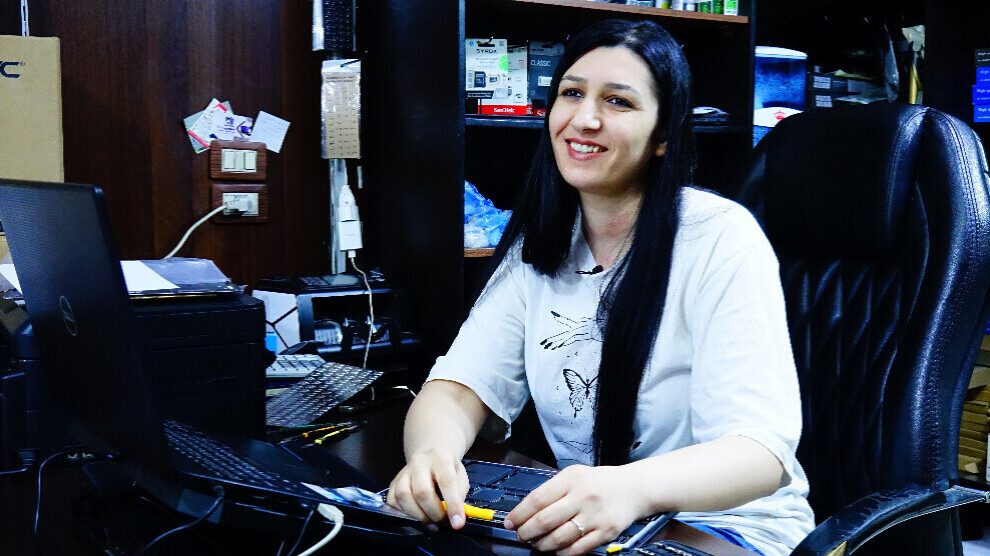
Suzvin Ibrahim is a 32-year-old Kurdish woman from the city of Qamishlo in Rojava. She currently works as a specialist at "Nay" Company in the sale and trade of computers, laptops, and accessories, and additionally manages the accounting department. Regarding her initial experience, she says she entered the world of computers and applied the knowledge she gained to her work.
She explained that when a student graduates from university, they must realize they have just begun their journey in the field of knowledge, keeping pace with the times and advancing accordingly. She added: "It was not acceptable to me to sit at home after years of study and effort. I decided to work in any good job that came my way. At first, I worked in the company's accounting department, but I discovered that I found myself more in laptop maintenance and repair. The place and opportunities were suitable for me to take my first step. For me, this place is a source of learning. There are humanitarian organizations with higher income, but they are temporary. This work is long-term for me; I can build my future on it and one day open my own project."
"When I Opened the Computer, My Fingers Trembled"
Suzvin Ibrahim spoke about her initial fears: "When a computer arrived, we were told we had to change its memory. I felt very afraid and said: How will I open the computer? I had never opened one before. When I opened it, my fingers trembled. Now, no matter what type of computer it is, I can repair it. This is also the first time I am working on Apple computers. Whether I succeed in repairing it or not, I will try and return it to its owner. It's an experience; I may succeed or fail, but what matters to me is that I tried."
She noted that "the reason a person often stays in place is fear. Fear becomes an obstacle to a person's development. When you overcome your fear, everything becomes easier. After that, a person looks at themselves and sees how many good steps they have taken and how they are moving forward. Even if they experience failure, merely going through the experience itself is worthy of respect."
Searching via GPT, YouTube, and Google
Suzvin Ibrahim explained that she downloads and installs new operating systems on computers, adding: "I also prepare computers and restore them to factory settings, or reinstall Windows. Through searching via GPT, YouTube, and Google, I can also troubleshoot software issues on the computer. Every time a new problem or malfunction appears on a computer, it becomes a new experience for me. Over the years, I keep learning new things."
She noted that "there are many types of screwdrivers used to open and tighten computer screws. Computers require special screwdrivers because their parts and screws are precise and magnetic, often of the Phillips type (PH0 or PH1) or Torx (star-shaped)."
Society's Gendered Perspective
Suzvin Ibrahim highlighted society's view, especially men's, toward her work: "Two young men passed by here and joked: 'We were wondering why we don't have any work left.' As if all young men come to women to repair their laptops. If there is a woman, why would they go to men? But there are many people who appreciate the work I do, encourage me with their words, and give me strength. I do not do this work because I want to be the first woman to do it, nor do I want to separate women's work from men's work. What distinguishes me is that I want to learn everything."
She added: "As long as we demand equality, we must learn all the work that men do, and not wait for anyone. I never thought about what society would say about me, or about the idea that I am a woman doing work considered men's work. What matters to me is not to make myself dependent on anyone or wait for anyone."
She mentioned that the progress of the region's youth reflects the progress and prosperity of the country they live in. "The government should care about society's interests and the intelligence of its youth, provide them with opportunities, and allow the development of technology, so that students and young people like us can advance with it as well."