
Art Exhibition in As_SweidaRevives Generations' Childhood Memory
Between past and present, an art exhibition at the "Al-Lujain" Center opens a window into children's memories and emotions, showcasing works spanning over two decades and documenting generations of expression.
ROSHELLE JUNIOR
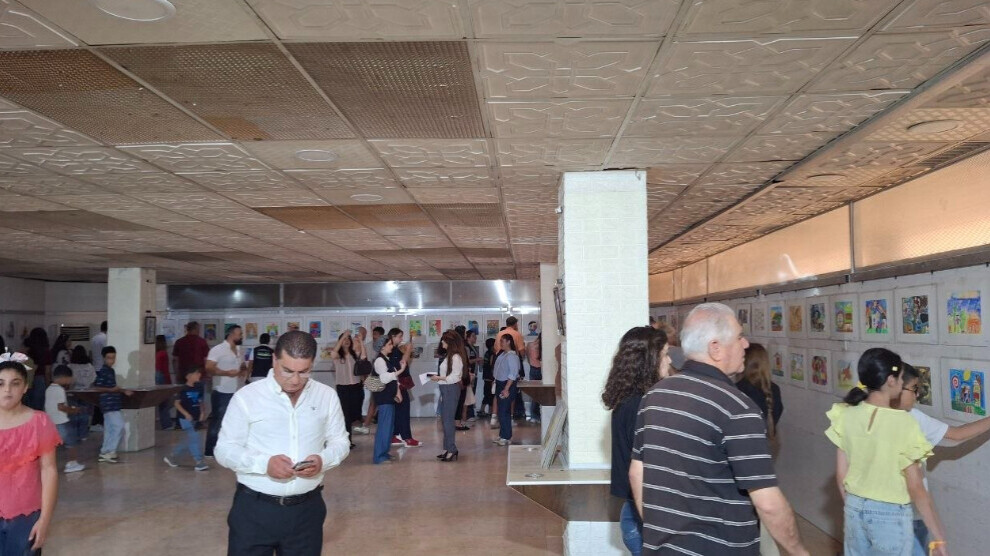
As_Sweida— The "Al-Lujain" Center for Fine Arts held an art exhibition yesterday, Thursday, August 20, titled "Between Past and Present" at the Directorate of Culture in the Syrian city of Suwayda, showcasing a collection of children's works created at the center from 2004 to the present day—an experience that brings together the memory of past generations and the talents of the current generation.
The exhibition comes within the framework of the "Al-Lujain" Center's journey, which was founded in 1995 by visual artist Adel Abu al-Fadl. His daughter, artist Maysaa Abu al-Fadl, has continued this path, carrying an artistic legacy that includes thousands of works documenting the experiences of children and students over the years.
Inherited an Artistic Memory of Approximately 8,000 Works
Maysaa Abu al-Fadl affirms that the center's transition to her represented a great responsibility, as it carries an artistic legacy spanning decades. She explains that the center preserves approximately eight thousand works of art, including works by children, students of the Faculty of Fine Arts, and others.
She says these works represent a "true treasure" that cannot be ignored or dispensed with, noting that the exhibition documents children's works since 2004, allowing for a follow-up of the development of their drawings, the changes they have undergone, and the impact left by the internet, social media, and the surrounding culture.
The exhibited works varied between drawing, sculpture, clay, ceramics, and other materials, with paintings carrying aesthetic and expressive qualities reflecting children's emotions, concerns, and ways of seeing the world.
Among the participating works are paintings by the child Rama Al-Masfi, who drew an incident about a month before her death—an experience that Maysaa Abu al-Fadl believes demonstrates children's ability to feel, capture details, and express delicate emotions through art.
The works also include paintings by former students who have become engineers or left the country, making these drawings part of the center's memory and a witness to their creators' journey from childhood to later stages of their lives.
Maysaa Abu al-Fadl's relationship with the center dates back to her childhood, when her father, artist Adel Abu al-Fadl, encouraged her to draw. She later joined the Faculty of Fine Arts and graduated in 2007 from the Department of Engraving. She then studied children's drawing analysis for three years, specializing in this field and continuing to work with children to this day.
From "Loss and Darkness" to Calm
One of the exhibition's participants, Manar Abu Mughdab, recounted the experience of her two daughters, Elin and Ela, with the center. She noted that Elin began drawing at home from the age of two and a half, drawing beautifully. However, after her father's death when she was five, her drawings changed significantly.
She says the colorful drawings, rainbows, and beautiful scenes turned into figures with black eyes, running, blood, horror, and black clouds, which prompted her to turn to the "Al-Lujain" Center for help.
She explains that the center worked with her daughter step by step through drawing, gradually guiding her to transform negative scenes into calmer, more positive images—"Instead of night, let's draw day." She also affirms that the center encouraged her to draw as well, after she had felt "lost," and helped her regain balance and organize her life.
Manar Abu Mughdab describes her experience as a transition from "loss and darkness" to stability, affirming that art helped her and her daughters find calm and express emotions in a better way.
The Exhibition as Continuity Between Generations
Rafika Al-Halabi, one of the exhibition visitors, believes that the exhibition's title "Between Past and Present" reflects her personal experience—her children were students at the institute, while her granddaughter is now participating in the exhibition, embodying the continuity of generations.
She affirms that talent exists in children but requires proper guidance from parents and supervisors, considering that the institute enjoys the trust of families and contributes to refining and developing these talents.
She notes that holding the exhibition despite the country's circumstances reflects the existence of a segment striving to support art and build a more active society. She called on those working with children to be responsible and aware, helping to build a generation that loves itself and is capable of giving back to its community.