
Ancient Hatra… between Religious Pluralism, Political Stability, and Women’s Representation
From military protection to polytheistic temples, the ancient city of Hatra demonstrates that women in all aspects of life and beliefs in Mesopotamia were not merely sacred symbols but constituted life and society itself. That is, they were society itself
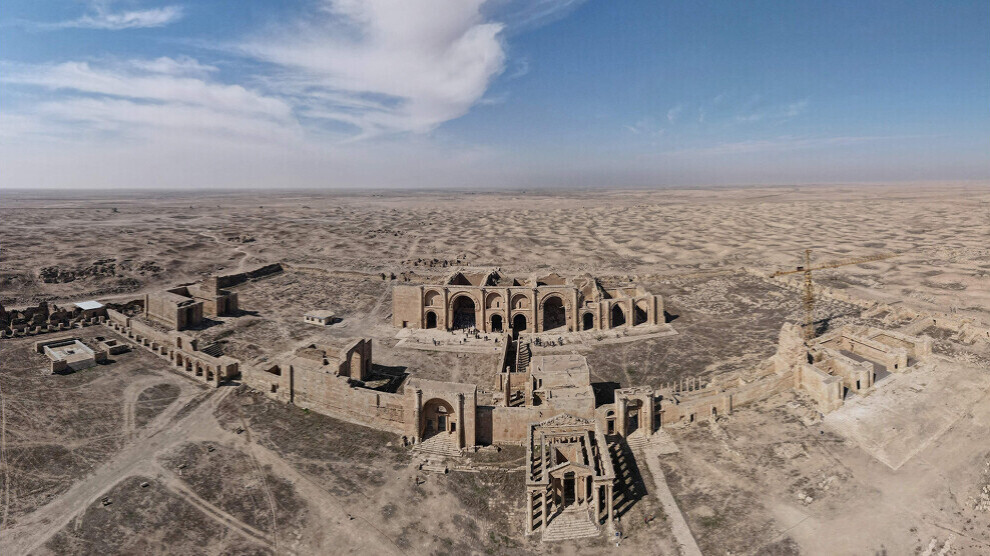
News Center_ “Hatra” is an important archaeological city in the Mesopotamia region, located within Nineveh Governorate. It lies between the Euphrates and Tigris rivers, on trade routes. The city flourished especially during the Parthian Empire. Hatra, which today attracts attention with its ruins, was inscribed on the UNESCO World Heritage List in 1985.
Although the exact date of Hatra's foundation is unknown, settlement is estimated to date back to the third century BCE. The city experienced its flourishing in the first and second centuries CE. During this period, it became both a commercial and religious center.
The Historical and Cultural Framework
Hatra was strategically located between the Parthian and Roman empires and thus played the role of a "buffer state." Thanks to its strong defensive systems, the city withstood Roman attacks and maintained its independence for a long period.
However, in 241 CE, the city fell to the Sassanian Empire and was largely destroyed, after which it was abandoned.
The temples discovered in Hatra reveal the existence of polytheistic beliefs. The presence and symbolic meaning of female goddesses stand out within this system.
Women's Representation in the Temples
In Mesopotamian beliefs, the image of woman is often associated with fertility,
abundance, protection, and the continuity of life. Traces of this conception are also evident in Hatra. Female goddesses did not only represent nature but were also considered part of the spiritual and cultural balance of society. This indicates that in ancient societies, women's role was not merely biological but also sacred. Woman is a powerful entity that creates, changes, teaches, and learns—present in all aspects of life. That is, she is society and life itself. This is what is reflected in Hatra.
City of the Sun
Hatra is also known as the "City of the Sun" because the god Shamash was considered the most important deity in the city. This name is directly linked to the city's religious and architectural structure and cultural identity.
In Hatra, Shamash was among the most revered gods. In Mesopotamian beliefs, he is seen as a symbol of justice, truth, and light. Therefore, he was highly esteemed, and one of the most important temples in the city was dedicated to him.
The temple complex in Hatra was designed in a way that enhanced the entry of sunlight. Wide courtyards and open spaces allowed light to penetrate directly inside, making light a sacred element in religious rituals.
The ancient city of Hatra, approximately 2,000 years old in Nineveh, was inscribed on the UNESCO World Heritage List. However, in March 2015, it was destroyed by ISIS using heavy machinery and bulldozers. After Mosul was liberated from ISIS, this archaeological site was also liberated.