
Between thought and the field… how Yasra Elias shaped her experience in the women's revolution?
Yasra Elias affirmed that the sensitive stage the Middle East is going through makes it necessary to take serious and legal steps to guarantee the right to hope for leader Abdullah Öcalan.
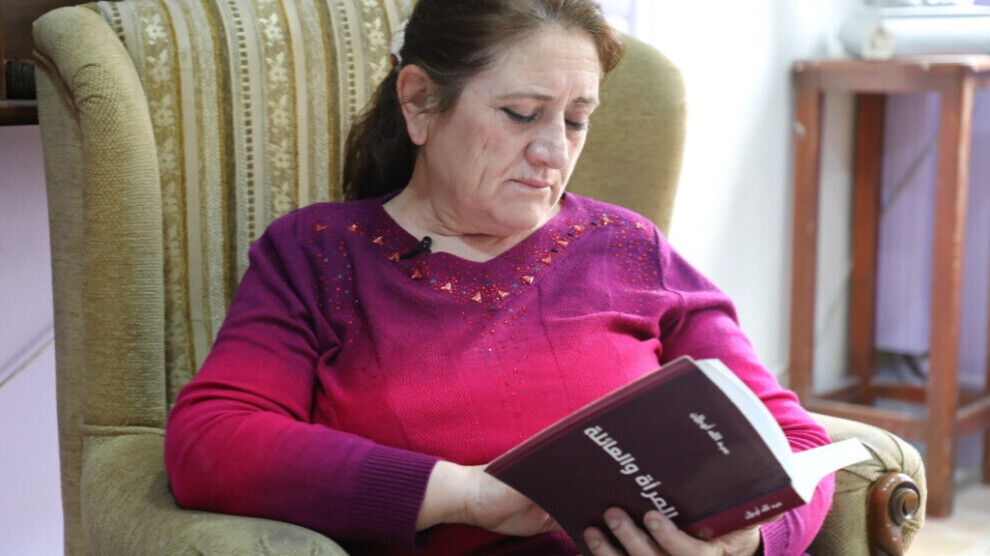
Ronida Haji
Al‑Hasakah – In the late 1980s, the region was living through one of its harshest phases. Security repression, arrests, and attempts to choke any dissenting voice. But amid this darkness, a completely different spark was forming: the women's movement that began to take its first shape inside homes, in secret, before later turning into a social and political force that cannot be ignored.
Women were resisting in silence. Under the pressure of the Ba'ath regime's apparatus and its persecutions, they worked in secret groups inside homes, organizing in the shadows, weaving the threads of awareness and resistance away from the eyes of authority. From the early 1990s until 1995, these groups began moving collectively to Lebanon, where they would meet leader Abdullah Öcalan, a step that constituted a decisive turning point in the path of Kurdish women's struggle.
Yasra Elias, today fifty years old and residing in Al‑Hasakah city, was born in Tel Tamer and raised in Qamishli, Rojava. She got to know the Freedom Movement (Apoci) in 1989, and since then she engaged in clandestine work to provide support. After years, she made her fateful decision to go to Lebanon, where she met leader Abdullah Öcalan, beginning a new phase of her political and intellectual commitment.
Yasra Elias says that she realized at that time that the party's work was conducted secretly with her comrades. "I grew up in a conservative family. My father was very religious, so I worked secretly with my comrades to support the party. We used to read magazines and discuss their content. We visited families, and carried seeds and cotton in the fields."
When Yasra Elias began to learn about the Kurdistan Workers' Party (PKK), talk about Kurds and Kurdistan filled her surroundings. That pushed her to ask her father, "What is Kurdistan?" His answer was shockingly profound: "The cause of Kurdistan is heavy, and to build it, sacrifices must be made until blood reaches the knee."
This answer was her first direct encounter with the weight of the cause, and the beginning of a new awareness forming inside her. She says she quickly realized that the party's work was conducted in complete secrecy among her comrades. She grew up in a conservative family, and her father was very religious, which made her political activity carried out in secret. She used to meet with her comrades to read magazines and discuss the ideas they contained, visiting families, and working in the fields carrying seeds and cotton.
She describes that phase as a mixture of danger and beauty – danger surrounding them from all sides, and beauty emanating from the shared spirit and the single goal that united them. With this spirit, she says, the party's branches spread everywhere. "Our work was full of risks and difficulties, but it was very beautiful. We had a spirit and a goal, and that is what connected us. With this spirit, our party's branches spread everywhere."
"We drew strength from the words of leader Öcalan"
Yasra Elias recounts that meeting leader Abdullah Öcalan was a real turning point in her life. In 1995, she went with a group of comrades to Lebanon. Her joy at seeing him was great, but the large number of attendees made it difficult to approach him.
Nevertheless, his words remained engraved in her memory: "We have a cause, and we must reach its goal. We must work and struggle for it. If we do not work for it, no one will pave the way for us. The enemies of our movement are many. History has witnessed many uprisings, but they collapsed. We founded our revolution in the mountains."
She says these words gave her indescribable strength – strength that accompanied her throughout her journey and renewed her determination whenever conditions became harsh.
Yasra Elias believes that leader Öcalan's writings are not just books, but a source of knowledge and a reference for understanding history and truth. "I have read many of leader Öcalan's books and writings, and through them my understanding of women's freedom and communal life deepened. We must always have a goal, and through reading Öcalan's works we can reach it, for he is a source of knowledge, history, and truth."
"The women's revolution is the fruit of the leadership and sacrifices of the years 1989"
Yasra Elias stresses that women comrades played a pivotal role in developing leader Öcalan's thought and philosophy. She recounts that in 2009, the Ba'ath regime arrested her on charges of "working to divide Syria and participating in political activities."
She recalls that period saying: "I spent three months in Guwairan prison in Al‑Hasakah, which today is under the administration of the Syrian Democratic Forces. After my release, I continued my work without hesitation. Women, thanks to their leadership, broke the boundaries imposed on them by society. Our revolution in Rojava is the fruit of years of effort. Thanks to this revolution, women's organizations expanded, and society reorganized itself around leader Öcalan's ideology."
She affirms the importance of adhering to the "Peace and Democratic Society Manifesto," considering it the intellectual foundation for protecting the revolution's gains. "I have worked in this revolution in many fields: political, social, organizational, and cultural. We have seen much effort and many difficulties to reach this stage. To protect what we have achieved, we must adhere to the Peace and Democratic Society Manifesto."
"Policies of genocide and starvation are renewed with new tools"
After speaking about the role of knowledge and leader Öcalan's thought in shaping women's awareness and organization, Yasra Elias moves to reading the current reality, affirming that the policies that have targeted peoples throughout history are still practiced today in different forms.
She says that the policies of genocide and starvation that the region has known for decades have not stopped; they are renewed with new tools. She recalls the events of 2004, when the Ba'ath regime, as she describes it, tried to create a rift between Kurds and Arabs, and she sees that the effects of that sedition are still present today.
She continues: "The policy of genocide and starvation against peoples continues. We share a common history and live together, and our memory is also shared. This policy is not only against the Kurdish people but against all peoples. Today, the interim government practices a policy of starvation against the people of Raqqa and Deir ez‑Zor, and this is one of the most dangerous policies."
Yasra Elias believes that the entire Middle East is living under the weight of wars and destructive projects, and that the major and authoritarian powers realize the importance of the region as the center of civilizations, and therefore, she says, they seek to create destruction and massacres to serve their interests. She points out that leader Öcalan's philosophy constitutes an intellectual protection for peoples against policies of genocide, starvation, and uprooting.
"Serious and legal steps must be taken to guarantee the right to hope"
In conclusion, Yasra Elias called for taking serious steps to guarantee "the right to hope" for leader Öcalan. "The Middle East is like a garden full of colors, and removing one color from it cannot be accepted, because that would rob the garden of its beauty. Therefore, a single‑color system cannot be accepted in the Middle East; it is dangerous." She affirmed that the stage the Middle East is going through today requires, in her view, an effective presence of leader Öcalan's thought, stressing the need to take legal and serious steps to guarantee this right.