
On the legacy of May Day… the struggle of workers continues
"Amid wars, poverty, and increasing rights violations, the working class’ struggle draws strength from historical roots, and May Day remains a symbol of workers' resistance, achievements, and pursuit of justice."
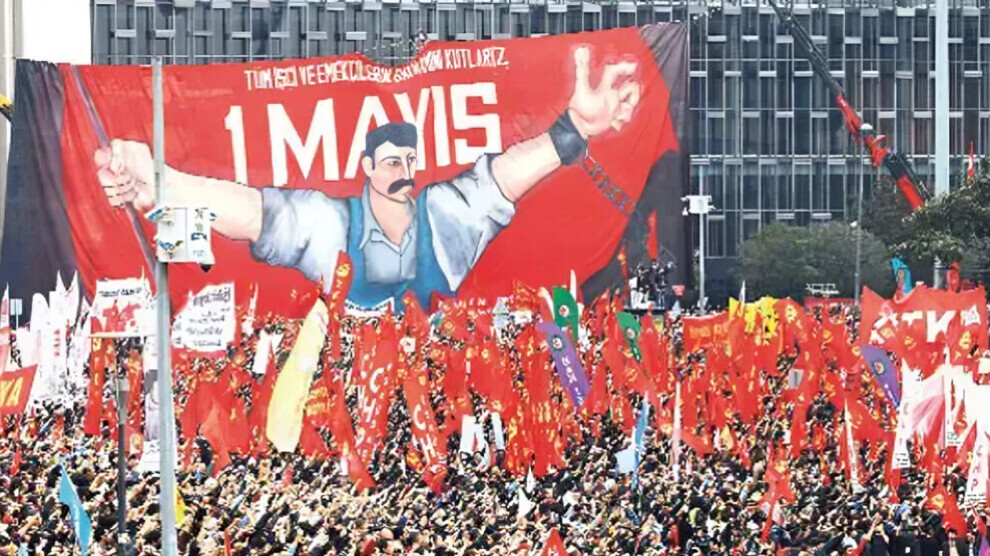
Sarya Deniz
News Center_ While wars continue today in many parts of the world, millions of people struggle to survive under the threat of hunger, poverty, and displacement. Worsening economic crises globally, income inequality, and unstable working conditions make life more difficult day by day for those who live by their labor.
On one hand, there are cities destroyed by war and lives scattered. On the other hand, there is the invisible struggle of millions of people who don’t receive fair compensation for their work. All of this reveals different aspects of the same system.
This image reminds us of a truth that hasn’t changed throughout history: while workers, who keep life going, try to continue under the most difficult conditions, their demands for rights are often suppressed, ignored, or met with violence. Yet, despite all this repression, workers’s resistance and struggle remain among the strongest social dynamics- not only in the past but also in the present.
For this reason,May Day, as one of the most symbolic days in the history of these struggled, isn’t just a memory, but also a collective voice rising against war, poverty, and exploitation.
2,525 workers lost their lives
In Turkey, the government continues its policies that push people to accept the lesser evil, while imposing working conditions based on job insecurity, unregistered work, and conditions close to slavery. While the slogan “enough is enough” echoes in the squares, people don’t abandon their struggle for their rights despite being like “slaved of this era.”
Reports from the occupational health and Safety Council clearly reveal what is happening in Turkey. In 2025, 2,105 workers lost their lives in work accidents – among them 138 women and 94 children. In the first three months of 2026, 420 workers died, including 25 women.
Child labor
Recently, child labor has become one of the most debated issues in the country. Children as young as five years old have been documented working in industrial zones. Data was compiled covering the period between 2013 and 2026. According to the report, at least 852 children lost their lives during these years.
The highest rate of child worker deaths was recorded in the city of Urfa. Of the children who lost their lives, 122 were female and 730 male. Fifty‑two percent of children were working in agriculture, 13% in construction and roads, 8% in accommodation, 7% in metal industry, and 3% in food.
The report also indicated that, by age group, 291 of the child victims were between 5 and 14 years old.
Attempts to suppress rights demands
While official data and field reports reveal deepening poverty in Turkey, they also reveal a harsher reality in working life: rights violations, non‑payment of wages, and dismissals.
Amid the marginalization of women's work and lack of recognition, the country is experiencing deep injustice and economic crisis, with women being more affected by poverty than others.
Workers affirm that "the solution lies in defending basic demands." Today, workers across Turkey take to the squares to demand their rights. While these legitimate voices are being suppressed through police interventions, workers' representatives are being arrested one by one, detained, and even sentenced. Even workers' right to demand their rights has become a subject of prosecution.
Origins of May Day
In this context, there is a need to recall the origins of May Day and perhaps refocus on what history tells us today. May Day arose primarily as part of the struggle for a shorter workday – a demand that was vitally important to workers.
In the 19th century, workers worked up to 18 hours a day for wages barely enough to survive. They lacked any social rights, often lived in huts built near factories, and their average life expectancy did not exceed 40 years.
On April 21, 1856, Australian construction workers in Victoria went on a collective strike as part of the movement for an eight‑hour workday. Later, this action inspired workers in the United States to carry out their first strikes. Thousands of workers went on strike, followed by events known as the "Haymarket Affair," which led to the choice of May 1 as International Workers' Day.
Early beginnings of uprisings
On May 1, 1886, a workers' gathering was organized in Haymarket Square in Chicago. Another reason for this gathering was the victory achieved by the union in Chicago three weeks earlier. Workers at an agricultural tool factory protested working conditions and announced their intention to strike, whereupon they were collectively dismissed. It was expected that immigrants waiting in front of the factory would apply for 800 to 1,000 vacant positions.
Thanks to a campaign led by a workers' newspaper, only 300 new workers applied to the factory, which was considered an important gain. Subsequently, Chicago witnessed a strike that lasted several days.
A bomb thrown at workers
By May 3, police attempted to disperse the workers, resulting in several deaths. But workers did not leave the streets; instead, they headed to Haymarket Square to continue their protest. On May 4, workers gathered in the square were attacked with a bomb, killing 12 people, including two police officers.
Following that, police opened fire on the crowd, killing at least four civilians and seven police officers, and wounding 115 civilians and 60 police officers. In the aftermath, hundreds of labor leaders were arrested, and four were executed after an unfair trial. On May 5, strikers were fired upon again, killing seven people, including a child. May 1 became one of the most important dates for the international labor movement.
The Second International and declaration of the occasion
At the proposal of the French workers' representative in the Second International, May 1 was declared a day for the unity, solidarity, and struggle of the working class. On May 1, 1890, workers in the United States and many European countries responded to this call. Demonstrations were also organized in Chile and Peru. At the Second International's second congress in 1891, May 1 was officially adopted as an annual event.
May Day in the Ottoman Empire and Turkey
During the Ottoman period, Armenians began celebrating May Day as early as the 1860s. It became more popular after 1886. With increasing participation, the celebration spread to areas such as Botania, Cilicia, and Western Armenia, becoming a widespread social phenomenon.
Workers adopted this day and organized celebrations. In 1923, tobacco workers, military factory and railway workers, bakers, tram, telephone, tunnel, and gas workers in Istanbul celebrated May Day in the streets.
In 1976, the labor movement and youth movement struggled together. Fifty years after 1923, Workers' Day was celebrated in Taksim Square in Istanbul with a large mass gathering. The May Day 1976 celebration, organized by the Confederation of Revolutionary Trade Unions (DİSK), marked the beginning of widespread mass celebrations of this occasion in Turkey.
Black spot... Bloody May Day
May Day 1977 has never been erased from Turkey's memory. Approximately 500,000 workers participated in the May Day festival organized by DİSK in Taksim Square. As DİSK leader Kemal Türkler was nearing the end of his speech, gunfire began to be heard while crowds were still flowing into the square.
Gunfire was directed at the crowds. Police armored vehicles advanced toward the crowd. People trying to flee down Kazancı Hill were also shot at. People continued to flee despite being run over by armored vehicles or falling on top of one another.
The events resulted in 28 deaths from being run over or suffocation, 5 from gunfire, and one under an armored vehicle. About 130 others were injured. On that day, which would go down in history as "Bloody May Day," 9 women were killed on Kazancı Hill. Those responsible for the massacre were never held accountable. Since that date, May Day celebrations have been banned.
Banned May Day
The ban decisions were not complied with. In 1979, despite a curfew, Behice Boran, chairperson of the Turkish Workers' Party, took to the streets in Istanbul and was arrested with about 1,000 others. On May 6, Behice Boran and 330 party members were detained.
In 1980, DİSK organized a gathering in Mersin with 50,000 participants. DİSK vice president Rıza Güven was arrested during the festival. With the September 12 military coup, a new ban was imposed on May Day.
They did not give up taking to the streets
The working class did not give up their day. In 1989, those trying to reach Taksim Square faced a police attack, and a 17-year-old young worker named Mehmet Akif Dalcı was killed by gunfire.
In 1990, the general assembly of the "Türk-İş" confederation decided to celebrate May Day, and the "Hak-İş" confederation also celebrated the occasion for the first time in its history. With tight security measures, clashes broke out between police and groups trying to demonstrate in several neighborhoods. During the Pangaltı events, university student Gülay Beşeren was shot by police and paralyzed.
After 30 years… back in Taksim
Taksim Square remained closed until the 30th anniversary of the Bloody May Day. In 2007, thousands of workers marched toward Taksim, but the area was completely cordoned off. Hundreds were subjected to police violence and arrested. Despite this, hundreds managed to bypass barriers and reach the square on May Day 2007 to commemorate the victims.
In 2008 and 2009, despite the ban and police violence, workers managed to reach Taksim Square and express their demands.
Declaration as official holiday
On April 22, 2009, the Turkish parliament passed a law declaring May 1 an official holiday under the name "Labor and Solidarity Day." More than 5,000 people celebrated this occasion in Taksim Square, despite the arrest of hundreds.
In 2010, after 32 years, Taksim Square was reopened for celebrations, with more than 200,000 people participating in a large demonstration.
New ban on Taksim
The year 2013 was recorded as a year in which state violence escalated. Just 27 days before the Gezi protests broke out, the government closed Taksim Square on May Day under the pretext of a "pedestrianization project" and security measures. Workers tried to reach the square, and clashes broke out with police.
In 2014, the government announced it would not allow celebration, closed all roads leading to Taksim, deployed 39,000 police officers in Istanbul, declared a state of emergency, and arrested 300 people.
In 2015, the situation was described as a turning point in the use of democratic rights. After the July 15 coup attempt, actual restrictions were transformed into laws. Taksim Square was closed to workers, opponents, Kurds, women, and youth. Nevertheless, workers continue their struggle despite all the ban decisions.
The workers' voice rises louder
May Day is no longer just a day to remember pain and achievements; it has also become one of the strongest symbols of the ongoing struggle against inequality, exploitation, and repressive policies.
At a time when rights achieved through historical sacrifices are once again under threat, the importance of workers' solidarity and common struggle increases more than ever. Even amid wars, economic crises, and worsening poverty, the voice of labor does not fall silent; rather, it grows stronger and louder.