
Killing of female journalists... a practice that targets voice and truth together
"April saw an alarming escalation in targeting female journalists in conflict zones and tensions worldwide, as reports documented killings of women media workers while on duty or due to profession."
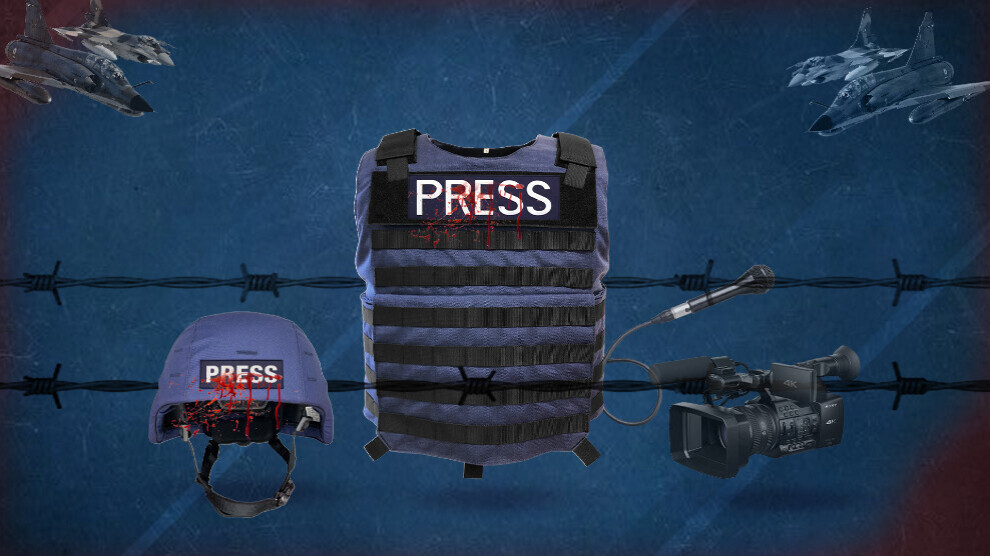
News Center – The killing of female journalists in conflict zones in on longer just a professional risk that can be included in war statistics. Since the first months of 2026, and increasingly, women working in media are being targeted, especiall in Gaza and Lebanon. It seems that targeting them carries a deeper meaning: “silencing a double voice- the voice of truth and the voice of women at the same time.”
The serious challenges facing female journalists continue, especially in unstable environments. Data shows that women in media are exposed to double risks: one related to the nature of journalistic work, and the other to gender-based targeting.
Female journalists have an important role beyond conveying the news. They often cover untold storie- stories of mothers, survivors, and forgotten communities. When they are killed, not just an individual is assassinated, but an entire alternative narrative path is choked. It is a loss for epistemic justice, not just for press freedom.
In the first months of 2026, the question was not only how many female journalists were killed, but also how many stories went untold because the one who would have told them is no longer here.
Israeli attacks target female journalists
There is still no fully updated official database documenting all cases of female journalists killed, especially since such information relies on reports from international organizations such as the International Federation of Journalists or Reporters Without Borders, which may be delayed in publication or verification.
However, according to documentation during April 2026, several female journalists were killed in the context of escalating violence in the Middle East, especially in ongoing Israeli attacks on Lebanon. Among them: Ghada Dayekh, a broadcaster at Sawt Al‑Farah Radio, who was killed in a strike targeting the building where she was staying in southern Lebanon on April 7; and Suzanne Khalil, a journalist at Al‑Manar TV, killed in an airstrike on southern Lebanon on April 8.
On April 22, Amal Khalil, a journalist at Al‑Akhbar newspaper, was killed in an airstrike during field coverage in the town of Al‑Tayri. Her targeting was widely condemned, as her killing came after a double strike that hindered rescue operations, raising accusations of violations of international law and questions about the deliberate targeting of journalists.
The bleeding continues
April was not an exceptional month, but rather an extension of a pattern ongoing since the beginning of the year. Conflict zones, whose scope is expanding rather than receding, remain the most dangerous for journalists' lives. Fatima Fatouni, a Lebanese journalist at Al‑Mayadeen TV, was also killed in an Israeli airstrike on southern Lebanon on March 28.
These numbers cannot be read as neutral. The killing of a female journalist is not just silencing a journalist, but breaking the presence of a woman in a space historically viewed as male‑dominated – especially working on the front lines of war.
A female journalist does not only report the event; she reshapes the narrative. She enters spaces long closed to women – front lines, mass graves, and the memory of victims. Her very existence is an act of resistance. Therefore, when a female journalist is killed, it is not just a body that is assassinated, but a part of truth is targeted and an alternative narrative is suppressed.
Notably, many of the female journalists killed in the first months of this year were working in local media, not major international institutions. This means they were closest to the people and to the small stories that do not reach global headlines, which doubles their loss.
Double violence
Female journalists face sexual threats, defamation before being killed, professional belittlement, targeting due to public presence, and, in the most extreme cases, murder. This makes violence against them compound – not only because they are journalists, but because they are women in a position not permitted within the logic of power.
According to international data, the killing of journalists worldwide has reached record levels in recent years, with near‑total impunity. Yet within these numbers, women remain fewer in number but more vulnerable in terms of protection and documentation.
These facts affirm the urgent need to strengthen protection mechanisms for journalists, hold accountable those responsible for crimes committed against them, and ensure a safe work environment that allows the transmission of truth without fear. Justice for slain female journalists means not only holding killers accountable, but also re‑examining the conditions that make the killing of women possible and repeated, and working to dismantle the structures that see their voice as a danger that must be silenced.