
Roken Ahmed: Protecting Women’s Gains Is a Priority in the New Phase of Syria
Roken Ahmed, Kongra Star committee member, confirmed the current phase demands continued political struggle despite challenges, stressing the goal is organizing women’s forces and unity for effective participation.
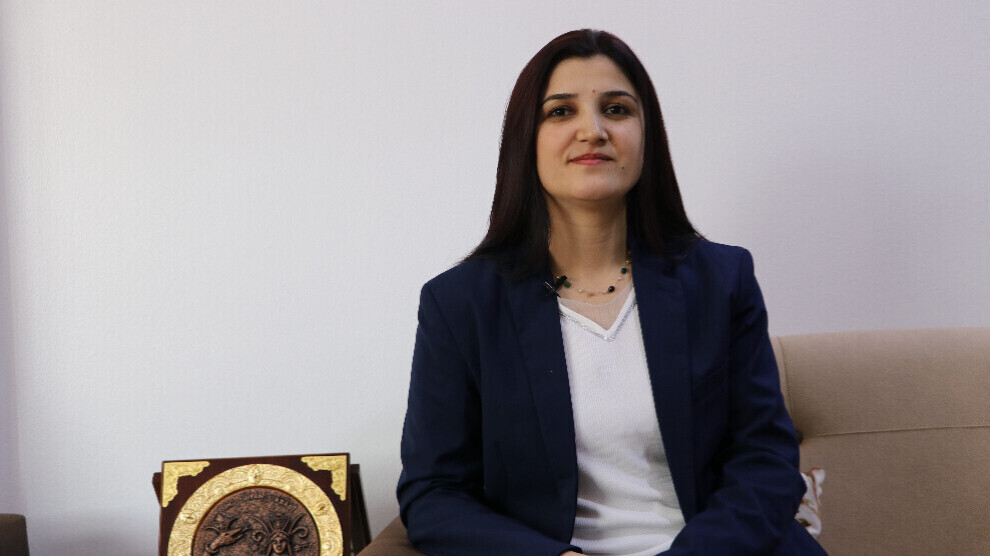
NAGHAM JAJAN
Qamishlo – In the new phase that Syria is passing through, the gains that women have achieved over years of struggle and resistance face many problems and risks. Accordingly, protecting the gains of the women's revolution is not merely a demand, but has become one of the main issues for the future of women and the building of a democratic Syria.
In this context, member of the Committee for Relations and Democratic Political Agreements in the Kongra Star, Roken Ahmed, stated that women have achieved important gains in the Rojava Revolution, in which the women's revolution turned into a global symbol of struggle and freedom. She noted that the revolution was distinguished by the merging of several revolutions at once, and women had a fundamental role in it, reflected in the co-presidency system, women's self-administration, and the establishment of their own institutions, alongside important developments in legal and social rights. "Without the participation and struggle of women, the revolution would have faced a great void in its structure and path."
"Women Had a Major Role in Revolutions Throughout History"
Roken Ahmed explained that "women played a pivotal role in many revolutions throughout history," confirming that "the experiences of women's struggle globally represent a legacy that can be built upon to be a source of hope for the struggles of the present and the future."
She noted that women participated effectively in "wars, building new systems, and decision-making, but they were often, after the end of revolutions, pushed away from political decision-making positions, and marginalization returned to affect their role."
She pointed out that northern and eastern Syria witnessed during the past years an experience based on "women's freedom, democracy, and the brotherhood of peoples," but these gains today face serious risks aimed at "restricting women's role and pushing them away from political and social life."
"They Want to Manage Syria with an Islamic System"
Roken Ahmed explained that Syrian women reached during the revolution an advanced level of political awareness, but the interim government deals with women's issues according to a "Salafi and radical mentality," which threatens their rights and gains. Experiences in many countries where Islamic systems were applied show that one of the first steps is to encroach on women's gains and restrict their will, noting the continuation of violations against women during its rule.
She confirmed that all women in Syria face a serious danger. "It is not only the women of northern and eastern Syria who face the danger, but all women in Syria suffer from these risks. In many areas in the Syrian interior, women have been subjected to snatching, assault, and killing. At the same time, the interim government is working through different methods to push them away from all areas of life, and to restrict their role and rights."
Regarding the agreement of 29 January between the Syrian Democratic Forces and the interim government, she explained that it was signed in "exceptional circumstances to avoid greater risks," and that the failure to discuss its details sufficiently led to the emergence of subsequent challenges and obstacles. She warned that any integration process not based on a democratic basis could lead to "strengthening the masculine, authoritarian, and nationalist mentality" and a decline in women's participation.
"Our Demand Is a Non-Centralized System"
Roken Ahmed noted that the Autonomous Administration issued laws in 2014 to protect the rights of women and the family, confirming that their demand was not the division of Syria, but a non-centralized system that guarantees the specificity of the region and protects the rights of women and the various components of society.
She stressed the necessity of protecting women's rights in the constitution and laws clearly, and increasing their representation in parliament to allow them a greater role in defending women's rights and participating in decision-making. "The government, official bodies, and institutions rely on the law to carry out their work and tasks. If the law allows violence and gender discrimination, that constitutes a great danger to women. Until now, there is no law that protects women's rights. In the era of the Baath regime, the situation was similar, and today the same scene is repeated. Therefore, there is a danger to women's gains. Women's rights and gains must be clearly protected in the law and the constitution."
She confirmed that the current phase consists of "protecting the gains that women have achieved," considering that preserving them is more difficult than achieving them, especially in light of the difference in the political and social system.
At the end of her interview, Roken Ahmed explained that the interim government does not accept the co-presidency system and does not guarantee women's participation adequately in decision-making positions, confirming that the next phase requires "continuing the political and intellectual struggle, organizing women's power, and ensuring the presence of Syrian women and their effective participation in the political process."