
Newbahar Mustafa: Women's Liberation and Democracy Are Two Conditions for Building Peace in the Middle East
Political and feminist activist Newbahar Mustafa warned continued interventions,conflicts may deepen societal fragmentation, stressing an inclusive state recognizing national, religious, and sectarian diversity, plus transitional justice,reconciliation.
MALVA MOHAMMED
NEWS CENTER_ In a transitional phase in which internal transformations overlap with regional and international interests and interventions, and the challenges accompanying that, many questions emerge about the future of Syria amid regional rivalry, the role of Turkey, Israel, and other international powers, the ability of the Syrian state to build an inclusive system that recognizes national, religious, and sectarian diversity, alongside the future of the Kurdish issue and the path of democratic integration, and the repercussions of developments in Syria and Turkey on the region.
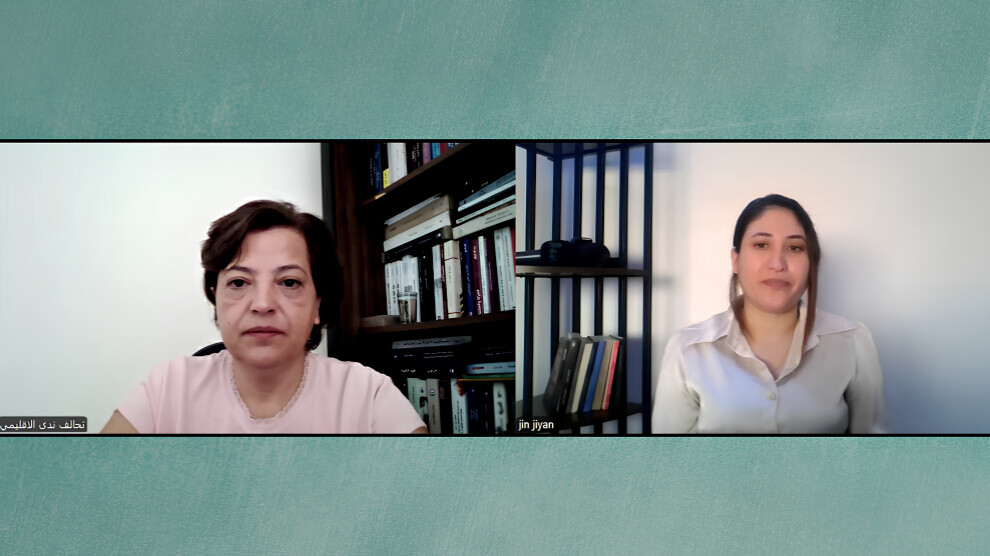
In the second part of the dialogue during which political and feminist activist Newbahar Mustafa was hosted, the future of Syria amid these transformations, the challenges facing the transitional phase, and the future of the Kurdish issue and the peace process in Turkey were discussed.
With a clear rivalry over the future of Syria and a Turkish, Israeli, and other international powers' presence, to what extent has Syria's future become linked to the interests of regional powers more than to the will of Syrians?
The situation applies to Syria as well, especially as it is distinguished by a strategic location and possesses resources and wealth, including oil, wheat, cotton, agriculture, and minerals. Therefore, it has become the focus of attention of dominant, external, and regional powers, including Iran, Turkey, and Israel.
It is necessary to return to the subject of the Syrian revolution. It was a revolution of peoples, stemming from the desires and aspirations of societies for freedom, but the monopolization of it by certain armed and political parties diverted its course.
We are today before a civil strife between religions, sects, and nationalities, and this is painful. But who benefits other than the dominant, intervening powers greedy for Syria, which do not want Syrian stability and societal civil cohesion. Therefore, the country has become an arena for settling accounts between Israel, Turkey, and other powers.
Turkey says it supported the movement or the revolution, but I see that it supported the crisis, and reached controlling the north through its actual presence and influence in the joints of governance.
In return, Israel sees in this presence a danger to its interests, and therefore attacked Syrian military capabilities at the beginning of the change of power and the collapse of the former regime. It also took control of the buffer zones and decided not to withdraw from them, in addition to controlling Mount Hermon with its strategic location.
There is rivalry over Syria, and each party wants to have its share in it. I do not know where this path will go, but I see that the fate may be unknown and tragic if it continues in this way.
If Syria is before an unknown fate, what is the real test it faces in the next phase?
We are living the test now, as women and as peoples. And we live it harshly and painfully. Syria will not recover if it continues on this path. It may head toward division, even if it is not a division of borders, but societal division and fragmentation, and we will suffer from this fragmentation for decades to come.
The Syrian interim government is primarily responsible for reforming this situation. First, a state must be built that constitutionally recognizes the diversity and richness existing in Syria, and does not deny the Kurdish, Assyrian, Syriac, and Chaldean people, and does not deny other religions.
Second, the state must be inclusive and embracing for all, and not for a specific group or identity. The Alawite, Druze, Kurd, Ismaili, Sunni, Christian, Yazidi, Circassian, Syriac, and others must see their identity in this state, not that their existence is mere formal representation.
Third, security must be for the benefit of all, meaning that weapons must be allocated only for defending the sovereignty of the country, not directed at the people's own children. If there are those who committed crimes, there are courts, meaning transitional justice must be activated and perpetrators of war crimes and violations must be held accountable before fair courts. This cannot be built without building trust, first within society and second between society and the government.
We must also go toward reconciliation. Every male and female citizen in Syria has their own narrative and grievance, and everyone has been harmed by the war. We must listen to each other's stories, and take a step toward safety, and search for the common denominator instead of searching for reasons for disagreement.
The Kurdish file in Syria represents one of the fundamental tests of the transitional phase, especially with the process of integrating the Syrian Democratic Forces into state institutions, simultaneously with Kurdish fears regarding language, political, and cultural rights. Can Damascus build a unified state without providing a real political formula for the Kurdish issue?
There is an agreement between the Autonomous Administration, the Syrian Democratic Forces, and the Syrian interim government regarding the integration process, but there are still differences in the frameworks and concepts related to defining integration and merger.
The Autonomous Administration talks about democratic integration, not integration in the sense of melting or denying identity or the will of the peoples of the region. Democratic integration means that the existing local institutions under the Autonomous Administration integrate with the central government institutions, while preserving the specificity, identity, demands, and gains where there was recognition of the identities of different peoples and shared coexistence. There must also be no religious domination or religious fanaticism, and the region must preserve its right to manage its affairs through its own people.
The Syrian Democratic Forces offered thousands of martyrs, and that was not in order to return to point zero, but in order to build and preserve what has been achieved. The inciting discourse, hate speech, and electronic attack on social media platforms also threaten reconciliation and increase distances between the people of the same country. Syria will not recover and will not become a prosperous state as long as societal demands, the rights of peoples, and the diversity existing in the region are denied.
There is an ongoing path in Turkey regarding the Kurdish issue, and the project of peace and democratic society launched by Abdullah Öcalan on 27 February 2025 allowed steps to be taken by both sides. How can the democratization of Turkey, alongside democratic integration in Rojava and building a democratic Syria, affect the region? And in the face of external powers' plans to reshape the Middle East, will such a path have a chance of success?
The assessment we presented for Iran also applies to Turkey. That is, it is before two choices. The path of peace and democratic solution proposed by leader Abdullah Öcalan places Turkey before the choice of heading toward a democratic solution and building peace internally.
If Turkey heads toward peace and democracy, it will get rid of the state of war and security instability, and will head toward a more democratic system by recognizing the rights and demands of the Kurdish people. This will mean a change in the structure of the system and constitution to become more democratic, transparent, and closer to the demands of peoples. Then Turkey can be a prominent regional power, as it is distinguished by an important geostrategic location linking Asia and Europe, lies on energy supply routes, and possesses human, financial, water, and mineral resources.
But if Turkey insists on denying the rights of the Kurdish people and democratic demands, it may enter a whirlpool of continuous conflict, and transnational corporations and military and political powers will benefit from that.
Turkey had a major role during a hundred years of the contemporary history of the region, and was part of NATO and has a role in protecting capitalist interests and energy supply interests. Therefore, if Turkey exploits its capabilities to build a democratic state, it can play a prominent role in the region in a different direction, and perhaps contribute to building a cross-border democratic alliance that supports prosperity and democracy.
You always link talk about military developments, conflicts, and wars to the issue of women and liberation. To what extent do you consider women the biggest victim of what is happening?
Women are among the groups most affected by what is happening, whether throughout history, during the last hundred years, or in the current phase. Authoritarian, totalitarian, and aristocratic regimes, regimes that integrate religious Sharia into governance, non-democratic and military regimes, in addition to wars, conflicts, and economic instability, all affect women directly.
These regimes only establish their pillars at the expense of the enslavement of women. Mental and intellectual enslavement was the first link, then links of class, intellectual, and political enslavement branched from it. Therefore, we always say if women are liberated, societies are liberated. Liberation from mental, intellectual, and patriarchal institutional restrictions opens the field for development and prosperity.
Wars of monopoly cannot lead to the liberation of women, but lead to more class enslavement and gender-based discrimination. Women's liberation is linked to changing regimes toward democracy, to stability, rejecting wars and conflicts, and building peace. Democracy is not complete without women's participation, and peace does not come without democracy and a liberated society. Women play a pioneering role in pushing the region and the world toward peace, modernity, and liberation.
In light of patriarchal regimes that try to deny women's role or represent them formally, how can women play their real role in the next phase and contribute to establishing peace?
We are witnessing globally a targeting of feminist and women's movements and the achievements women have made, and a targeting of women's gains and marginalization of these movements, emptying them of their content, and demonizing them.
Women have achieved gains in constitutional, social, and economic rights over the past decades, but we have been witnessing in recent years a targeting of these gains. Today, women face greater challenges and obstacles than before. The challenge is no longer only in obtaining the right to vote, run for office, or parliamentary representation, but the challenge has become in preserving gains and changing the societal structure. In some countries there is a quota for women, but the quota alone is not a solution. It is one of the means, not the final goal. Women's representation in leadership and sovereign positions is also part of the solution, alongside changing laws and constitutions that legislate violence and discrimination against women, and strengthening laws that protect them.
But the basic condition is societal change. Governments, civil society organizations, and women's movements must develop integrated plans to change societal mentality, and destroy patriarchal institutions, through upbringing and education in schools, universities, and institutes, intensifying awareness programs and activities, and directing media and breaking the stereotypical image of women.
We cannot build a strong society if women are still treated as the weaker link. Therefore, destroying the first link that was formed in human history, which is the control over women, is a fundamental step toward building a more democratic and free society.