
Newbahar Mustafa: Transcending the Nation-State May Be an Entry Point for Rebuilding the Region
Political and feminist activist Newbahar Mustafa confirmed the Middle East faces radical transformations, but its future won't be determined by international and regional powers alone, stressing women's liberation and democracy.
MALVA MOHAMMED
NEWS CENTER– The Middle East is witnessing an accelerating phase of political, security, and social transformations, amid wars, conflicts, and regional and international interventions that are redrawing the balances of power and influence in the region. From Syria, Yemen, and Sudan, to Iran, Turkey, and the Kurdish issue, internal crises overlap with regional and international interests, while challenges related to sovereignty, stability, and the rights of peoples are increasing.
Amid these transformations, many questions emerge about the future of the regional order, the nature of the nation-state, and the role of regional and international powers in shaping the future of the region, alongside the repercussions of wars and conflicts on societies, especially women and marginalized groups.
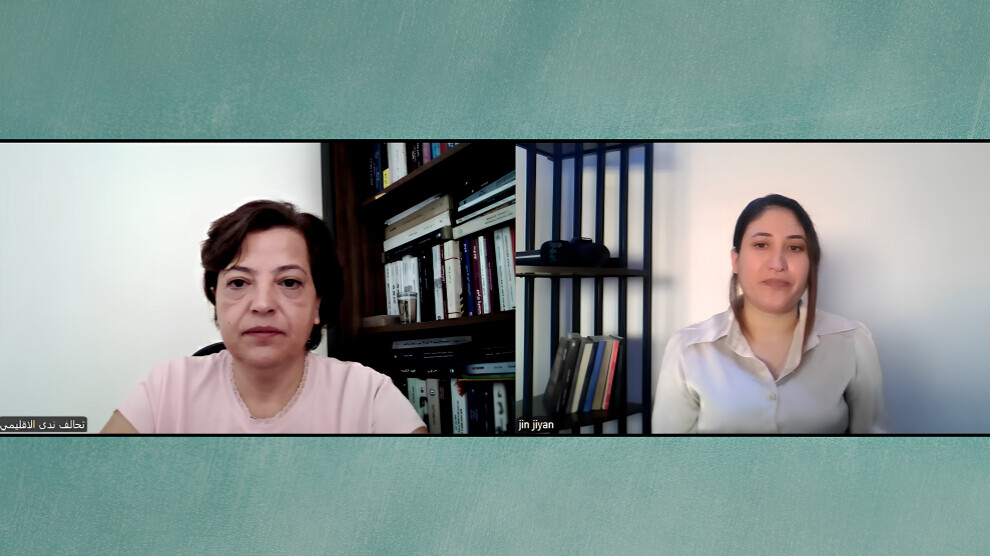
To discuss the nature of these transformations, whether the region is heading toward a new regional order, their repercussions on the future of states and societies, and the role of regional and international powers in Syria, Yemen, Sudan, and Iran, our agency conducted a dialogue with political and feminist activist Newbahar Mustafa. In the first part of the dialogue, she addresses the most prominent of these issues and their repercussions on the future of the region.
Let us start from the broader regional scene... How do you read what is happening today in the Middle East?
The world is witnessing accelerating developments and successive transformations, especially after about a hundred years since the Sykes-Picot Agreement, which contributed to drawing the region's maps and dividing it according to the interests of the dominant powers at the time, foremost among them commercial and financial interests. After a century since that phase, these maps, according to the vision of some of these powers, have become an obstacle to their renewed profit interests, which pushed them to work on implementing what can be described as the "centennial plan" to reshape the region.
In this context, some dominant powers seek to change existing political borders, in parallel with changing regimes they see as obstructing their interests. In return, other powers seek to keep the current borders, meaning the Sykes-Picot borders, while working to change the behavior of regimes or reshape them in line with their interests.
These interests consist mainly of energy and its resources, in addition to the routes for supplying energy to the dominant continents, including Europe and America. Therefore, we see that developments are accelerating, whether through creating new alliances, setting new plans, and creating new wars in the region, or at the international level, as in the war between Russia and Ukraine, the Israeli war on Gaza, and the wars we witnessed in Sudan, Syria, Iraq, Iran, and Lebanon.
These developments are taking place violently, and they are conflicts and wars targeting regions and peoples and their aspirations for sovereignty and the right to self-determination. As for the countries that the war has not reached, they too have not been spared from these plans, but suffer from a decline in freedoms and democracy. This behavior is linked to the ruling authorities in the nation-state, which reconcile with the interests of the major states and powers.
In your opinion, are we facing a set of simultaneous crises, each with its own causes and paths? And do these crises reflect broader transformations in the balances of power and influence in the region?
We are facing security crises and instability, stifling economic crises, political crises and a decline in democracy, in addition to social and societal destabilization, and the issues of women, youth, the unemployed, and the migration of minds from the region.
Each crisis may have its own causes and paths, but they share one common denominator, which is that these crises are manufactured as a result of the international policies of the dominant powers and profit-seeking states that seek to organize the region and create a Middle Eastern situation suitable for their interests, and not constituting a danger to their security plans and financial and profit interests.
But these international plans will not succeed without tools and extensions inside the region, and this is what we witness through the ruling authorities and governments regionally, which align with these interests and seek profit even if that is at the expense of national interest, national sovereignty, and reconciliation with societies.
In light of these transformations, can it be said that the Middle East is entering a phase of real reshaping of the regional order? And if we are before a new phase, what are its most prominent features?
Internationally and regionally, we are heading toward radical changes at various levels. There are several poles, fronts, and intellectual theories seeking to draw the features of the new Middle East. Capitalist states and their supporting or cooperating powers regionally seek to draw the features of the region in line with their interests, foremost among them protecting energy routes, obtaining cheap labor, and benefiting from water resources, energy, and cheap and sustainable petroleum resources. They also seek to make the region unable to object to these plans.
But we cannot say that the future will necessarily proceed according to this plan, because there are resistance movements, vigilant societies, civil organizations, leftist and women's movements, and oppressed peoples who oppose these plans and resist them. To thwart these plans, there is a need for more inclusiveness, organization, and interconnection, so that an allied front is formed in the face of the front of capitalist states.
Iran has so far adopted a different strategy in the region. It succeeded in keeping the war outside its territory through Hezbollah, the Popular Mobilization Forces, the Houthis, and others. But now, a new military campaign has been launched against these groups. Is a new strategy hostile to Iran being developed, seeking to include Syria also within this confrontation? And what is the impact of a war targeting all areas where Iran has influence on the region?
First, regarding Iran, I do not believe it succeeded in keeping the war away from it, as it is in reality living in a state of internal war. The Iranian authorities do not recognize the rights of the peoples within the borders of the Iranian state, nor do they recognize women's rights. With the anniversary of the "Woman, Life, Freedom" uprising and the martyrdom of Jina Amini, we still witness executions, arbitrary arrests, and the silencing of mouths, alongside the marginalization of peoples and the ignoring of their demands.
If Iran wants to be able to confront any external war, it must first build its internal house on strong foundations, and this is only achieved through the establishment of security, lifting the state of emergency, and constitutional recognition of all peoples and their cultural and national rights.
I see that Iran is before two choices: either it heads toward internal reforms and building a democratic system that guarantees the rights of all peoples and contains the cultural and national diversity existing within the state, or it heads toward further weakness. I do not necessarily mean the collapse of the state or the authority or the departure of the regime in the traditional form, but it may appear in the form of a weak and dilapidated Iran, especially in light of the pressures, air, financial, and economic siege it faces, and the economic and security confusion it is living through internally.
Consequently, even if Iran is able to endure, it may not be the Iran we knew previously, but a state suffering from large internal gaps and facing a decline in its ability to impose its sovereignty. Therefore, I return to emphasize that Iran is before two choices: either it becomes a strong state with its human and material wealth, by changing the regime and form of governance toward democracy, or it heads toward further weakness before the challenges it faces.
As for what is called "Iran's arms," including Hezbollah, the Popular Mobilization Forces, and the Houthis, regardless of the labels used in the media, especially media dominated by major powers, our criterion is clear. We are with the right of any human group, nationality, or ethnicity, whether religious or sectarian, to self-determination, and with its right to have representation and a voice within the state in which it lives, in a manner consistent with the national interest. We see that elevating the voice of the marginalized and oppressed from various nationalities, minorities, and ethnicities, in their diversity, can constitute a source of richness for the homeland, and does not detract from patriotism or national sovereignty.
By the same principle, we are with all forces that resist occupation, and with the right to self-defense, because resisting occupation and self-defense is a legitimate right. Resistance should not be dealt with through negative assessments merely because of disagreement about its methods, as that is another matter. But there are basic criteria that must be adhered to, which is that resistance and defense of the rights of the marginalized, minorities, and nationalities be consistent with the national interest, and be part of peaceful coexistence, and that the language of dialogue be the basis, not the language of weapons. Any weapon used in an internal war, or any weapon outside the framework of national sovereignty, will turn into a burden on society and the state, and will ultimately only lead to prolonging the war and deepening the conflict.
The conflict in Yemen and between the Houthis has internal and external factors alike. Can Yemen be viewed as an arena for a war waged by Saudi Arabia and Iran against each other?
We can take Yemen as an example and apply it to the countries of the region. Internal wars may fall within internal disputes and conflicts, but they are not far from external interventions.
In Yemen, there is an issue related to the historical marginalization of the Houthis, but the matter does not stop there. The legitimate Yemeni government is supported by Saudi Arabia financially, security-wise, intelligence-wise, and militarily, while Iran supplies the Houthis with weapons, and this leads to fueling the conflict.
Societal parties and peoples will not reach a solution among themselves if they are hostage to external powers. External powers do not intervene in another state unless that serves their interests. Internal forces, whether the legitimate government or the Houthis, must be more rational and address issues through dialogue and negotiations, and build a system that includes the interests of the various parties and represents all forces present in Yemen.
Being hostage to external parties increases tension and ignites escalation, and this is what we witness in Yemen. What appears in the media as a conflict between the government and the Houthis is in part an arena for external interventions, most prominently Saudi-Iranian rivalry.
If we add Sudan to Yemen, internal and external crises and wars have led to the exacerbation of social problems, as well as the situation of women. Under this situation, how can the structure of the nation-state withstand when its social crises have deepened to this extent?
Yes, it can be said that life in Sudan and Yemen has become hell. We witness mass killing and massacres, systematic rape, and the use of women as tools in wars, in addition to kidnapping, mass displacement, food crises, and the spread of epidemics.
Sudan is living these conditions to deeper degrees, with the absence of security, individual revenge, and the absence of life necessities, especially after the war that targets the infrastructure of cities and villages and affects agriculture, production, and stability.
Sudan is living an internal conflict between the Sudanese army and the Rapid Support Forces, but it is in essence a conflict over power. This applies to the region in general, as internal conflicts do not represent the interests of peoples and societies seeking stability and well-being, but are linked to the monopoly of power.
There are also multiple external interventions, international and regional, that further fuel the conflict. And who is the loser? The people, and women first and foremost, the poor, the working classes, and the marginalized groups. The wars taking place today regionally are not our wars as women, and are not the wars of peoples, the working classes, and the marginalized groups. They are the wars of authorities and financial interests.
If we return to the contemporary history of peoples, we find that the building of nation-states was linked to the concept of peoples' right to self-determination and to live within a state with political borders. We respect the sacrifices and revolutions that peoples made against occupation and for their freedom, but the question is: Where did these peoples head afterward? They headed toward building nation-states, but this state was based on an authority and a ruling clique monopolizing society, the economy, and security. Thus society moved from the monopoly of occupation to the monopoly of a clique from the country's own people.
The harsh political borders also divided the region, despite the existence of tribal, clan, cultural, and linguistic extensions and a shared history and shared interests between its peoples. These regimes monopolized the economy, security, and governance, and continued to dominate their peoples, and headed in many countries toward tyranny, non-democracy, and silencing mouths with security apparatuses. Prison came to affect opinion-holders, journalists, thinkers, and opponents, instead of being limited to perpetrators of crimes and violations.
Therefore, the nation-state reached the point of becoming a burden on its peoples and societies. This is why we must rethink the concept of the state, sovereignty, and borders.
We can also benefit from some models existing in the West, including the European Union model, where borders were removed in several aspects, customs were abolished, and cooperation took place in economic fields, projects, and parliament. I do not say that this model is ideal, but it presents a model that can be benefited from.
Why does the region not head regionally toward federalism and removing existing borders, and building democratic systems instead of the rigid nation-state that seeks the domination of one people over another or building a state on the denial of another people or another identity? Then the features of the new Middle East could be a democratic Middle East, recognizing women's rights and women's freedom, developing industries and production, and preserving the sovereignty of the country.
Tomorrow: Newbahar Mustafa: Women's Liberation and Democracy Are Two Conditions for Building Peace in the Middle East