
From the Dream of Freedom to the Battle for Survival... Sudanese Women at the Heart of Conflict and the Search for Peace
Sudanese women insist that neither military victory nor a temporary sttlement can end the crisis_only a national Project takling marginalization and upholding equal rights can.
MERVAT ABDEL QADER
Sudan — From the September 2013 protests to the December 2018 revolution, Sudan's streets accumulated anger against authoritarianism and deteriorating living and political conditions, until the protests transformed into a popular revolution that toppled a regime that had ruled the country for three decades, under the slogan "Freedom, Peace, and Justice," with notable participation by women and youth, and demands that went beyond regime change to building a state of citizenship, justice, and the rule of law.
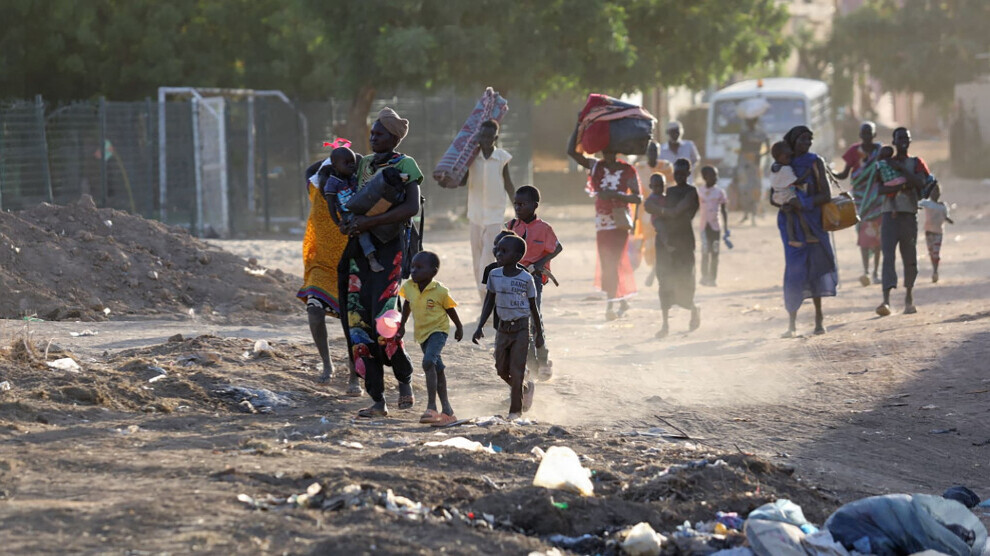
However, the transition to the desired state faltered amid power struggles and political divisions, before war erupted on April 15, 2023, between the Sudanese Armed Forces and the Rapid Support Forces, moving Sudan from a political conflict over the future of governance to an open war threatening the unity of the state and its institutions, exacerbating displacement, poverty, hunger, and the collapse of services, and deepening social division.
Between the memory of September and December, Sudan today faces a harsher question: Is it still possible to reclaim the state project for which Sudanese people took to the streets, or has the war pushed the country toward a path that threatens its unity and existence?
Roots of the Crisis... An Old Conflict Taking a New Form
Hala Abdel Aziz, a leading member of the Women's Secretariat in the Justice and Equality Movement, believes that invoking September and December is necessary to understand the current conflict, because the crisis did not begin with the gunfire in April, but was preceded by political, economic, and social accumulations that reflected on citizens' lives through deteriorating living conditions and services, and the widening circle of poverty and displacement.
For her, any genuine solution must not stop at a ceasefire but must address the roots of the crisis and rebuild the state. From her perspective, the continuation of war keeps scenarios open between reaching a comprehensive political settlement leading to peace and stability, and the continuation of conflict that exacerbates the humanitarian and economic crisis and deepens social division.
Hala Abdel Aziz sets a number of priorities for exiting the crisis, beginning with "a national political will and comprehensive Sudanese dialogue, along with rebuilding state institutions and addressing the roots of the crisis, with the protection of civilians and the return of displaced people and refugees at the forefront of priorities."
For writer and independent political activist Sally Zaki, the answer cannot start with the war alone, because what is happening today is the result of accumulations dating back many years.
She says: "Conflict within Sudan has not stopped since independence, and its causes have continued to renew and intensify, especially due to center-periphery issues, imbalances in the distribution of power and wealth, and the accumulation of political and social crises."
She explained that these imbalances did not remain merely a political framework but were directly reflected in the lives of Sudanese people, through poverty, deteriorating services, and the widening gap between the center and the periphery, while conflict zones, foremost among them Darfur, the Nuba Mountains, and Blue Nile, continued to pay a heavy price due to wars and marginalization.
In this context, feminist initiatives and organizations, notably the "Women for Peace" organization and the "Feminist Network Against Violence," have continued to warn that any peace process that does not place women, displaced women, transitional justice issues, and gender‑based violence at its core will not be able to address the roots of the crisis.
Sally Zaki believes that the continuation of these accumulations, along with the failure of political forces to build a genuine national consensus, contributed to moving Sudan from peaceful protest to armed conflict.
Looking to the future of the crisis, Sally Zaki outlines three main scenarios. The first is national consensus through comprehensive dialogue, which she sees as the shortest and safest path to peace, stability, and democracy, through dialogue involving political, civil, and community forces, placing the national interest above partisan, personal, and regional interests. This is the scenario supported by most feminist initiatives, as the "Women for Peace" initiative presented a paper in 2024 calling for a parallel feminist roundtable to any official negotiation process to ensure that transitional justice and sexual violence issues are not excluded.
The second scenario, she sees, is a return to military rule, especially if civil and political forces fail to overcome the deadlock and sit down for serious dialogue. However, this option, from the perspective adopted by the majority of feminist initiatives, does not represent a solution to the crisis but may reproduce it, especially since past experiences of military rule did not address the roots of power, justice, and citizenship issues, nor did they contribute to placing women's issues in their natural position within the state project.
The third scenario is negotiation under the pressure of power balances, where the continuation of war and the exhaustion of parties may push them to negotiate, but the outcome, according to Sally Zaki, will remain open between a political settlement that preserves Sudan's unity, or the disintegration and division of the state—the scenario she considers "the most dangerous."
She summarizes her vision: "The best option for Sudan lies in the victory of the project of the state of citizenship, law, and institutions. Comprehensive national dialogue, based on recognition of diversity and mutual concessions, remains the least costly path and the most capable of preserving the country's unity and building sustainable peace." She added: "Sudanese people are required to make mutual concessions to build a homeland that accommodates everyone—a Sudan of equal citizenship, rule of law, freedoms, and justice."
If Sally Zaki traces the roots of the crisis to deep historical and political accumulations, Dr. Hala Al‑Karb, Regional Director of the Horn of Africa Women's Initiative "SIPA," focuses on the period following the December revolution and sees that the problem was not in the revolution itself, but in the conflict that took place around it and its project.
She says: "The conflict in Sudan is primarily an existential conflict, threatening the idea of the Sudanese state's survival and Sudan as a unified country," noting that the multiplicity of actors, overlapping interests, and internal fragmentation have made reaching a settlement extremely complex.
She describes the post‑revolution period as harsh: "Despite the greatness of the Sudanese revolution, it was a revolution born orphaned. The conflict that took place around it and in its aftermath was largely isolated from it and its aspirations, and was centered on how to seize power, without this fierce desire being accompanied by clear strategies, sufficient knowledge, or a serious pursuit of building coherent projects for change."
For her, the current war cannot be separated from this path; instead of the revolution transforming into a project for rebuilding the state, competition over power turned into armed conflict, then the war expanded to multiple regions, and new alliances and armed formations emerged, making the scene more complex and closer to a long war of attrition.
Hala Al‑Karb believes that the danger of the current situation lies in the fact that the war is no longer just a military confrontation between two parties, but has come to threaten the very structure of the state, in light of the erosion of institutions, the multiplicity of armed forces, and the declining ability of the center to manage the country.
She does not separate this scene from the regional and international environment, seeing that developments have become largely linked to regional conflicts and interests, and that the complexities of the international scene make the international community less capable of producing decisive pressure toward a settlement.
She also sees that Sudan has not yet witnessed sufficiently serious initiatives that respect the diversity of Sudanese people and their right to determine the future of their country, and that place justice, good governance, and stability at the heart of any solution: "The point is that we are no longer in need of more analysis; we have analyzed enough. We are in desperate need of a way out, and this way out does not lie outside Sudan, nor in the desperate interventions of regional states, but is internal—in accepting one another and neutralizing external forces as much as possible."
She explained that this way out may come through the emergence of new leaderships born from the war, leaderships that work on building a different political project based on more decentralized governance and taking into account the interests of local communities, rather than reproducing the center‑periphery conflict.
Amid This Scene, Another Question Arises: What Remains of the December Project? Has the Conflict Removed It from the Scene, or Does It Still Represent a Foundation for Any Future Political Project?
In her answer, Nidal Hisham, official spokesperson for the Democratic Bloc in Sudan, sees that the December revolution has not ended, but its priorities have changed due to the war.
She says: "The glorious December revolution has not faded; it remains strongly present, and its constituent bodies continue to present their visions. However, the war has made the top priority achieving peace, because without peace and stability, the homeland remains in a state of instability."
She explained that the Sudanese crisis is multi‑track and cannot be addressed through a single track. There is a military track, a humanitarian track, alongside the political and civil track, each with its own tools and parties. She noted that international and regional efforts should help achieve a ceasefire and address the humanitarian situation, while the political track requires a Sudanese‑Sudanese dialogue process bringing different forces together around one table.
However, she points out that the disagreement is not only about the content of the dialogue but extends to the question of who participates, who represents Sudanese people, where it is held, and what its mechanisms are. Nevertheless, she believes that continued meetings and bringing viewpoints closer could lead to common ground.
She affirmed that revolutionary bodies, political parties, and all active forces are required to sit together within the framework of "Sudanese‑Sudanese dialogue," with purely Sudanese ownership, while emphasizing the importance of the international role as a facilitator and enabler, not as a substitute for Sudanese will.
From Leading the Street to Protecting the Community
What the country is witnessing has not only changed the nature of political conflict but has also changed women's position within the crisis. From September, through the December revolution, women were an essential part of popular mobilization. In the revolution, Sudanese women led processions and sit‑ins, carried slogans of freedom, peace, and justice, and paid a heavy price during peaceful struggle phases.
With the outbreak of war, women became among the groups most affected by displacement, homelessness, loss of income sources, collapse of services, in addition to the increased risks of gender‑based violence.
On the other hand, women emerged on the other side of the scene as key actors in humanitarian response. Many feminist initiatives moved from direct political work to relief, and emergency rooms led by women emerged in Khartoum, Darfur, and Kordofan, providing food, medicine, and assistance to displaced people, alongside documenting violations and participating in peace initiatives.