
Raziye Öztürk: Resolving the Kurdish Issue Requires a Legal and Institutional Framework Beyond Disarmament
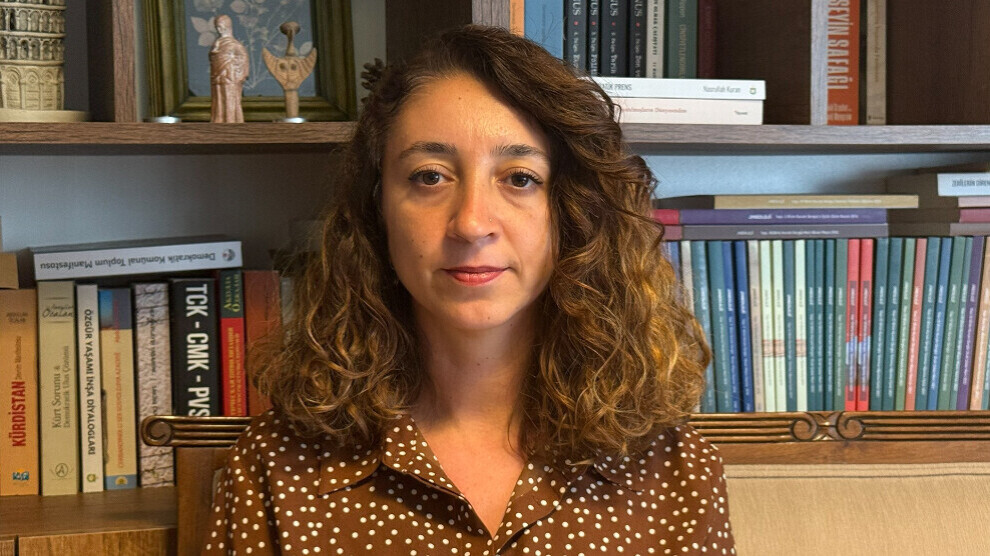
Lawyer Raziye Öztürk confirmed moving from political statements to sustainable peace requires clear legal and institutional steps, addressing Abdullah Öcalan’s legal status, and enabling his political participation.
ELİF AKGÜL
Istanbul- Discussions related to resolving the Kurdish issue and the path of democratic transformation have acquired a new dimension, with the escalation of controversy over the role of leader Abdullah Öcalan in this process and how to address his legal status.
İn this context, the Office of the Legal Era_ the legal Office dedicated to defending leader Abdullah Öcalan_ confirmed in a written statement addressed to public opinion that the ongoing discussions about the housing issue in Imrali have come to overshadow the fundamental political and legal issues of the process, stressing the necessity that the discussion focus on the legal status of leader Abdullah Öcalan.
Lawyer Raziye Öztürk, one of the office’s members, said that resolving the Kurdish issue cannot be reduced to the issue of disarmament alone, confirming the necessity of transferring the process, stressing the necessity that the discussion focus on the legal status of leader Abdullah Öcalan.
Lawyer Raziye Öztürk, one of the office's members, said that resolving the Kurdish issue cannot be reduced to the issue of disarmament alone, confirming the necessity of transferring the process to the ground of democratic politics and the rule of law, as well as giving a legal framework to the status of leader Öcalan, working to institutionalize the process, alongside setting a roadmap that enjoys the consensus of the concerned parties.
The Framework Law: The First Legal Step
Raziye Öztürk indicated that the meeting of leader Öcalan's lawyers with him in September 2025 coincided with the beginning of official talk about a framework law, in parallel with the Council of Europe's Committee of Ministers examining the issue of the "right to hope," which leader Öcalan considered a "legal window" that could open before the Kurds, while Raziye Öztürk described it as "the first legal step," despite its shortcomings, confirming that addressing an issue of this magnitude requires a more comprehensive legal and political framework.
She explained that the law, despite targeting members of the Kurdistan Workers' Party and fighters, does not include all categories, as it excludes some leaders, while it may include persons arrested on charges related to belonging to the party, including political activists and feminists. She warned of the risks of postponing implementation or linking it to an administrative and political body, stressing the importance of societal mobilization in the next phase.
Implementing European Court Rulings and Ending Trusteeship
Raziye Öztürk indicated that moving forward in the political process requires, alongside the new legal arrangements that the requirements of the phase may impose, taking urgent steps that do not necessarily require new legislation or legal amendments.
She explained that among the most prominent of these steps is implementing the rulings of the European Court of Human Rights, improving the conditions of sick prisoners, and ending the trusteeship system over municipalities. She noted that the continuation of this system restricts political will and impedes progress toward a democratic and sustainable solution. "Removing these obstacles will allow the process to advance more seriously and soundly, and therefore all legal and political requirements should be fulfilled as soon as possible."
She said that the parliamentary committee's report and the framework law open the door to legal arrangements that suit the requirements of the phase, while stressing at the same time that there are measures that can be implemented immediately without waiting for new legislation.
Political Will for a Solution
Raziye Öztürk stressed that the formation of a political will to address the Kurdish issue was a fundamental factor in launching the process, explaining that this will began to crystallize clearly since October 2024.
She added that the efforts to search for a political solution are not new, noting that leader Öcalan proposed this orientation long ago. "The existence of a political will for a solution was an essential condition for starting this process. The goal is to end the issue through a peaceful and democratic solution. Mr. Öcalan expressed this will since 1993, but he did not find a party to deal with him as an addressed party, except for some indirect communication channels, which prevented the building of a sustainable path to resolve the issue."
Transforming the Political Path into a Legal and Institutional Framework
Raziye Öztürk believes that the current phase represents an opportunity to push the process forward, but it needs to accelerate the pace of implementation and translate political statements into practical steps, despite the delays that crises and political complications may impose.
She confirmed that any negotiating path cannot be separated from the legal and political conditions surrounding leader Öcalan, who she believes represents, due to his political and intellectual influence and his presence within the Kurdish community, a fundamental party in any dialogue process, citing signatures and mass movements supporting this role.
On the other hand, she pointed to the continuation of restrictions on the conditions of his detention in İmralı, explaining that his last meeting with his lawyer was on 21 March, with limited family visits and communication largely limited to meetings with delegations.
She considered that the continuation of these restrictions poses a problem before any actual negotiations, as the peace path requires providing channels of communication and equal participation for the concerned parties, allowing the presentation of visions and discussion of ways to build a sustainable peace process. According to Raziye Öztürk, preparing these conditions is not related to Öcalan alone, but to providing the necessary political and legal environment for the success of any negotiating path.
"Mr. Öcalan's Physical Freedom Must Be Guaranteed"
Lawyer Raziye Öztürk said that the discussion about the status of leader Abdullah Öcalan is also connected to what is known as the "right to hope," in reference to the European Court of Human Rights ruling issued in 2014, noting that Turkey, as a party to the European Convention on Human Rights, is obligated to implement the Court's rulings.
She explained that the ruling concerning leader Öcalan has not been implemented despite more than 12 years having passed since its issuance. "Our fundamental demand is to guarantee Mr. Öcalan's physical freedom, and for this we continue to emphasize the right to hope."
"There Is No Issue That Can End with Disarmament"
In her comment on the announcement by Mohamed Ouchoum regarding leader Öcalan's participation in the parliamentary subcommittee concerned with disarmament and strategic coordination, Raziye Öztürk considered that establishing a parliamentary committee constitutes an important step toward institutionalizing the process.
She said: "Reducing the Kurdish issue to a framework of terrorism or dealing with it from a single security angle cannot lead to a comprehensive solution, because it has multiple historical, social, economic, and political dimensions. Therefore, it must be addressed as a whole, as limiting the process to disarmament alone will not provide, from our point of view, a sufficient basis for a lasting peace."
"Conditions Must Be Provided That Enable Mr. Öcalan to Perform His Role"
Raziye Öztürk indicated that leader Öcalan's role in the process should not be reduced to the disarmament file, but should be placed within a broader political path heading toward societalizing the process and moving it to a stage of democratization. She noted that the legal framework for the work of the parliamentary committee and its powers, alongside Öcalan's legal status, still lacks clarity.
She stressed that disarmament is only a stage within a more comprehensive path, confirming that leader Öcalan has proposed visions and projects regarding integration, which requires providing the conditions that enable him to present them and contribute to the process directly. She explained that any path that begins secretly should later turn into a societal and institutional process, leading to democratic politics, sustainable peace, and a shared life that prevents the return of conflict.
"The Actual Role Must Be Transformed into a Clear Legal Status"
Raziye Öztürk called for setting a clear timetable and roadmap, considering that the absence of specific criteria and guarantees fuels a state of distrust toward the future of the process.
She said that political understandings need legal and institutional translation that gives the path a degree of stability and clarity, and prevents one party from monopolizing the determination of the direction of negotiations. "What is raised politically should not remain within the framework of statements, but should find a legal and institutional translation that provides clear guarantees for the process. Otherwise, one of the parties will remain in a position that allows it alone to determine the course of negotiation."
"The Discussion About Housing Should Not Obscure the Essence of the Process"
Regarding the controversy over the residence allocated to leader Abdullah Öcalan in İmralı, Raziye Öztürk considered that focusing on the nature and function of the building distances the discussion from the essence of the issue. The fundamental issue, from her point of view, is not the place of his residence, but providing the legal and practical conditions that enable him to perform his role in the political process.
Official statements had indicated that the building is an additional unit belonging to the prison, and that its allocation aims to provide more suitable conditions for leader Öcalan to continue his role. The Office of the Legal Era considered that this space is necessary for the continuation of political and legal work. "The real question is how to push the process forward and bring it into a legal and institutional framework. Hence, the discussion should focus on democracy and the policies necessary to achieve it, and on the issue of the 'right to hope' and why it has not been applied to Mr. Öcalan. Addressing these issues could open the way for the process to advance instead of limiting the discussion to side details."
At the end of her interview, Raziye Öztürk stressed that dealing with leader Öcalan as a party in the process must precede any discussion about the nature of the role assigned to him. "Mr. Öcalan is a negotiator in this issue and an addressed party in it, and he represents, as we see it, a party of the Kurdish people and society. Therefore, he should be dealt with on this basis, not reduced to a mere subject or turned into a tool for implementing a specific goal within the process."