
Iman Al-Sharfi: Seven decaded and the croaking vioces haven’t fallen silent
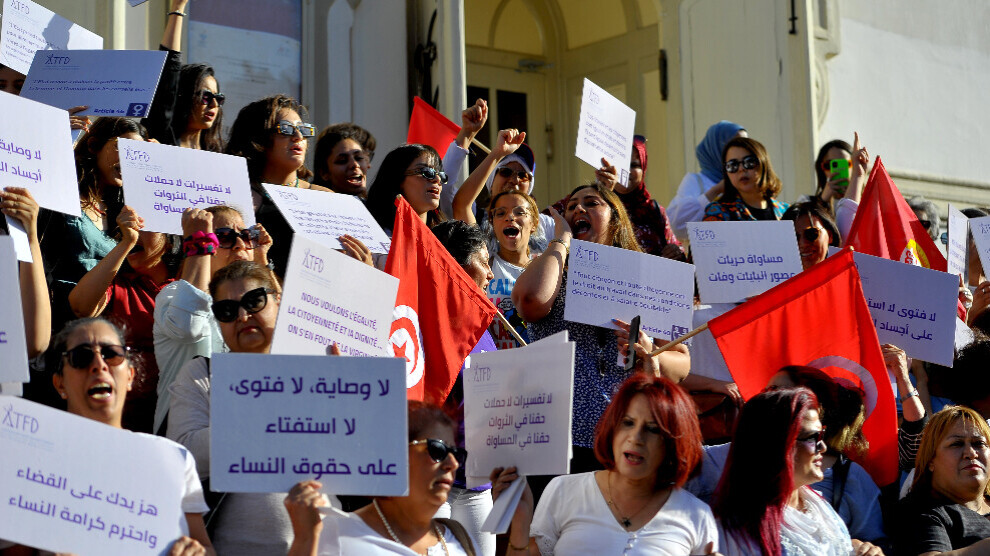
In Tunisia, voices rise to amend the Personal Status Code, which would undo decades of women's struggles for recognition as fully‑fledged humans, not mere complements.
Zahour Al‑Mashrqi
Tunis – When Tunisia chose the path of modernity after independence, the Personal Status Code was a clear declaration: that this nation cannot be built with only half of its society. The Code was the fruit of the struggles of Tunisian women who broke the shackles before the law did. It was not a gift; it was a wresting of rights.
Decades passed, and the path of struggle did not stop. The 2011 revolution came to expand the space, and women won other laws: the anti‑violence law, and the principle of gender parity in elected councils – which was later abolished – but every step said that women's place is not the margin of the nation, but its heart.
Today, seven decades after feminist pioneering and resistance, new croaking voices have emerged – voices that have never digested the idea that woman should be a full partner. They now demand an amendment of the Personal Status Code under the banner of "revision," in addition to efforts to undermine the Code. Just recently, parliament proposed early retirement for women under the pretext that "they are tired." The truth is that the goal is the same: to return women to the home.
It is not a legal revision; it is an attempt to revise history. It is patriarchy that has grown tired of disguising itself in modernity's clothes, so it returns to demand its rights openly: its right to our silence, its right to our absence, its right to have us as mere decoration that adorns the scene without making decisions.
Voices are rising to amend the Code, abolish maintenance payments, and many other women's laws that were won with their blood. The president of the "Houn" Association, Iman Al‑Sharfi, spoke about the current state of women's rights in light of the challenges facing the Personal Status Code, pointing to indicators of a tangible regression affecting women's very being, dignity, and freedom.
She indicated that there are pressures and calls demanding a revision of the Personal Status Code and changes to some of its articles, based on claims that the Code gave women more rights than they deserve, or that it exercises arbitrariness against men.
The gap between text and reality
Iman Al‑Sharfi affirmed that the rights enshrined in law have often become "ink on paper." While the laws exist, reality witnesses a fading and disappearance of these rights, especially in the absence of popular and civil pressure to uphold and support them.
She pointed to the increasing phenomenon of violence against women, attempts to always blame them, and the persistence of stereotypical views that confine women's role to "home and kitchen," denying their inherent rights on the pretext that they are not theirs.
Affirming women's competence
She stressed that today's woman is educated and cultured; she is a judge, a lawyer, a pilot, a teacher, as well as a farmer and a housewife. All these women share the right to preserve their achievements, which represent the "spirit of life" for them.
Iman Al‑Sharfi said that any revision of the Personal Status Code must be for addition and development, not for regression. Tunisian women are the nation's most important asset, and preserving their rights is the only guarantee for the continuation of their giving and their care for the family and society as a whole.
She believes there are more urgent priorities concerning the dignity and life of Tunisian women, such as the issue of "death trucks." She considers that the top priority should be to protect women workers in the agricultural sector who are transported in un‑equipped trucks, described as being transported like "goods," leading to fatal and repeated traffic accidents. She believes that preserving the lives of these women who toil for a living is more important than the legal debate over the Code.
She criticizes the focus on topics such as "polygamy" or "modification of maintenance" in a difficult economic situation, asking sarcastically, "Does our economic situation allow polygamy?" noting that Tunisian men themselves would not agree due to living costs.
She explained that current maintenance amounts (e.g., 120 dinars, about 39 dollars) are not enough even for private lessons for one subject for one child, so how can some demand the abolition or reduction of women's maintenance when it "does not even guarantee a dignified life"?
Providing safe transport
Iman Al‑Sharfi called on the government and relevant authorities to provide safe and dignified public or private transport, such as buses or shared taxis, for these women workers, instead of leaving them to face the risk of death daily. She affirmed that women's dignity begins with protecting their lives and providing humane working conditions for them.
She believes that the current debate over the Personal Status Code is a kind of "intellectual luxury" or a distraction from life‑and‑death issues concerning the safety of a wide class of toiling women in Tunisia.
Those who think that today's debate is merely a "revision" of legal texts are mistaken. It is an exposed attempt to revise the path of an entire state.
The Personal Status Code was never a gift from authority; it was the fruit of a long struggle that Tunisian women wrested with their will. It is a social contract that cannot be revised in closed rooms away from its true owners: the women who carry this nation on their shoulders.