
The reality of female media professionals in Yemen... Challenges multiply in an extremely dangerous environment
International reports indicate that journalists in Yemen work under constant threat, which has pushed many to leave the country, while others have been forced to reduce their activity or withdraw from field work for fear of being targeted.
Rahma Shanzour
Yemen — In a country where media work has turned into an open field of danger, the assassination of journalist Rasha Al-Harazi revealed the scale of violence surrounding female journalists in Yemen. One incident in a long series of violations that have made women's presence in the media a daily gamble, where security threats intersect with social restrictions in an environment that does not recognize the right of female journalists to work safely.
On the evening of November 9, 2021, journalist Rasha Abdullah Al-Harazi (27 years old) was not on her way to cover a crime or expose corruption, but to a maternity hospital to give birth to her expected child. However, the explosive device planted in her car turned the moment of birth into a scene of double assassination, claiming her life and the life of her unborn child, and seriously injuring her husband, journalist Mahmoud Al-Atmi.
This crime, which shook the Yemeni media community, was not an isolated incident but an embodiment of the bitter reality lived by Yemeni female journalists: a daily struggle with the fear of death, incitement campaigns that turn the body into a pretext for targeting, and a complete absence of justice in a country where journalists have become direct targets of repression and physical liquidation.
Limited presence... and increasing risks
Available data reveal the scale of the challenges facing female journalists in Yemen, amid an unstable media environment and increasing risks. According to a survey conducted by the Yemeni Journalists' Syndicate, the percentage of women working in journalism does not exceed 20% of all journalists, reflecting the weak representation of women in this sector.
The challenge is not limited to limited presence but extends to the nature of the environment in which female journalists work. Human rights reports indicate the registration of hundreds of violations annually against journalists, including arrest, threats, trials, work bans, in addition to direct assaults.
"More than 2,000 violations"
During the years of conflict, the pace of these violations has escalated markedly. The Yemeni Journalists' Syndicate, in cooperation with the International Federation of Journalists, documented a total of 2,014 violations of media freedoms since the outbreak of war in 2015 until last April, an indicator that the syndicate described as "the most widespread since the reunification in 1990."
This number reflects an upward trajectory of restrictions on journalistic work, with violations including 482 cases of detention (kidnapping, arrest, and prosecution), 244 cases of direct assault on journalists and media institutions, in addition to 223 cases of threats and incitement campaigns.
The report also recorded 212 cases of website blocking, 175 cases of trials and interrogations, 125 cases of salary and entitlement suspensions, in addition to 74 cases of torture, and 72 cases of being prevented from covering.
On a more dangerous level, the report documented 55 cases of attempted murder, 46 cases of journalists killed, in addition to 165 cases of media shutdowns, 41 cases of arbitrary dismissal, and 38 cases of confiscation of media institutions' property.
In this context, female journalists appear more vulnerable to these risks, as security challenges intersect with social restrictions, making their experience in media work more complex and multiplying the scale of the challenges they face daily.
Double targeting
While journalists in general suffer from a hostile environment, female journalists face additional challenges. 128 participants indicated that female journalists are more exposed to threats and verbal violence, especially through social media.
This targeting is not limited to professional work but extends to personal life, where the female journalist becomes a target of smear campaigns, often based on gender, in an attempt to silence her or push her to withdraw.
In addition to the traditional societal view that still restricts women's presence in the media and places their roles within narrow frameworks, the unstable security situation imposes an even more complex reality, where journalistic work, especially field work, becomes a risky gamble that may expose the female journalist to threat or targeting at any moment.
These challenges do not stop here but extend to the structure of media work itself, from limited opportunities, to weak protection, to difficulties in accessing information, which directly affects the performance and continuity of female journalists in the profession.
"We live as if in a jungle"
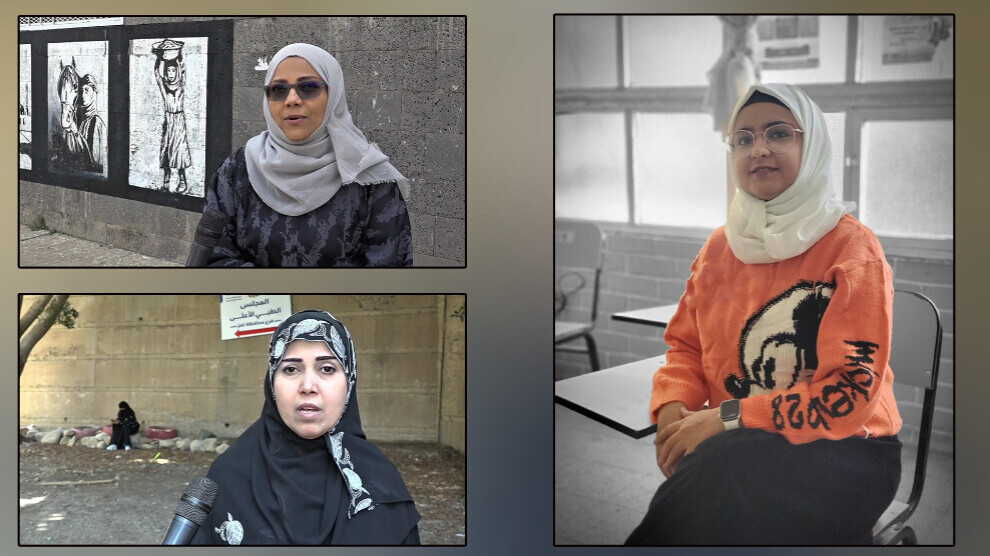
In this context, Yemeni journalist Renad Al-Omrani says: "The reality is very painful. We live as if in a jungle, and there is no law protecting us as women or as media professionals."
She adds: "We cannot clearly practice our rights as media professionals on the ground. I cannot freely express my political tendencies or myself, because that could harm me. There are many incidents that make any female journalist feel afraid, especially those who work in the field and move between regions. You might go to a place and be considered against one faction, and in another place against another faction, which pushes us to silence and to adapt to a harsh social and cultural reality."
Renad Al-Omrani affirms that the absence of legal protection imposes harsh restrictions on freedom of expression, saying: "The government does not take responsibility for protecting us, and there are no laws to protect us, so I cannot declare any political tendencies," pointing out that job opportunities themselves have become linked to affiliations. "Often, opportunities are linked to your political leanings, and if you do not have a clear affiliation, it is difficult to find work."
"A reality harsher than the region"
For her part, Dr. Dhikra Al-Areqi, head of the Sociology Department at Taiz University, believes that the reality of female media professionals in Yemen goes beyond the usual professional challenges to reflect a deeper crisis experienced by society as a whole. "The reality of female media professionals in Yemen may seem similar to that in the Arab world, but it is actually harsher, due to the lack of societal awareness of women's role in the media, and the weak interest of official bodies in supporting them."
She explains that the environment surrounding female media professionals "is full of security risks and complex social challenges resulting from wars and conflicts," making media work a difficult task, despite the ability of many female media professionals to continue and overcome these conditions.
Economic collapse... additional pressure
Dr. Libya Saeed highlights the economic and professional aspect, pointing out that "the conditions of female media professionals, especially during the war years, have deteriorated significantly, with salaries cut and the absence of job stability." She adds that "journalists lack any form of protection, and moving between provinces has become difficult and dangerous, limiting field work opportunities."
She noted that "speaking the truth has become fraught with risk, in an environment that does not tolerate independent voices," pointing out that "the past years have seen the killing of a number of journalists in various ways, simply because they tried to convey the truth." She affirms that there are those who seek to fight press freedom and prevent the clear transmission of the image.
Despite this harsh reality, attempts at resilience have not disappeared. Many female journalists have resorted to working on media platforms, seeking space for expression away from imposed restrictions, and striving to convey the voice of society and its issues.
With the continuation of security, social, and economic challenges, the future of female media professionals in Yemen remains dependent on the availability of a safer and more just environment. Between a harsh reality full of risks and an unbroken determination, Yemeni female journalists continue to write their stories, not only as carriers of news but as makers of hope in one of the most complex environments.