
Potato Fields in Bamyan... Women Carrying the Burdens of Livelihood and Deferred Dreams of Education
Deprived of education, girls in Afghanistan's Bamyan work long days in potato fields for meager wages yet still dream of returning to school and university.
BAHARAN LAHIB
BAMYAN – Bamyan province is considered one of the most prominent Afghan regions in potato production, which constitutes a fundamental source of income for thousands of families that depend on cultivating and selling it to secure their living needs. Therefore, potatoes do not represent merely an agricultural crop for the province's residents, but are directly linked to their source of livelihood and their ability to support their families.
With the arrival of the harvest season, the fields turn into open workshops requiring large numbers of workers. Uprooting potatoes from beneath the ground, gathering them, and sorting them requires great physical effort. Therefore, workers spend a day or several days in the fields to complete this task before transporting the crop to its storage or sale locations.
But this year's potato harvest season carried a different scene that drew our attention more than anything else; the presence of women, especially young women, was clear among the workers in the fields. Their presence was not just a passing detail in the harvest scene, but appeared linked to economic and social conditions that pushed them to work in order to support themselves and their families.
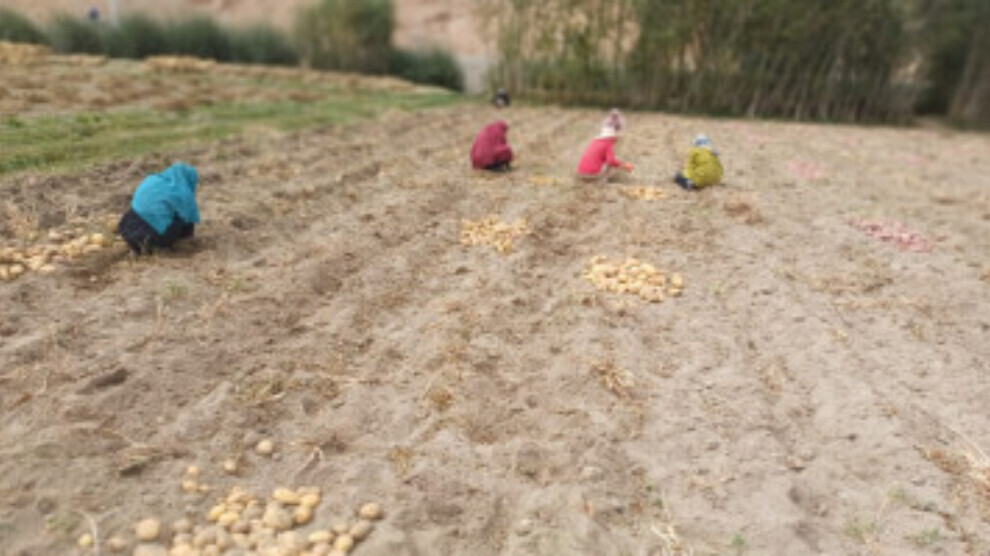
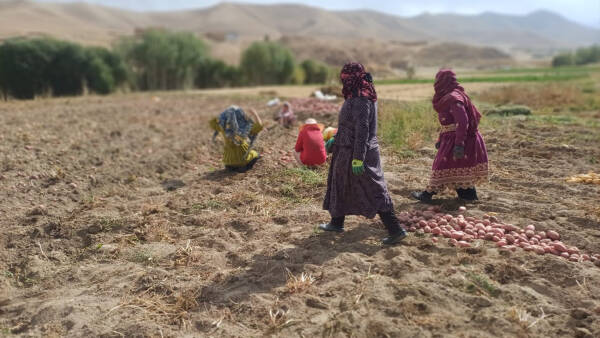
To understand what lies behind this scene, we headed to one of the potato fields in a village in Bamyan province, where dozens of women were working among piles of soil and potatoes freshly uprooted from the ground. While the bright colors of their clothes added some vitality to the place, their features told a different story; faces burned by the sun, hands cracked and hardened from work, and clear traces of exhaustion on their bodies and features.
Despite the harshness of the work, the women continued performing their tasks quickly and regularly, uprooting potatoes from the ground and gathering them without stopping. When we approached them to talk about their lives, it became clear that behind this scene are stories that go beyond the harvest season itself.
Most of these women and girls were deprived of continuing their education, and found themselves before a difficult economic reality that pushed them to work in the fields instead of studying. Today, they do not work only to earn some money, but to contribute to securing a living for themselves and their families, under conditions that have made hard work one of the few available options before them.
Deferred Dreams
Sadaf Taherian was one of the women we met in that field. While she continued her work, fatigue was clear on her face, but what was more present than the traces of hard work was that heavy feeling of an unknown future that appeared in her features.
When we asked her about the reasons that pushed her to work in the potato fields, and about her life before becoming an agricultural worker, she sighed bitterly before answering: "I was in my third year of medical school in Kabul. My family got me there after facing thousands of difficulties."
Sadaf Taherian paused for a moment and stared at the soil in front of her, as if recalling in her mind a life that stopped before reaching its end. Then, after one of her colleagues called her, she returned to talking and said: "I was going to become a doctor specialized in obstetrics and gynecology, but the Taliban did not allow me to do so. As for now, I am just a farmer. All I think about is being able, at any price, to provide food for myself and my family."
Her loss of her education was not the only loss she faced. Her family lives in difficult economic conditions. Despite the passage of three years since the ban on women's education and study, Sadaf Taherian is still deprived of returning to school benches, and found herself forced to work in the fields to secure the expenses of daily life. In this hard work, she receives only a small wage in exchange for a full day of effort.
While Sadaf Taherian's story revealed an aspect of this reality, there were other stories in the same field no less harsh. A short distance from her, we met Nargis Taleb Hussein, who received us with a childlike smile hiding behind it years of deprivation.
She said: "The Taliban did not allow me to go to school after the sixth grade. I now work in the potato fields, and they pay me 200 afghanis for a day of work."
Like Sadaf Taherian and Nargis Hussein, the stories of thousands of girls and women in Afghanistan reflect a reality in which they were deprived of education and forced into hard work to support themselves and their families. Despite that, the dream of returning to schools and universities is still present for them, waiting for a day when the doors of education will open again and their lives and deferred dreams will resume.
https://www.youtube.com/watch?v=W5DeHzxN_Bg