
Blind People Facing Digital Exclusion in Iran
Internet shutdown in Iran are now a tool for social and economis control, weakening livelihoods exacerbating inequality, and excluding vulnerable groups, plunging millions into crisis.
Bershenk Dolatyari
News Center — Since the beginning of the war, and even during the recently announced ceasefire period, internet disruption and shutdowns in Iran have become one of the most prominent tools of governance. This tool can no longer be explained solely within the framework of "security necessity." This phenomenon has reached a level of organization that can be described as a kind of "engineering of poverty" and the gradual exclusion of human beings from social life.
According to official statistics, more than 60 million people—including the blind, who rely on the internet for mobility, daily tasks, and maintaining their independence—face restrictions that not only deprive them of access to information but also strip away their very possibility of "existence" in the world.
In this context, the internet is no longer just a technological means but has become the dividing line between presence and absence. Among these large numbers, the story of "Awat M." from Eastern Kurdistan emerges, transferring this crisis from the level of statistics to the level of a human being.
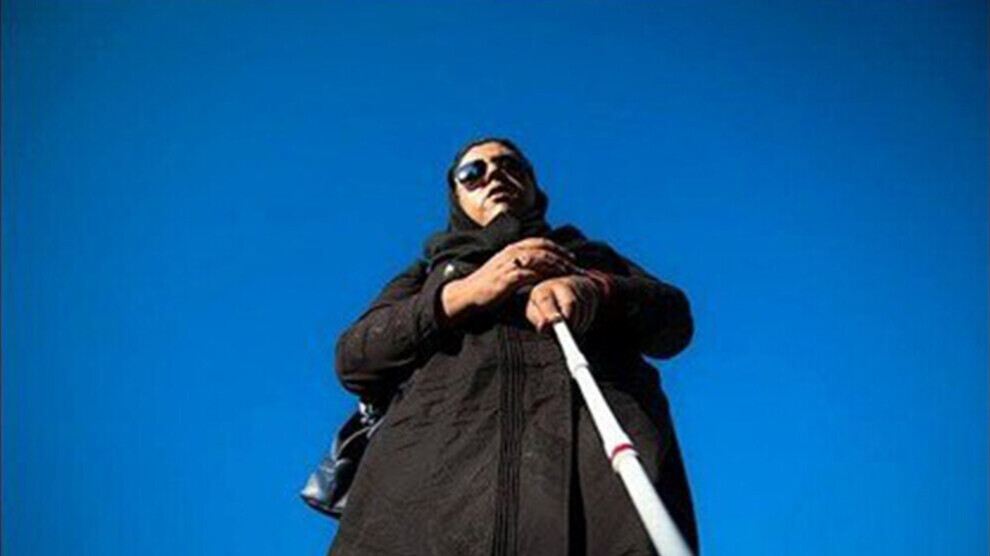
Awat M. lost her right hand, three fingers of her other hand, and the sight in both eyes due to the explosion of an unexploded landmine. After this catastrophe, she rebuilt her life relying on the internet, through screen reader programs, online banking, and communication.
But with every internet shutdown, not only does her connection to the world break, but her "rebuilt life" also collapses. For her, an internet shutdown means returning to the moment of the explosion—a repeated experience of exclusion from the world.
This collapse does not occur on an abstract level; it manifests in the smallest details of her daily life. Awat M., who was previously able to conduct simple banking transactions using her phone and speech programs, now, in the darkness of the internet shutdown, depends on her ten-year-old daughter. Tasks that once meant independence have today become symbols of dependence on others.
Even the simplest movements, such as leaving the house or walking a short distance using special voice applications, have become disabled. With the absence of the internet, these tools stop working, and she is forced to hold her child's hand to walk through the city. The city is no longer a comprehensible space for her but a dark labyrinth that only regains its meaning through her daughter's voice.
This dependence is not only practical but also an internal collapse. She who spent years trying to regain her independence now finds herself forced to rely on her child for the simplest matters. Here, an internet shutdown means a forced return to a state of helplessness, to the point she had tried to overcome.

Gradual exclusion from social life
Today, cutting the internet has become a governance tool targeting citizens' daily lives. Reports from NetBlocks indicate that internet disruptions in Iran have reached approximately 1,000 hours, meaning that more than 70% of the population (about 60 million people) are effectively deprived of access to the global internet.
This situation has transformed the internet from a global network into a "controlled intranet," where access becomes a political privilege. This can be called the concentration of digital power—the transfer of control from the user to the authorities, from society to the governing structure. In such a system, opacity replaces transparency, accountability becomes unnecessary, and power is exercised through deprivation and closure.
The blind on the front line of silent exclusion
For the blind, the internet is an infrastructure for survival. It provides mobility, independence, participation, and even human dignity. But in Iran, even under normal circumstances, many digital services are not adapted to the needs of the blind. And with the internet now cut off, even this limited possibility is lost.
For Awat M., the internet was a substitute for her eyes. When it is cut off, this "digital sight" goes out, and the world becomes inaccessible to her. Here, a form of violence emerges that is not physical or visible, but structural and invisible. Just as the landmine destroyed her body without warning, the internet shutdown destroys what remains of her life without warning.
Invisible unemployment... exclusion without registration
On the other hand, according to official statistics from several authorities in Iran, about 8 to 10 million people depend directly on the internet as a source of income. Daily internet shutdowns cause losses estimated at about 5,000 billion tomans to the overall economy, reaching about 150,000 billion tomans over 30 days. Recently, with this situation continuing for 40 days, estimates indicate losses approaching 200,000 billion tomans.
If these losses are distributed among workers in this sector, each individual experiences an average daily income reduction of about 500,000 tomans. For many, this figure means the complete loss of their livelihood.
But what makes this crisis more complex is its nature: it is not a "natural disaster" or an "external shock," but rather a form of organized extraction of resources from society. This can be described as "reverse redistribution"—the transfer of wealth from the lower classes to the upper classes, without law, without transparency, and without the possibility of objection.
For people like Awat M., these numbers carry a very direct meaning: an internet shutdown means a complete loss of income, with no alternative. She cannot work in the traditional labor market. The digital economy is her only refuge—a refuge that collapses with each new shutdown.
In the same context, one of the main justifications Iran offers for cutting the internet is "national security." But what is happening in practice is an inversion of the concept of security. Instead of security meaning the protection of citizens' lives, it has come to mean control over them. Thus, what is practiced in the name of security is actually the production of livelihood insecurity.
The experience of the November 2019 protests, and the continuation of internet shutdowns even after the ceasefire was announced, shows that this policy is not circumstantial but part of an ongoing pattern of governance. In an economy where the informal employment rate exceeds 60%, the internet plays a vital role in production and income. Cutting the internet leads to the unemployment of millions of people, but this unemployment is not recorded in any statistics. This is known as "invisible unemployment."
On the other hand, according to official statements, many businesses cannot continue for more than 20 days. With the internet shutdown entering its second month, this means crossing the threshold of collapse. Estimates indicate daily losses of 500 billion tomans for the digital economy and 5,000 billion tomans for the overall economy. But these figures represent only part of the picture. Internet disruption creates a cascade of effects, from the disruption of sales and payments to transportation, customer communication, and even the activities of traditional professions.
In addition, additional burdens have been imposed on citizens, such as the sharp rise in VPN service prices, to the extent that many have had to allocate part of their monthly income to obtain limited internet access.
Another important dimension of this crisis is the emergence of what can be called "class-based internet." While most people face severe restrictions on internet access, certain entities within the power structure enjoy unlimited access. The special connection cards known as "white cards," and the statements of some officials who authorize the internet for "those who convey the voice of others," show that the internet has been transformed from a public right into a political privilege.
Thus, what is happening today in Iran is a form of governance through shutdown. This policy, through the combination of digital control, economic pressure, and social exclusion, creates a structure in which human beings are gradually excluded from independent life. In this context, Awat M. is a model of what millions of people are going through without being seen. In an internet shutdown, what disappears most is not just connection, but the very possibility of human existence.