
Schools of Southam Lebanon After the Attacks… A Return to Classrooms That Have Not Yet Recovered
In southern Lebanon, schools are returning to receive their students despite the damage, displacement, and effects of the attacks. A return in which classrooms do not only recover their educational role but try to open a window toward the future.
RANA JONY
LEBANON-Israeli attacks targeted schools in southern Lebanon, destroying dozens of them and damaging hundreds of others, while access to some of them has become impossible, due to destruction or the security conditions that still surround several towns.
It was not only students who were forced to leave their seats. The schools themselves emerged from the attacks burdened with damage, and some are no longer fit to receive their students as they were before.
In towns that experienced displacement and destruction, returning to school has become part of a bigger question: How does education return to a place where life has not yet regained its stability?
In Burj Qalaouiyah, the return looks different. The school that was damaged during the attacks is returning again, but not to a fully ready reality. The building still bears the traces of destruction, and the classrooms lack many of their components, while the administration and teachers try to restore the educational process with what is available.
Classrooms Lacking Much
At "Hassan Kamel Al-Sabah" Secondary School, the impact of the attacks is still present in the details of the scene, but students talk about the return as a recovery of something of their lives that had stopped.
Student Aya Murad says: "The place has changed, but the heart is still the same, and so is the passion for studying. Everything in the classroom, of spirit and memories, is still present inside us."
For students, school is not just a place for learning, but is colleagues, teachers, memories, and a space they are used to living part of their day and childhood in.
As for student Rima Faqih, she confirms that difficult conditions will not prevent her from continuing her education and achieving her dreams, saying: "Nothing can prevent us from achieving our dreams and pursuing our passion in life. We have confidence in ourselves, and we believe in our ability to continue."
In-Person Return Exceeded Expectations
At "Kafr Rumman" Second Intermediate School, the return to in-person education came as a surprise even to the school administration. Expectations indicated lower attendance, with a large number of students relying on remote education, but reality came differently.
School principal Lina Ibrahim says: "The start was successful and very positive. We were surprised by the density of student attendance. We expected the rate of remote education to be 40% and in-person education 60%, but the result came differently, as the attendance rate reached 80%, compared to 20% for remote education."
For the school administration, these figures do not only reflect students' desire to return to their classrooms, but also express parents' desire to restore their normal lives after months of displacement.
She adds: "This is encouraging, and indicates that our people are enthusiastic about restoring their lives, and also reflects steadfastness, resilience, and determination."
Lina Ibrahim explains: "We did not abandon any student. All our students remained within the school even during the displacement period, and we continue in the afternoon to provide the same lessons via the internet for students who are still displaced."
What is remarkable is that the numbers of students did not decline, but increased, with a number of students moving from private schools to the public school. She says: "A large number of students coming from private schools joined us."
What is happening inside the classrooms cannot be separated from the outside
The teachers themselves emerged from the experience of war and displacement, and find themselves today before a double responsibility: caring for their families, and continuing to perform their educational role with students.
Maryam Hamza, one of the teachers, says: "I am here today a mother and a teacher at the same time. I think about my children, and at the same time I know that I must perform my role toward my students."
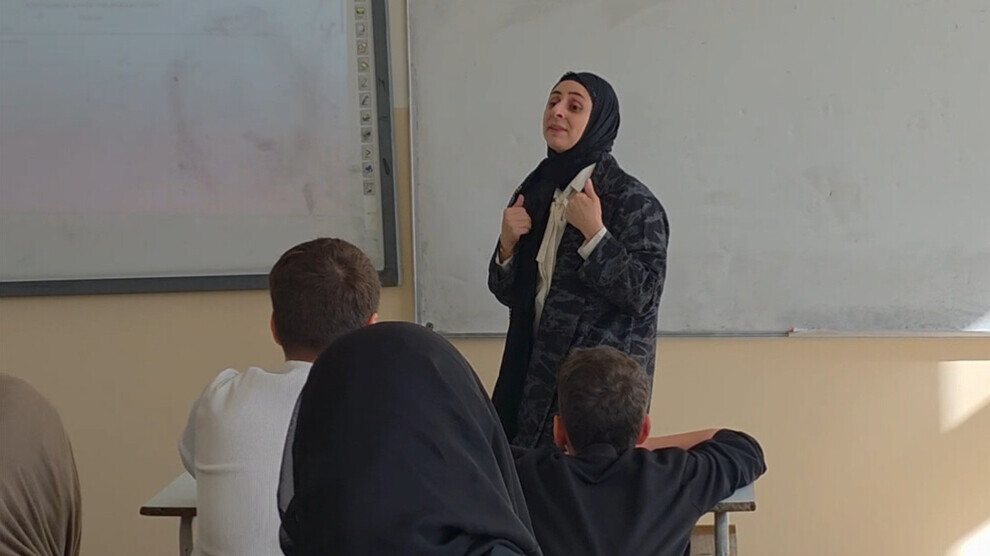
When she enters the school, she tries to put her worries aside, adding: "As soon as we cross the gate of Kafr Rumman Second Intermediate School, we leave everything outside. We enter to be before students who are the youth of the future, and all our focus is on them inside the classroom."
For students, returning to school does not mean that life has returned to normal. The effects of the attacks and displacement are still present in the details of their lives, but they hold on to education as a space for continuity and building what is to come.
Students return to their seats after months of interruption, amid damaged buildings and accumulated lessons, in an attempt to restore the rhythm of study and life together.
Teacher Mariana Salloum describes the reality of education today: "We are still under the influence of displacement, and we live between two homes and move from one area to another. But we have faith and hope that this country is only built with knowledge and development."
Perhaps the phrase that summarizes the meaning of this return is: "We return to carry the pen and fight with our pen, just as we fight by other means." For schools in southern Lebanon are not only restoring education, but restoring with it hope for the future, as students return to their classrooms despite the effects of the attacks, to confirm that education remains a space for life and a beginning for what comes after war.