
Reverse Migration in Iran… Social Obstacles or a Noose Choking Women?
High rents and the burdens of living costs push women who support their families to move from small homes to the edges of the city, ultimately to remote villages; a forced migration that exacerbates poverty, restrictions, and inequality.
SARA POUKHZARI
KERMANSHAH _ Reverse migration is a complex social phenomenon, but due to poverty and restrictions, it turns into a loop tightening around women’s necks, as they alone face the consequences of displacement, loss of independence, and the cruching of ambition in environments drowning in crises.
She moved from an 80-square-meter space to 60, then to 40; and now she is constantly searching for a dwelling smaller than that, but finds nothing, not even at the farthest edges of the city. She used to say: "My situation has reached a point where I may have to rent a place where I cannot even stand upright."
This is the story of a woman whose living standards decline day after day with the rise of inflation, as she witnesses a continuous shrinking in her meals, her housing, and her source of livelihood. In economics, when inflation rises and expenses exceed income, the initial reaction is retreat, meaning trying to ward off extreme poverty even for a brief period. But how does this mechanism work? Regarding food, with rising prices, families replace goods with cheaper alternatives; for example, they may shift from consuming red meat to chicken, then from chicken to soy products.
When Rents Push Women to Leave the City
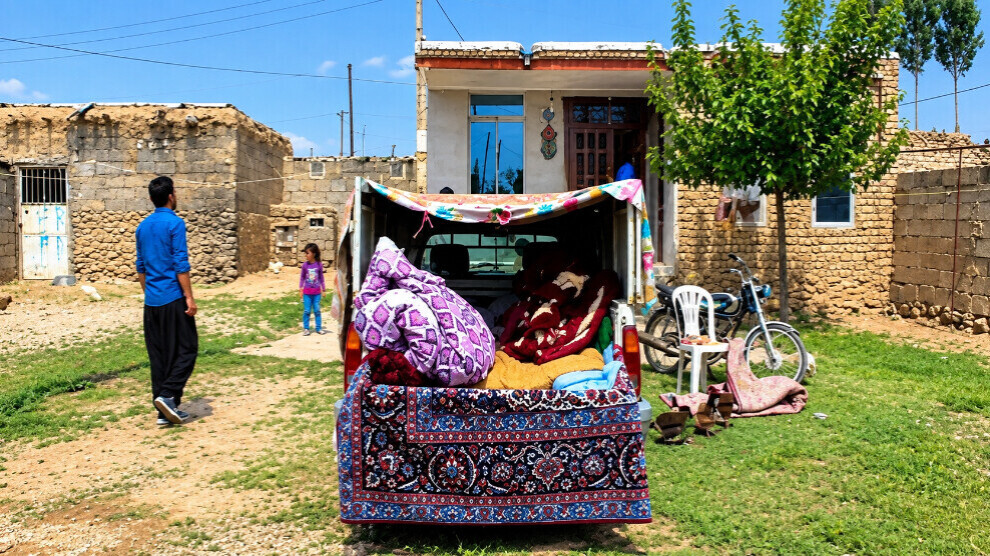
In Kermanshah city, high rents push women who support their families to move to smaller homes located in remote areas at the edges of the city; a trend that sometimes forces them to leave the city entirely and migrate to villages. Kobra Z., a woman who supports her family and was forced to move some time ago due to rent burdens and other living expenses, recounts her story: "We initially lived in the 'Maskan' neighborhood, but economic pressures forced us to move to a smaller house in a less affluent area to manage our living affairs. We moved to the 'Anahita' neighborhood, and later, due to the same continuing difficulties, to 'Karnachi.' Now, the rise in rent and food costs has forced us to move to a village, as life in the city is no longer possible. I rented a house in the village of 'Qazanchi' on the outskirts of Kermanshah some time ago. However, even with living in the village, I feel I will be forced to move to a more distant village next year, given the increasing burden of these expenses."
In recent years, economic pressures have pushed some women who support their families to undertake "reverse migration," meaning moving from cities to smaller towns and villages. The lack of job opportunities, education, and transportation in these areas has negatively affected their living conditions and their ability, and that of their children, to access basic services.
Razieh S., a woman who supports her family and had been living in "Qasr-e Shirin" for a period before being forced to return to a village near "Seh Tappeh Babajani," recounts her story: "I returned from Qasr-e Shirin to my original village some time ago because I could no longer bear the living costs in the city. I now live in a small room in my father's house courtyard, and I must work to secure my living needs. However, the only work available in the village is limited to weeding and agricultural work. I was unable to send my eldest daughter, who is 18 years old, to university; our village is very far from the city, and there are no means of transportation to take her there. Although cities provide more advantages and services, the high living costs and economic pressures make staying in them impossible."
When Gender Intersects with Poverty
Sources and statistical data in Iran, when analyzing the phenomenon of "reverse migration," meaning the movement of families from major cities back to small towns or villages, generally focus on economic conditions and livelihood challenges. However, reality indicates that this phenomenon is not merely a purely economic issue; gender also plays a crucial role in it. Women, especially those who support their families, are disproportionately affected by this migration and its consequences.
Mitra G., a sociology student, comments on this: "Gender dynamics in the labor market mean that priority in employment is constantly given to men in various sectors; as a result, women are the first to be excluded from the workforce. The absence of job opportunities for women means the absence of independent income for them, making them more vulnerable to economic pressures compared to men. Ultimately, these pressures push women toward 'reverse migration,' a step not taken by choice, but out of necessity and inability to continue living in the city. Many women who previously migrated to major cities in pursuit of education, work, or financial independence now find themselves forced to return to their original places of residence due to harsh economic and social conditions. Accordingly, reverse migration for women who head families and young women who moved to cities in search of a better future has turned into a whirlpool of forced return, a whirlpool that further undermines their independence and security."
The analysis of this issue reveals that reverse migration in recent years is not merely a result of economic conditions, but is a phenomenon with gender dimensions that disproportionately and deeply affects women; they are the group that bears the greatest burden of any transformation in social and economic structures.