
Olive Culture in Derik… A Legacy Passed Down by Women Despite the Hardship of Work
With the arrival of autumn, the olive picking season begins in the Derik area of northern Kurdistan, where inherited agricultural traditions are renewed despite economic burdens and work difficulties.
AKIN STERK
MARDIN– The olive harvest season has begun in Derik, affiliated with Mardin city in northern Kurdistan, where olive trees rooted in the region's land for centuries return to witness a new season of work and giving.
After a year of effort and patience, farmers begin picking the olive fruits from the branches, in an arduous journey that requires a lot of work before these fruits reach the people's tables. With the first threads of morning breaking, producers head to the orchards to harvest the crop that represents the outcome of a full year of fatigue.
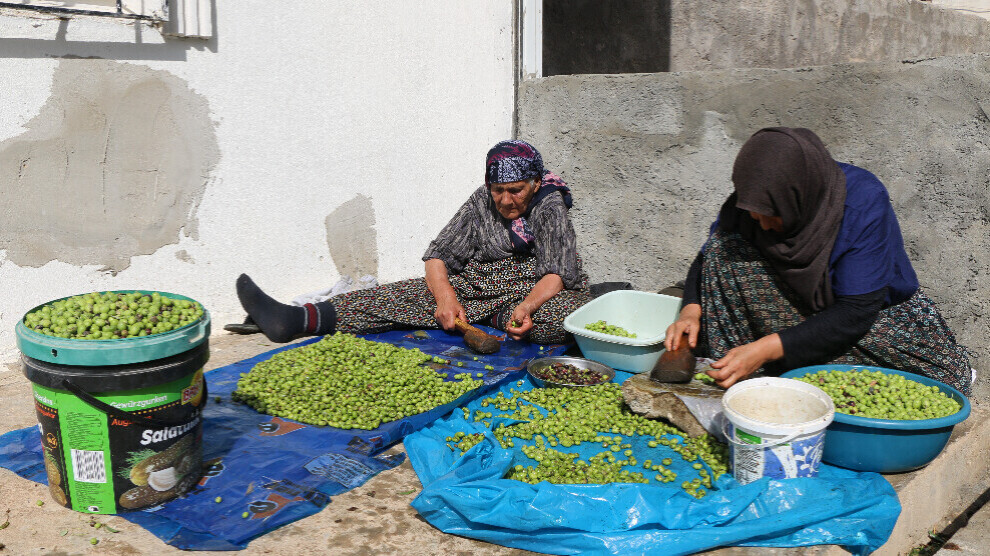
Shahida Kul, despite not owning an olive orchard, continues to preserve this inherited custom by buying the crop from her relatives and cracking it in front of her house in preparation for the winter season. She says: "I buy olives and bring them to my house to crack them. We do not have our own orchards, but my relatives own orchards and pick the crop, so I buy from them and begin preparing it."
She explains that her family used to own olive orchards in the past, noting that the crop comes from the village of "Harmia," to which she belongs. "When the rains fall and the olive grains begin to turn black, we start picking them. The harvest season begins in autumn, specifically during these months. But the current economic crisis affects us greatly."
An Arduous Journey from the Orchard to the Home
Regarding the hardship accompanying the olive harvest and its preparation, Shahida Kul notes that work begins in the orchard, where farmers spread plastic covers under the trees, then climb ladders to pick the fruits from the branches. "Collecting olives is hard work, and even cracking them requires great effort. After the harvest, some sell their crop, while others keep part of it to prepare at home. As for me, I buy olives and crack them in front of my house door."
She confirms that Derik's olives carry cultural and social value, alongside the continuous effort their production requires, explaining that their preparation passes through several stages, starting with sorting the black olive grains and cleaning them using a sieve, then cracking them and placing them in containers filled with water to remove their bitterness.
She adds: "After two or three weeks, the olives become palatable, so we add salt to them and distribute them in small containers. People sell the quantities exceeding their need, while keeping enough for household consumption."
"We Suffer Greatly During Picking and Cracking Olives"
Regarding the physical burdens she bears during work, she explained that cracking olives alone causes pain in the back and hands, despite her not participating in the picking process. "I start work in the morning and continue until evening, then return home to follow up on household chores. Women's responsibilities do not end; many burdens fall on their shoulders."
In reference to the high cost of living, Shahida Kul explains that she bought a measure of olives for seven billion, as she put it, but the quantity was not enough to meet her needs. Despite the economic difficulties and the effort that preparation requires, she holds on to olives that are grown naturally and prepared by hand, considering that this gives them a distinctive taste. As for black olives, they turn them into olive oil and then sell it. Olive oil is very beneficial for health.