
From War to War… A Palestinian Woman Stuck in Gaza
Aseel Omeira fled Sudan's conflict seeking safety for her children, only to face Gaza's war, where displacement, hunger, and faltering aid persist as she dreams of family reunification and dignity.
NAGHAM KARAJA
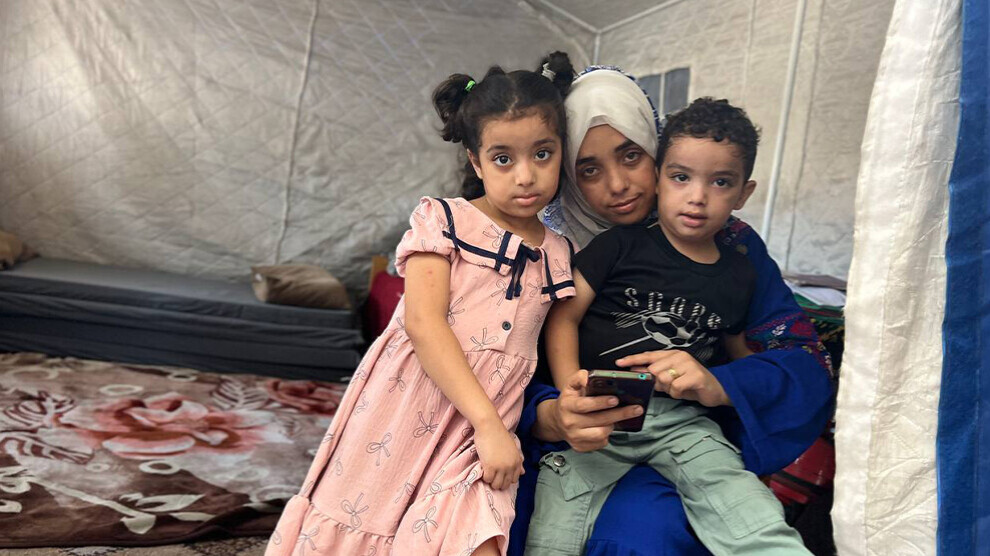
PALESTINE_Aseel Omeira fled from Sudan to the Gaza Strip in April 2023 accompanied by her two children searching for safety, while her husband remained in Khartoum. Six months later, war broke out in Gaza, and she found herself stuck between two wars, suffering displacement, hunger, and her children's deprivation of a normal life, unable to return to her home.
The Palestinian Aseel Omeira (30 years old) recalls that her departure from her father's house in the Gaza Strip in Palestine for the first time did not mean to her the beginning of a long displacement. She believed she would return after a short period, and never imagined that the stations of displacement and fear would turn into a reality lasting for years. She says: "When we left the house for the first time, we thought we would return soon. It never occurred to us that the period would extend to this extent, and that we would find ourselves stuck here."
She adds: "I fled from Sudan to save my children from the war, only to find the Gaza war in front of me. The bombardment was terrifying, and all that preoccupied me was how to protect my two children and ensure their survival."
Aid That Does Not Always Arrive
Aseel Omeira held on to staying in her father's house, but the escalation of attacks forced her to face repeated displacement in search of safety. She confirms that famine was the harshest thing she experienced with her two children, as she faced difficulty in providing food for them amid scarce resources and the impossibility of accessing aid, under constant fear for their safety.
She also encountered administrative obstacles preventing her family from obtaining some relief aid. Being a Palestinian married to a Sudanese, and her two children holding Sudanese nationality, makes proving the family's status and submitting its data to institutions more complicated, according to her account.
She explains that some entities request complete personal data, then inquire about the husband's status and whereabouts, and request proof that he is outside the Gaza Strip and not residing with the family. She says that the Sudanese nationality field in her documents increases the difficulty of procedures, and that she is forced to make repeated attempts to complete registration.
She explained that she suggested to her husband to record a video in which he explains that he is outside the Strip and that his family is stuck in Gaza, in the hope that this would help prove their status. Nevertheless, the family does not receive aid every time.
After years of appeals, she no longer sees her need as limited to food parcels or temporary aid, but is demanding a solution that allows her to leave the Strip and restore her family life.
When Aseel Omeira talks about return, she is not talking about an unknown place; she has a home in Khartoum, and a life she had hoped to resume after the end of the conflict. But she cannot, until now, turn this desire into an implementable plan.
She confirms that her fundamental demand is to open the crossing before her to travel to Egypt so that she can reach Khartoum to restore her family's stability. "I want nothing more than to live a normal life. I want to feed my children and give them water, and to accompany my daughter to school like the rest of the mothers. I want us to live a dignified life."
Education Is a Deferred Right
Aseel Omeira faces difficulties in registering her daughter in school due to limited seats and fees, as one school requested about 50 dollars to register a child in the second grade, an amount that exceeds the capacity of many families affected by the war. With public schools not accommodating all children, education opportunities remain limited for her family.
The burdens do not end at food and education; life inside the tent imposes daily challenges related to privacy and the use of sanitary facilities, especially when they are far from her temporary residence. She says that she is sometimes forced to ask for help to meet her basic needs, in an experience that affects her dignity and independence.
Reunification Is a Humanitarian Necessity
Aseel Omeira's case transcends the limits of individual suffering, to reveal how war, displacement, and the separation of family members intertwine with administrative and economic obstacles, turning the simplest rights into deferred demands.
The United Nations Population Fund warned of the worsening of family separation, gender-based violence, and child marriage in Gaza during the first quarter of 2026, simultaneously with the deterioration of humanitarian conditions. The United Nations Office for the Coordination of Humanitarian Affairs also indicated the continuation of efforts to protect children and reunite those separated from their families.
These data indicate the widening need to protect family ties, but they do not provide a comprehensive figure determining the number of foreign women or wives stuck in Gaza due to the impossibility of travel and reunification.
Aseel Omeira demands the provision of a safe and clear path that allows her to leave Gaza, so that she can restore her life with her two children, confirming that her right and that of her children is to live in dignity and safety and to reunite the family away from continuous suffering.