
Duaa Al-Wazir: Empowering Women Is a Fundamental Entry Point for Enhancing Civil Peace in Gaza
Amid the escalating crises in the Gaza, women emerge as an active societal force in preserving civil peace and resolving conflicts, which requires enhancing their participation in decision-making,providing protection, support, and official representation.
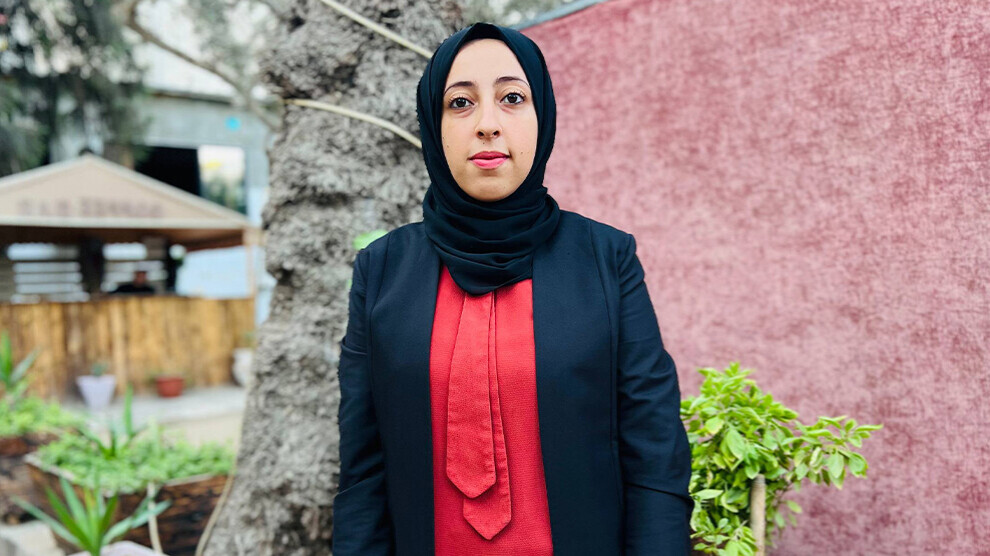
RAFIF ESLIM
Palestine – Civil and societal peace is considered one of the pillars for the establishment of any sound society. But how can this be achieved in societies still suffering from the effects of horrific wars and their severe consequences on the individual and society? And do women have a role in this through activating protection mechanisms and their leadership and relief roles alike in community organization committees?
Duaa Al-Wazir, a researcher at the International Commission to Support the Palestinian People's Rights, indicates that the term civil and societal peace in its simple concept means the stability of society and making it calmer and more disciplined. When linking the concept to women's role, the narrow view that confines their roles to the family scope only must be transcended, as they are the safety valve and the first shock absorbers in society, and their initiatives in support of this must be considered, as they fight daily battles to preserve civil and societal peace.
She explains that civil peace cannot be achieved except by building an essential partnership with women so that society becomes more stable and cohesive. She notes that to achieve this, protection mechanisms must be provided, which requires providing technical, logistical, or legal support, such as receiving reports from women exposed to violence and adopting complaint programs that do not rely on the internet.
She explains that the Gaza Strip is living in a state of chaos and shortage of resources and basic life necessities, all of which works to threaten women and their internal safety. She notes that achieving civil peace cannot begin without guaranteeing internal peace for women and providing their basic needs and a dignified life for them.
She points out that women's leadership roles come from a responsibility stemming from themselves; they do not wait for a signal from anyone to perform their role. Women were the first to establish educational points without support from anyone, and the first to open medical points to provide various services, most importantly physical therapy.
She adds: "Women organized many awareness workshops to activate women's leadership role. They had a role in resolving conflicts in the camps and enhancing civil peace, especially in light of the collapse of the judicial system and the absence of security in the Gaza Strip."
The Absence of Support
While at the level of civil society and local leaderships, there must be a role for women in reform and official neighborhood committees by including legal experts in those committees, so that there is real involvement in conflict resolution and achieving civil peace. She notes that among the difficulties women also face are the tribal pattern and the stereotypical image by confining their role to the family scope only, material dependency, economic violence, their deliberate exclusion from decision-making centers, in addition to logistical complications with the absence of support.
To achieve societal peace, she recommends harmonizing legislation and approving the quota — that is, harmonizing all laws, regulations, and special government plans and crisis and emergency management with UN Security Council Resolution 1325 and the CEDAW Convention — with the approval of a governed mandatory representation rate of no less than 30% to involve breadwinning women and women pioneers of community work in neighborhood committees and supreme emergency committees as a fundamental condition for their national and legal legitimacy.
Duaa Al-Wazir also confirms the necessity of challenging the exclusionary administrative decisions issued by traditional or tribal emergency committees, and considering any committee that excludes women as lacking legitimacy. In return, women must be officially and structurally involved in local reconciliation and mediation committees, and constitutional cover must be provided for resolving internal disputes over scarce resources inside displacement centers.