
Child Labor in Gaza… Childhood Traded for Survival
In the Gaza Strip, child labor is no longer an exception driven by necessity but a daily reality fueled by war and poverty, depriving thousands of children as they work.
NAGHAM KARAJA
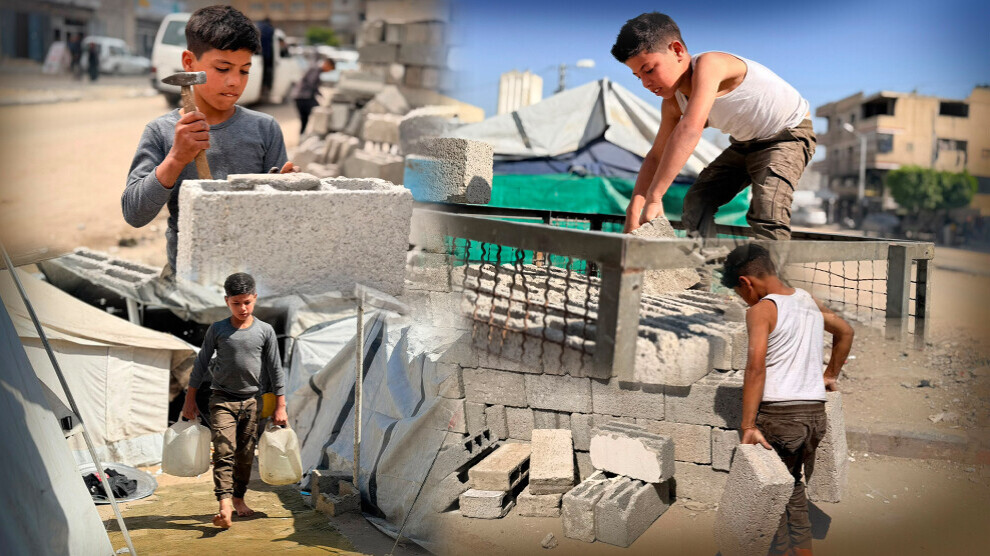
Gaza — From the early hours of the morning, Hassan Saad, a nine-year-old boy, bends over piles of rubble from destroyed homes, carefully collecting, cleaning, and sorting stones before selling them for a small income. Instead of waking to the sound of a school bell, Hassan begins each day under the scorching sun, searching for a way to help feed his family, whose lives have been devastated by war and poverty.
A Child Carrying the Burden of an Entire Family
Living in a displacement camp in the Gaza Strip, Hassan's childhood has become a daily struggle for survival. The war forced him to leave school despite being an outstanding student. Now, he supports a family of ten, including his late brother's orphaned children after their father was killed during the war. While other children try to play or continue their education under difficult conditions, Hassan spends his days collecting stones from buildings destroyed during the conflict, cleaning and sorting them for reuse in construction.
The work is physically exhausting and painful. Heavy tools often cut his fingers, while carrying stones for hours leaves him with constant pain in his back and shoulders. Yet the family's desperate financial situation leaves him with no choice but to continue working for a meager daily wage.
"I never imagined I would leave school like this," Hassan said as he wiped dust from his face. "I loved studying and coming home with my books and homework. Now I carry stones instead. I'm always tired, and my back and hands hurt, but I can't stop because my brothers and my brother's children need food. We have no other source of income."
He added, "Whenever I see children carrying schoolbags, I remember my school, my classmates, and my teachers. I still dream of returning to the classroom. I didn't choose this work—the war forced it upon us. I hope one day I can put down the stones and hold a pen again."
The Harsh Reality of Child Labor
His 40-year-old mother, Sanaa Saad, works beside him from early morning, watching her son carry loads far beyond his strength. Whenever she notices signs of exhaustion, she helps him lift, transport, and stack the stones, trying to ease a burden no child should bear.
"Every day I watch my son go to work instead of school, and it feels as though my heart is being torn apart," she said. "No mother wants to see her child carrying rocks instead of notebooks, but we were left with no alternative. My husband is elderly and can no longer work, and we receive no humanitarian assistance because the area where we live is almost forgotten. Hassan became our only option."
"When I see sweat pouring down his face under the burning sun, I leave everything to help him. I carry stones beside him because I cannot bear to watch him suffer. He often returns to the tent with cuts on his hands and severe back pain, yet he wakes up the next morning and does it all again because hunger cannot wait."
Sanaa explained that her eldest son was killed during the war, leaving behind orphaned children. "Hassan now feels responsible for them as though he were a grown man. It breaks my heart to hear him worrying about household expenses instead of talking about school or playing. The war stole his childhood, just as it has stolen the dreams of thousands of children."
"I don't ask for the impossible," she continued. "I only want my children to have a normal life—to have food, education, and safety. Every mother in Gaza carries the same concern. We fear for our children more than for ourselves."
Beyond earning enough to feed the family, Hassan also feels responsible for caring for his orphaned nieces and nephews. Between every stone he lifts lies a story of grief, resilience, and survival—a reflection of how war has transformed childhood into a life of labor and responsibility.
A Ceasefire That Failed to Restore Childhood
Although a ceasefire came into effect on October 10, 2025, humanitarian conditions in Gaza have seen little improvement. Violence and insecurity continue, while hundreds of thousands of displaced people remain trapped in severe hardship. Economic collapse and the lack of employment opportunities have forced increasing numbers of children into the labor market, depriving them of their rights to education, protection, and healthy development.
As the sun sets, Hassan gathers the last of the cleaned stones and returns to his tent with cracked hands and an exhausted body. At just nine years old, he no longer measures his days by school lessons or games but by the number of stones he has sold and the money he has earned to feed his family and his orphaned relatives.
Amid the ruins of flattened homes, Hassan's story reflects the reality of an entire generation whose childhood has been taken away by war, forcing children to shoulder responsibilities far beyond their years at a time when they should be building their futures—not rebuilding the rubble of their homeland, one stone at a time.
https://www.youtube.com/watch?v=4zv_4IuC-UM