
“Bayt Al-Mouneh”…A Project Achieving Self-Sufficiency for Women in Kobani
In Kobani city, women preserve the tradition of preparing winter provisions, turning this skill into a job opportunity and a source of income, through the “Bayt Al-Mouneh”project, which provides economic opportunities for women.
NORSHAN ABDI
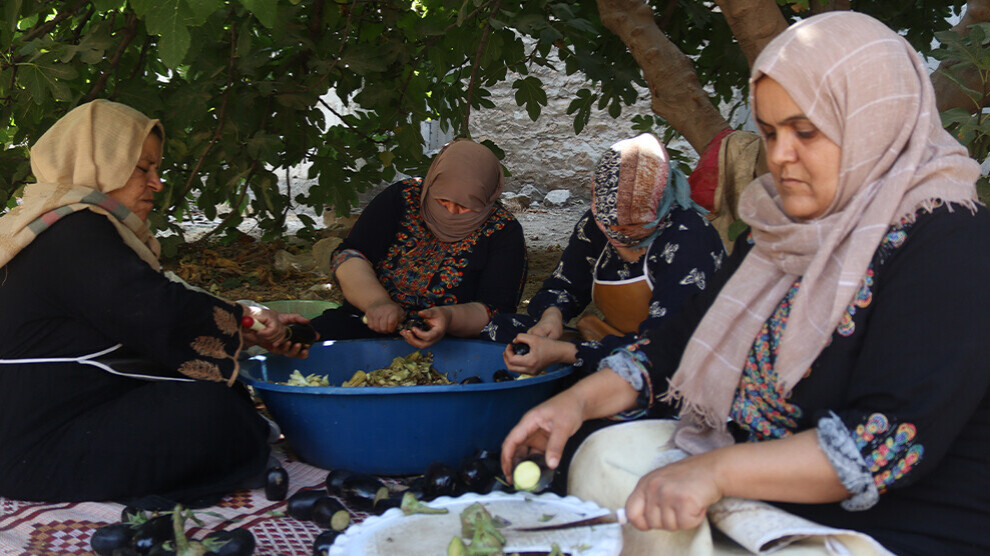
Kobani – With the aim of encouraging women to work, rely on themselves, and empowering them economically, the Economy Committee of the Kongra Star in Kobani city in Rojava opens several projects for women, including the "Bayt Al-Mouneh" (Pantry House) project, which is opened every year in the summer months until the beginning of winter, for five consecutive years, in which about ten women work.
Women's work increases in the summer and autumn months of each year, as they begin their work by preparing winter provisions. This is considered a culture among the people of Kobani throughout history, and women still preserve it from generation to generation, as they store grain crops — wheat, chickpeas, lentils, and other legumes — and dry all kinds of vegetables, in addition to all types of jams. Women consider winter provisions a main and necessary economic pillar in every home.
To learn about the "Bayt Al-Mouneh" project, the nature of women's work within it, the goal of opening it, and its importance for women, our agency conducted interviews with the women working in it.
A Job Opportunity for Women and Support for the Local Economy
Regarding the goal of opening the "Bayt Al-Mouneh" project by the Economy Committee of the Kongra Star, Shiraz Ibrahim, the supervisor of this project in Kobani city, explained that "the primary goal of this project is to encourage women to engage in the labor market and contribute to improving their economic conditions, especially working women and those seeking job opportunities. Through these projects, the Kongra Star seeks to provide a space for women and enable them to obtain job opportunities that help them achieve economic independence and enhance their role in society."
She added: "The project met with remarkable response and acceptance from the people of Kobani city, despite its launch with limited capabilities and a small scope. However, our ambition is to develop the project and expand its scope, allowing us to reach the largest possible number of women wishing to work, and provide suitable job opportunities for them, contributing to supporting them and improving their economic and living conditions."
She pointed out that the number of women working in this project reaches 10 women and increases according to the pace of work, as they begin from eight in the morning until three in the afternoon. She explained that "this type of project and work requires care and cleanliness, so all of us workers here focus primarily on the cleanliness of the place and the materials we prepare."
At the end of her interview, Shiraz Ibrahim stressed the importance of continuing to support this type of project with the aim of providing more job opportunities for women and improving their economic conditions.
"Our Work in This Project Is a Source of Income for Us"
For her part, Almaz Mohammed, a worker at Bayt Al-Mouneh, said: "Two years ago I started working in it in order to secure a living for my children. For me and all the women working here, this project represents a good job opportunity to rely on ourselves."
About the nature of the work, she explained: "We make tomato paste and pepper paste, and dry peas, beans, okra, molokhia, and grape leaves, in addition to drying zucchini, cucumbers, and eggplant. We also prepare all types of jams such as fig and apricot, among others, as well as cheese provisions."
She added: "We start our work with a cheerful and united spirit. We work together hand in hand to make this project succeed, given its great importance for women who do not have the ability to work in institutions that require certificates, as it grants job opportunities for women."
At the end of her interview, Almaz Mohammed spoke about the difficulties in this work: "There is no work that is carried out easily. The work here also has hardships and is very exhausting, but we work together with effort to ease the burden and finish it."